- Reading time: Reading time: 9 min min.
Gambling MCC Code 7995: Rules, Costs & Approvals
This guide explains what MCC 7995 covers, how it differs from U.S.-region gambling codes such as MCC 7800, 7801, and 7802, and what operators should check after an acquiring or authorization decline. MCC 7995 covers betting establishments and games of chance with prizes of monetary value. For card-absent Visa transactions, MCC 7995 is treated as a High Integrity Risk category, which brings additional acquiring controls. Qualifying U.S. lottery and gambling merchants must instead use the applicable MCC 7800, 7801, or 7802 (Visa). Everything below follows the order an operator actually needs it in: what the code means, who it covers, how it compares to MCC 7801 and its other neighbors, why it triggers transaction declines and acquiring rejections, what it costs, how to check your own classification, and, if you’ve already faced either one, exactly what to do next. What Is MCC 7995? Short answer: Visa’s April 2026 Merchant Data Standards Manual defines MCC 7995 as “Betting, including Lottery Tickets, Casino Gaming Chips, Off-Track Betting, Wagers at Race Tracks and games of chance to win prizes of monetary value”. ISO 18245:2023 defines the broader merchant-category-code framework used to classify businesses (ISO). Under Visa rules, online gambling transactions generally use MCC 7995, while qualifying U.S. merchants must use MCC 7800, 7801, or 7802. What a Gambling MCC Code Actually Controls An MCC forms part of the merchant data attached to card transactions. It can affect issuer authorization policies, card-network risk requirements, and acquiring decisions. The code does not by itself determine one universal approval rate, interchange rate, or reserve requirement. Those depend on the issuer, acquirer, and merchant relationship behind it.Two terms recur throughout this guide and they are not interchangeable. A transaction decline is a single payment rejected by the card-issuing bank — it’s about one authorization attempt. An acquiring rejection (or account termination) is the merchant’s own application or account being turned down or shut off by the acquirer supporting it — it’s about the merchant relationship itself. The fixes for each are different, and the sections below flag which one they’re addressing. Who Falls Under MCC 7995 and Who Doesn’t Short answer: MCC 7995 generally applies to betting establishments and games of chance that offer prizes of monetary value. It is not the correct code for every real-money gaming product. Visa uses separate U.S.-region codes for qualifying government-owned lotteries, government-licensed online casinos, and government-licensed horse or dog racing, and certain card-absent skilled-game wagering can instead fall under MCC 5816. Businesses That Fall Under MCC 7995 Online and land-based casinos offering slots, table games, or live dealer products Sportsbooks and betting exchanges accepting real-money wagers Licensed lottery ticket sellers and lottery courier services Real-money poker rooms and tournament platforms Bingo halls and online bingo with cash payouts Off-track and card-not-present race wagering Businesses That Usually Don’t Social casinos where in-app currency has no cash-out value Free-to-play fantasy sports with no entry fee or real-money prize Skill-based games with no wagering element Gambling training, education, or strategy content sites Affiliate and review sites that never touch player funds The boundary depends on the payment network, product structure, and jurisdiction. Visa can classify certain card-absent skilled-game wagering, including some fantasy-sports activity, under MCC 5816 rather than MCC 7995. Operators should confirm the applicable code with the acquirer instead of inferring it from product naming alone. MCC 7995 vs MCC 7801 and Neighboring Codes Short answer: for a US-facing operator, the MCC 7995 vs MCC 7801 distinction is the single most consequential classification decision in the entire payment stack. For Visa in the U.S. Region, merchants that qualify for MCC 7801 must use that code for online gambling transactions, rather than the general MCC 7995. Code Covers Visa classification / note 7995 Betting establishments and games of chance with monetary prizes General gambling MCC; card-absent transactions fall within Visa’s High Integrity Risk framework 7800 Government-owned lotteries U.S. Region only; merchant must meet Visa requirements 7801 Government-licensed online casinos U.S. Region only; merchant must be licensed or otherwise regulated by a U.S. government entity and registered with Visa 7802 Government-licensed horse or dog racing U.S. Region only; covers qualifying on- and off-track wagering 5816 Digital goods, games Can apply to certain card-absent skilled-game wagering 7994 Video game arcades / establishments Can include social casinos with no monetary prizes Why 7995 vs 7801 Matters So Much in the US MCC 7801 applies to merchants licensed by a U.S. government entity, or otherwise sanctioned and regulated by applicable legislation, and registered with Visa. A merchant should not switch between MCC 7995 and 7801 merely to seek higher approval rates. Authorization and pricing still depend on the issuer, acquirer, merchant profile, and transaction context, not on the code alone. Why MCC 7995 Leads to Acquirer Controls and Issuer Declines Short answer: MCC 7995 triggers two different things, not one. At the merchant-account level, Visa identifies card-absent gambling transactions in this category as High Integrity Risk, so the acquirer supporting that merchant must apply enhanced due diligence and ongoing monitoring — that’s about the account, not any single payment. At the transaction level, issuers can separately apply their own gambling policies, so authorization outcomes vary by issuer, market, card type, and merchant profile. MCC 7995 does not automatically signal a decline on its own. Visa Integrity Risk Program Requirements This is a merchant-account-level control, not a single-transaction decline. Visa’s Integrity Risk Program (VIRP) sets additional controls for High Integrity Risk merchants. Visa’s Acceptance Risk Standards require acquirers supporting these merchants to apply enhanced due diligence, and acquirers registering for Tier 1 High Integrity Risk acquiring must complete a control assessment for the approved category, with periodic reassessment thereafter (Visa). Issuer-Level Blocks This is where individual transaction declines actually come from. Beyond the network’s own program, individual issuing banks layer on blanket policies that have nothing to do with an individual merchant’s track record. Issuers can restrict gambling transactions based on jurisdiction, card type, internal risk policy, or applicable regulation. These issuer decisions are separate from VIRP

- Reading time: Reading time: 15 min min.
iGaming Payment Options, Currencies & Integration Guide
This guide compares the main payment method families available to iGaming operators: cards, e-wallets, open banking, crypto, prepaid vouchers, and local APMs, and how they differ in cost, settlement, regulatory fit, currencies, and integration. The best iGaming payment stack is not the longest one. It’s the set of methods that covers the operator’s priority markets, player needs, payout requirements, and licensing constraints. For a broader walkthrough of how to choose and build an iGaming payment gateway, see BillBlend’s iGaming Payment Solutions guide. Everything below follows how an operator has to think about payments: what exists, what to offer, where each method wins or loses by region, what it costs, which currencies it needs, and how to get it live. Six Payment Method Categories Used in This Guide Choosing the right payment methods for iGaming starts with knowing what exists before deciding what to offer. This guide groups them into six practical categories: cards, e-wallets, open banking (account-to-account, or A2A), cryptocurrency, prepaid cards and vouchers, and mobile or local rails. These categories overlap rather than sitting side by side as mutually exclusive types: e-wallets, vouchers, and local rails are themselves commonly classified as APMs, and open banking is itself a form of A2A payment. The split below groups them by how each behaves on cost, speed, and regulatory exposure, not by a strict non-overlapping taxonomy. Card Payments in iGaming Visa and Mastercard remain a common payment rail in regulated gambling markets, but they are subject to additional acquiring and card-network controls. Visa generally uses merchant category code MCC 7995 for online gambling, while qualifying U.S. gambling merchants may instead use MCC 7800, 7801, or 7802 (Visa). Card payments also expose operators to issuer declines and the card-network chargeback process, so approval rates and dispute costs should be evaluated by market and acquirer. E-Wallets E-wallet availability depends on the provider, market, and gambling license. PayPal, for example, allows approved gambling merchants to use its service in certain jurisdictions where the activity is legal (PayPal). Settlement speed, dispute rules, and chargeback exposure vary by wallet and by the source used to fund it. Open Banking and A2A Open banking is one form of account-to-account, or A2A, payment: it lets a player initiate a payment directly from a bank account without entering card details. A2A payments use bank-based infrastructure rather than card networks, so card chargeback rules do not apply in the same way. Settlement, refunds, payouts, and dispute procedures still depend on the provider and payment scheme. Cryptocurrency Bitcoin, Ethereum, and increasingly stablecoins let operators accept deposits that settle in minutes and are difficult to reverse once confirmed on-chain. Regulatory treatment swings hard by market: some regulators bar crypto outright for licensed betting, while others are building licensing frameworks around it (more below). Prepaid Cards and Vouchers Paysafecard and similar vouchers let a player deposit without a bank account or card, which matters in markets with lower banking penetration. The tradeoff shows up on withdrawal: most vouchers were built to send money, not receive it. Mobile and Local APMs Local methods such as BLIK in Poland, Pix in Brazil, and mobile money in parts of East Africa can be important payment rails in their home markets. Their availability and regulatory treatment vary by country, so an operator entering a priority GEO should confirm the local method’s current status rather than assume it.Two companion guides cover these methods from the player’s seat: best online casino payment methods and betting payment methods. Everything from here covers the same six families from the operator’s side – cost, regional fit, currencies, and integration. Payment Methods by Region: The iGaming GEO Matrix Short answer: there is no single “best” payment method, only the methods that fit a given market’s regulation and player habits. The table below maps relevant rails and the regulatory catch in eight priority regions. Region Relevant payment methods Regulatory note Great Britain Open banking / Pay by Bank, debit cards, e-wallets Credit-card gambling has been prohibited for Gambling Commission licensees since 14 April 2020 Selected Nordic Markets Bank-based payments, debit cards, local methods Sweden, Norway, and Finland have different licensing and payment rules; review each country separately Poland BLIK, debit cards, bank transfers Payment services linked to domains in the official illegal-gambling register are restricted; check operator status against Ministry of Finance records Germany SEPA and other account-based payment methods Deposits and withdrawals must use a payment account held in the player’s name at a regulated institution; anonymous methods are prohibited Brazil Pix, TED, debit and prepaid cards Credit cards, cash, boletos, and virtual assets/crypto are prohibited for regulated fixed-odds betting USA Cards, ACH / Pay by Bank, e-wallets, prepaid Availability varies by state, operator license, acquirer, and provider India Not applicable to prohibited online money games The Promotion and Regulation of Online Gaming Act, 2025 prohibits online money games and related fund transfers; UPI, wallets, or crypto are not compliant alternatives East Africa Mobile money and bank/card methods vary by country Kenya and East Africa are not one regulatory market; check country-level rules separately Europe’s Patchwork of Rules Brazil’s regulated betting market runs on Pix, alongside TED transfers, debit cards, and prepaid cards, while credit cards, crypto, cash, and boletos are barred under Normative Ordinance SPA/MF Nº 615/2024 (Ministério da Fazenda). The logic is traceability: every deposit is meant to move between a player’s registered bank account and the operator’s authorized account, cutting out anything that obscures where the money came from. Where Regulation Is Moving Fast Poland’s Ministry of Finance maintains an official register of domains used for illegal gambling, and payment service providers can face penalties for continuing to provide payment services to a domain entered in that register (Ministerstwo Finansów). Operators should check both the legal-operator lists and the illegal-domain register before enabling local payment methods.India’s Promotion and Regulation of Online Gaming Act, 2025 prohibits online money games and financial transfers connected with them (Ministry of Electronics and IT). Crypto and alternative wallets should not be presented as compliant substitutes

- Reading time: Reading time: 15 min min.
Adult Payment Processing for Cam, Dating & Content Platforms
Adult-related businesses such as cam sites, VOD platforms, fan-subscription services, dating apps, and adult e-commerce often face stricter payment-provider eligibility and underwriting requirements than conventional e-commerce merchants. Mainstream providers such as Stripe and PayPal restrict or prohibit many adult-related categories.This guide explains the fees, reserve terms, provider capabilities, and application requirements adult merchants should compare. The appropriate setup depends on the business model, content type, billing structure, operating regions, and the terms available from the provider and acquirer. What Is an Adult Payment Processor? An adult payment processor is a provider that supports underwriting and transaction processing for eligible adult-related business models. It may provide or integrate a payment gateway, merchant-account services, fraud tools, recurring billing, and dispute-management capabilities. The exact setup depends on the provider, acquirer, and jurisdiction.Generalist payment providers often lack underwriting models and banking relationships designed for adult and other high-risk categories. Specialized providers assess factors such as expected dispute levels, content type, billing descriptors, age-compliance procedures, and processing history.Card networks and acquiring banks apply stricter risk criteria to adult merchants than to conventional e-commerce businesses. Adult payment solutions therefore need to account for subjective disputes, privacy-related purchasing behavior, fraud exposure, and regulatory requirements that vary by jurisdiction. Why Adult and Dating Platforms Are Classified as High-Risk Adult and dating merchants are commonly treated as high-risk because underwriting considers multiple factors, including recurring billing, expected fraud and dispute levels, content policies, regulatory exposure, transaction volume, and processing history.Visa monitors card-not-present fraud and disputes through the Visa Acquirer Monitoring Program, or VAMP. Where the acquirer itself is not identified as Above Standard or Excessive, the VAMP Excessive Merchant ratio threshold is 1.5% in Asia Pacific (AP), Canada, the EU, the U.S., and LAC, with at least 1,500 monthly fraud-and-dispute events. In CEMEA, the threshold is 2.2%, with at least 150 monthly events totaling at least USD 75,000. The VAMP ratio combines reported fraud and disputes rather than measuring chargebacks alone.Three things drive this. One is friendly fraud – a customer disputes a legitimate charge because they don’t recognize the billing descriptor, forgot they signed up for a free trial, or just don’t want a partner or family member to see the purchase. Each chargeback reverses the disputed revenue and may also create processor fees, staff review costs, and additional pressure on the merchant’s dispute ratio. The total cost varies by processor, transaction value, and business model. Digital products can also be harder to defend in a dispute when the merchant cannot provide conventional shipping or delivery evidence. Clear access logs, login records, usage history, and customer communications therefore become especially important. And then there’s regulatory exposure, which we’ll get into later in this guide. Why Stripe, PayPal, and Generalist Payment Providers Restrict Adult Merchants Stripe prohibits pornography, adult services, and sexually explicit content. PayPal also restricts sexually oriented digital content and services. These policies reflect each provider’s acceptable-use rules, regulatory obligations, financial-partner requirements, and risk controls. A lawful business may still fall outside a provider’s permitted merchant categories.These restrictions may apply even when the merchant’s activity is legal in its operating jurisdiction. Payment providers base eligibility decisions on their own acceptable-use policies, legal and regulatory obligations, financial-partner requirements, and risk exposure.Eligibility can also be reassessed after onboarding as part of ongoing account monitoring. PayPal’s current terms allow it to hold funds for up to 180 days when reasonably necessary to protect against liability or following an Acceptable Use Policy violation.Adult merchants should confirm before onboarding that the provider and its acquiring partners explicitly support the merchant’s exact content type, billing model, and operating markets. A specialized high-risk provider may be appropriate where mainstream providers do not accept the category, but the suitable setup depends on the merchant profile, jurisdiction, acquiring coverage, and commercial terms. Must-Have Capabilities of an Adult Payment Provider High-risk processors differ substantially in their underwriting practices, fraud controls, billing capabilities, and support for adult business models. When comparing providers, focus on five core areas: Real-time fraud protection – behavioral and device-level scoring that catches suspicious card testing and account-takeover attempts before they convert into chargebacks. PCI DSS compliance is mandatory for any provider touching cardholder data and is a baseline trust signal for banks and card networks. 3D Secure 2.0 – an authentication protocol that can reduce card-not-present fraud and may shift liability for certain authenticated or attempted-authentication transactions, depending on card-network rules and the transaction outcome. Recurring billing with retry logic – critical for subscription and membership models, where a single failed renewal shouldn’t mean lost revenue. Chargeback management tools – automated alerts, pre-dispute resolution (like Ethoca or RDR-style alerts), and representment support. These capabilities show whether the payment solution can support the merchant technically. The next step is to assess the provider’s underwriting, commercial terms, settlement arrangements, and contractual protections. Why PCI DSS Compliance and Real-Time Fraud Detection Matter Verizon’s 2024 Payment Security Report found that 14.3% of organizations in its 2023 assessment dataset achieved full PCI DSS compliance at interim validation. Verizon also noted that it was not aware of publicly disclosed cases in which an organization experiencing a confirmed payment-card data breach had been found fully PCI DSS-compliant at the time of the breach. Adult Merchant Fees, Reserves & Underwriting Terms Pricing for adult payment processing is usually determined after underwriting. The final offer may depend on the merchant’s business model, content type, operating regions, transaction volume, average ticket size, recurring-billing structure, processing history, and dispute profile. Merchants should review the full commercial structure of each offer, including processing fees, reserve terms, dispute costs, cross-border charges, and account fees. Pricing term What the merchant should verify Processing fees Percentage rate, fixed per-transaction fee, minimum monthly charges, and pricing by card type or region Reserve terms Reserve percentage, holding period, release schedule, review conditions, and treatment after account closure Dispute costs Chargeback fees, alert fees, representment costs, and card-network monitoring charges Cross-border costs Currency-conversion markup, cross-border fees, and settlement-currency options Setup and account fees Integration, gateway, compliance, monthly maintenance, and termination

- Reading time: Reading time: 12 min min.
Gaming Payment Gateway & Solutions for Operators
A gaming payment gateway is the payment infrastructure that processes purchases for video game platforms – premium game sales, in-game currency, subscriptions, and battle passes. Standard video game transactions are generally classified separately from gambling, although their risk treatment depends on the merchant’s business model, transaction flow, geography, fraud exposure, and chargeback history.Operators building a checkout for a PC, console, or mobile title in 2026 need three things working together: a wide mix of payment methods including local and crypto rails, chargeback tooling built around instant digital delivery, and smart routing that recovers the transactions a single acquirer would otherwise decline.This guide covers what genuinely separates gaming payments from betting and casino payments, how different monetization models change your risk profile, and what to look for before you commit to a provider. What Is a Gaming Payment Gateway – and Is Gaming High-Risk? Gaming payment providers authorize and settle transactions for video game studios and platforms, including premium purchases, downloadable content, virtual currency, subscriptions, and in-app purchases. Standard video game transactions are not automatically classified as high-risk. Acquirers assess each merchant based on its actual business model, transaction frequency, delivery method, target markets, fraud exposure, chargeback history, and the presence of wagering or prize-based mechanics.The underlying driver is consumer behavior at checkout. Digital items deliver instantly, transactions happen in seconds with minimal friction, and that combination – good for conversion – is also exactly what fraud and buyer’s remorse disputes feed on. Gaming vs Gambling – Why This Guide Isn’t About Casino Payments Here, gaming means video games – PC, console, and mobile titles monetized through purchases, subscriptions, and microtransactions. It does not refer to online casino, sports betting, or poker, which BillBlend covers separately.Video gaming and gambling generally fall under different regulatory frameworks. However, the classification of battle passes, paid-entry competitions, loot-box mechanics, prize-based games, and other real-money features depends on the applicable jurisdiction and the role of payment, prize, and chance. Businesses offering these mechanics should obtain qualified legal advice in every market where they operate. MCC 5816 vs MCC 7995 – How Video Games and Gambling Are Classified Visa’s April 2026 Merchant Data Standards Manual lists MCC 5816 for digital games, including in-app purchases and games of skill but excluding games of chance. MCC 7995 applies to betting and games of chance involving prizes of monetary value. Fantasy sports may fall under MCC 5816 only in jurisdictions where they are not treated as gambling.The final MCC is assigned by the acquirer based on the merchant’s actual business model, transaction flow, primary activity, and applicable law. Skill-based competitions are therefore not automatically assigned MCC 5816. Skill-based wagering classified under MCC 5816 may also be treated as a high-integrity-risk activity and subjected to enhanced underwriting and monitoring. Payment Models in Gaming – What Different Operators Actually Need Not every video game business monetizes in the same way, and the payment setup that works for one model may not suit another. The table below provides an illustrative comparison of four common models by transaction profile, billing pattern, and typical areas of operational risk. Model Typical Transaction Profile Common Dispute and Operational Risks Billing Pattern Premium / Buy-to-Play One-time upfront purchase Unauthorized, unrecognized, or disputed purchase Single transaction Free-to-Play / Microtransactions Optional, repeatable one-time in-app purchases Repeated unauthorized purchases, account takeover, card testing, and first-party misuse Repeated one-time charges Subscription / Game Pass Monthly, annual, or other recurring payments Renewal confusion, cancellation issues, and disputes over recurring charges Recurring billing Esports / Skill Games Entry fees and, where permitted, prize payouts Eligibility and identity verification, payout timing, disputes, and jurisdiction-specific classification Entry-fee and payout cycle Sources and methodology: The table is an editorial synthesis based on the App Store and Google Play documentation on paid apps, one-time in-app products, and subscriptions; Visa guidance on digital-goods and recurring-payment disputes; Stripe guidance on card testing and account takeover; FTC enforcement materials concerning unauthorized in-app purchases; and Skillz, Visa, and UK Gambling Commission materials on paid-entry competitions, prizes, verification, payouts, and regulatory classification. It is not a card-network or industry benchmark. Transaction profiles and dispute patterns vary by title, platform, geography, audience, and merchant data. Sources: Apple; Google Play one-time products; Google Play subscriptions; Visa; Stripe; Skillz; Visa Merchant Data Standards Manual; UK Gambling Commission; Transaction size and frequency vary widely by title, platform, market, and audience. Premium games generally rely on fewer, higher-value purchases, while free-to-play models may generate a larger number of lower-value transactions. Merchants should assess dispute concentration using their own payment data rather than relying on universal ticket-size or chargeback assumptions. Esports, Skill Games and Social F2P Microtransactions Paid-entry esports and skill-game platforms combine payment acceptance with prize-payout flows, but their legal and payment classification is jurisdiction-specific. Whether a format is treated as a skill competition, gambling, or another regulated activity depends on the applicable law and on the role of entry fees, prizes, and chance. Operators should not assume that a skill-based label automatically places the business outside gambling regulation or under MCC 5816.The payment mechanics differ from standard microtransactions in one important way: money flows in both directions. Players pay entry fees, and winners receive payouts, which means the platform needs payout infrastructure on top of standard checkout – something a lot of generic “gaming payment gateway” providers don’t handle well, since they’re built around one-directional purchase flows. Social F2P games sit closer to standard microtransactions but may involve higher-frequency, lower-value transactions. This pattern can increase exposure to card-testing attempts and other forms of automated payment fraud. Payment Risks in Gaming and Digital Entertainment Chargebacks in gaming follow a pattern that’s structurally different from physical retail, and understanding why matters more than memorizing statistics. When a customer disputes a shipped package, the merchant can point to a tracking number. When a customer disputes an in-game currency purchase, there’s no equivalent proof a traditional bank analyst finds convincing – server logs and transaction IDs get dismissed as insufficient evidence far more often than shipping confirmations do.Three patterns drive

- Reading time: Reading time: 8 min min.
iGaming Payment Gateway Integration Services
An iGaming payment solution combines the player-facing cashier with gateway, PSP and acquirer connections, payout rails, fraud controls, and – where several providers are used – payment orchestration. It supports deposits and withdrawals for casino, sportsbook, poker, and other licensed real-money gaming products.iGaming is commonly underwritten as a high-risk vertical because providers must assess card-not-present fraud and disputes, rapid movement of funds, cross-border traffic, operator licensing, AML and KYC controls, and the rules that apply in each target market.In 2026, the quality of a payment setup depends on its architecture, implementation plan, regional method coverage, fraud controls, and negotiated commercial terms – not simply on the number of payment methods shown on a sales page.This guide explains the payment stack, integration process, pricing and reserves, payment methods by geography, licensing constraints, fraud controls, and the criteria operators should use to compare providers. What Is an iGaming Payment Gateway – and Why Is iGaming High-Risk? iGaming payment processing covers licensed real-money casino, sportsbook, poker, and related gaming activity. Before approving an account, a payment provider or acquirer may review the operator’s legal entities, ownership structure, licences, target countries, player-verification procedures, processing history, dispute ratios, fraud exposure, settlement model, and website.MCC 7995 is commonly associated with betting and gambling, but it is not the only code that may apply. For example, Mastercard’s 2026 specialty-merchant classification lists MCCs 7801, 7802 and 7995 for non-face-to-face gambling and MCC 7800 for government-owned lotteries in the United States. The applicable MCC is determined by the acquirer based on the operator’s activity, transaction channel, jurisdiction and card-scheme rules.For operators, a high-risk classification usually means enhanced underwriting, a smaller pool of eligible acquirers, closer transaction monitoring, and potentially stricter settlement or reserve terms. It does not mean that every operator receives the same MCC, processing rate, rolling reserve, or payout schedule.For a deeper casino-specific breakdown of underwriting and card-network requirements, see our casino payment processing guide. The Payment Stack – Cashier vs Gateway vs PSP vs Orchestration These four terms get used almost interchangeably in vendor marketing, and that’s a real problem for operators trying to evaluate what they actually need. Each layer does something distinct.The cashier is the player-facing interface – the deposit form, the payment-method picker, the 3DS prompt, the success or failure message. It renders; it doesn’t move money. Operators typically choose between a white-label cashier supplied by the provider and a custom-built one wired into their own brand – the former is faster to launch, the latter gives more control over the player experience. The gateway securely captures or tokenizes payment data and transmits the authorization request between the cashier, processor or acquirer, card network, and issuing bank. In a card transaction, the issuer generally approves or declines the authorization; clearing and settlement are handled later by the relevant network, acquirer, and processor. A PSP typically bundles gateway and processing together as one commercial offering – most businesses use “PSP” and “gateway” interchangeably, even though they’re technically distinct. Orchestration sits above all of this: it decides, transaction by transaction, which PSP or acquirer handles a given payment, retries failures automatically through an alternative route, and gives operators one unified view across everything underneath. Which Layer Do You Actually Need? The honest answer depends entirely on scale and complexity, not on which layer sounds most sophisticated. Layer What It Actually Does When You Need It Cashier Player-facing deposit and withdrawal interface Every operator needs one, whether hosted or custom Gateway Transmits payment data or tokens and authorization messages between the checkout and payment participants When connecting the cashier to processors, acquirers or alternative payment methods PSP Provides gateway access and processing or acquiring connections, often with risk and reporting tools A common starting point for operators using one principal commercial provider Orchestration Routes payments across multiple PSPs or acquirers, manages retries and consolidates reporting When operating across multiple providers or markets, or when routing resilience and centralized control are needed A single-market operator running steady volume through one processor rarely needs a full orchestration layer – a solid PSP relationship covers it. The signals that it’s time to add orchestration are concrete: adding providers to reach new markets, approval rates plateauing, and downtime becoming too costly to risk. Skipping straight to orchestration before you’ve outgrown a single PSP just adds a management layer with nothing underneath to actually optimize. iGaming Payment Gateway Integration Services – What’s Actually Included “Integration services” gets mentioned constantly in sales conversations but rarely broken down into what’s actually delivered, so here’s the concrete sequence most providers follow, whatever they call it. Discovery and scoping. The provider reviews your license, target markets, expected volume, and current stack (if you’re migrating rather than starting fresh). This determines which PSPs and local methods actually matter for your business, rather than defaulting to a generic global list. API and webhook integration. Deposits, withdrawals, and status updates get wired into your platform through REST APIs and webhook callbacks, so your system stays in sync with every transaction without manual polling. Sandbox and UAT. Before anything goes live, transactions run in a test environment against realistic scenarios – successful payments, soft declines, timeouts, chargeback simulations – so integration bugs surface before they cost real money. Go-live and SLA commitments. Once testing passes, traffic moves to production, typically with a defined uptime SLA and documented escalation paths for incidents. Timeline and SLA – What to Expect Implementation time varies materially by project. A hosted cashier or single-PSP connection can be relatively quick when the operator’s licence, KYB documentation, API access, and test credentials are ready. A multi-market launch can take several weeks or longer because local payment methods, bank onboarding, compliance reviews, technical certification, and UAT may follow separate timelines.The implementation plan should distinguish technical development from underwriting and regulatory dependencies. Before signing, ask the provider to document the scope, responsibilities, test cases, external dependencies, expected go-live window, uptime SLA, and incident-escalation process. Pricing Variables: Acquiring, Open Banking, Crypto and Dispute Costs Pricing should be modelled
- Reading time: Reading time: 13 min min.
Payment Gateway for Online Casinos, Built for Scale
A casino payment gateway securely transmits payment data and transaction instructions between the operator’s checkout, payment processor, acquirer, and supported payment methods. In an integrated payment platform, gateway services may be combined with processing, fraud screening, player-withdrawal orchestration, reporting, and settlement support.Online casinos are commonly treated as high-risk because of licensing requirements, fraud and dispute exposure, restricted acquiring coverage, and gambling-specific merchant classification. A scalable payment setup therefore requires suitable acquiring routes, relevant local and global payment methods, and fraud and chargeback controls designed for regulated gambling. What Is a Casino Payment Gateway – and Why Are Casinos High-Risk? A casino payment gateway connects the operator’s checkout with processors, acquirers, card networks, wallets, bank transfer systems, and other payment partners. It securely transmits deposit and player-withdrawal instructions and returns transaction-status information to the casino platform.The broader payment stack may also include authorization routing, fraud screening, processing, settlement, and player-withdrawal services. Casino operators face additional underwriting because of gambling licences, fraud and dispute exposure, jurisdictional restrictions, and merchant category codes that can affect issuer and acquirer controls. What Is MCC 7995? MCC 7995 covers betting transactions such as casino gaming chips, lottery tickets, off-track betting, wagers, and certain other gambling-related activities. Visa also uses more specific codes, including MCC 7801 for government-licensed online casinos and MCC 7802 for government-licensed horse and dog racing.The acquirer assigns the applicable MCC based on the operator’s activity, licensing status, jurisdiction, and card-network rules. Accurate classification matters because issuers and acquirers may apply different authorization, compliance, registration, and risk controls to different gambling categories.Operators should confirm the applicable MCC and any card-network registration requirements with their acquiring partner during underwriting. Gambling-related MCCs may affect acquiring availability, authorization controls, compliance reviews, reserve terms, and transaction monitoring. How to Choose an Online Casino Payment Gateway Picking a payment solution provider for online casinos comes down to five practical criteria, rather than the generic checklist most vendors hand you: Approval performance backed by relevant data. Smart routing can improve authorization rates by directing transactions to the most suitable acquirer or payment route. The uplift varies by market, issuer mix, payment method, and implementation, so operators should request measured results from comparable regulated gambling merchants in their target regions. Geo-specific method coverage, since cards alone leave revenue on the table outside a handful of markets – more on this below. Crypto settlement options. Confirm which cryptocurrencies and stablecoins are supported, whether automatic fiat conversion is available, how settlement works, and which compliance controls apply. Compliance support. Verify the provider’s PCI DSS status, 3D Secure capabilities, transaction-monitoring tools, and ability to support the operator’s KYC, AML, SCA, and reporting workflows. Uptime and SLA guarantees. A checkout outage during peak hours costs real deposits, not just goodwill. PCI DSS, AML, KYC, and SCA/PSD2 – What Actually Matters Compliance requirements depend on the operator’s markets, license, payment methods, and role in the transaction flow. PCI DSS governs the protection of cardholder data, while customer due diligence, AML controls, and source-of-funds procedures arise primarily from gambling and financial-crime regulation. Payment providers may support these controls at the transaction layer, but they do not replace the operator’s own obligations.In the EEA, Strong Customer Authentication requirements under PSD2 apply to in-scope payer-initiated electronic payments, subject to available exemptions and exclusions. The UK applies its own SCA framework under domestic payment-services rules, with the e-commerce implementation deadline having passed in March 2022.For card deposits, 3D Secure is a common way to perform SCA. The exact authentication flow depends on the issuer, transaction characteristics, payment provider, and exemption status.Regulatory enforcement across licensed gambling markets continues to demonstrate the importance of effective source-of-funds checks, customer due diligence, and transaction monitoring. Operators should incorporate these controls into payment design and ongoing risk management rather than treat them as post-launch requirements. Payment Methods and Currencies for Online Casinos Online casino payment strategies often combine cards, e-wallets, bank transfers, local payment methods, and cryptocurrency. The appropriate mix depends on the operator’s markets, licence, customer preferences, device usage, transaction size, and provider coverage. The number of methods advertised by a provider is less important than their actual availability and performance in the operator’s target regions. Regional Playbook – Local Methods by Geography Card-only checkout can limit payment coverage in markets where customers widely use bank transfers, wallets, vouchers, or other local methods. Operators should compare method availability and transaction performance separately for each target country.Payment-method availability depends on the operator’s license, merchant category, acquiring partner, provider agreements, and local regulation. The table below shows methods operators may evaluate in selected regions; it does not mean that every listed method is available to every gambling merchant. Region Payment methods to evaluate What the operator should verify Brazil Pix and other authorised electronic transfers from a bank or payment account registered in the player’s name; credit cards are not permitted Player-account ownership, permitted transfer methods, transaction limits, player identification, player-withdrawal support, and provider coverage Mexico SPEI transfers, OXXO vouchers, cards, approved wallets Cash-voucher settlement, deposit confirmation time, refunds, player-withdrawal alternatives, and local acquiring EEA Cards with 3D Secure, open-banking payments, bank transfers, e-wallets SCA treatment, exemptions, country coverage, settlement currency, and gambling restrictions United Kingdom Cards where supported, bank transfers, open banking, approved e-wallets UK-specific SCA rules, gambling-payment restrictions, affordability and AML controls, and player-withdrawal compatibility Latin America outside Brazil and Mexico Local bank transfers, vouchers, wallets, cards Country-specific provider coverage, local currency settlement, deposit success rates, and player-withdrawal rails India No payment processing for prohibited online money games Exact product classification; permitted e-sports and social games are treated separately Brazil. In the regulated fixed-odds betting market, player deposits must be made by authorised electronic transfer from a bank or payment account registered in the player’s name; credit cards are not permitted. Pix is a major payment method for online betting. A 2024 Pay4Fun study covering bookmakers connected to its platform found that Pix accounted for 96.72% of the transactions analysed. Mexico. Operators should assess how SPEI transfers and OXXO vouchers perform alongside cards

- Reading time: Reading time: 8 min min.
How to Choose the Right Payment Gateway and Processor: 12-Step Guide for 2026
When choosing a payment gateway, the relative importance of authorization rates, local payment method coverage, and pricing depends on the merchant’s business model, target markets, customer base, and transaction structure. A gateway that declines several percentage points more transactions than a competitor can cost more in lost revenue than any difference in per-transaction pricing, in many cases. The 12-step payment gateway selection criteria framework below gives you a structured approach to evaluate any provider objectively.There is no single universal benchmark for payment approval rates. Performance can vary materially by market, card type, issuer, transaction type, customer status, fraud settings, routing configuration, and measurement methodology. Providers should therefore be compared using the same merchant cohort and a consistently defined metric, ideally segmented by country, issuer, payment method, and decline reason. As a simplified illustration, if two providers process the same $10 million of attempted payment volume and one approves five percentage points more, the difference would equal up to $500,000 in additional approved payment value before refunds, chargebacks, retries, fulfilment costs, and other adjustments.This guide walks you through everything needed to pick the right gateway in 2026 – complete with a scoring matrix, 15 questions for every provider, and a migration playbook. Provider capabilities, pricing, and regulatory requirements change frequently. Validate current terms directly with providers and legal counsel. What Is a Payment Gateway and How Does It Work? A payment gateway is the technology layer that connects your checkout page to the banking networks that approve or decline a transaction. It does not hold or move money – its job is to securely capture payment details, encrypt them, and pass them along the chain that decides whether a sale goes through.A typical card payment moves through five main stages. The authorization process is usually completed within seconds under normal conditions, while capture, clearing, and settlement take place later: Payment data collection and tokenization – the customer enters card or payment details at checkout. The gateway securely encrypts and, where applicable, tokenizes the data before it is submitted for processing. Transmission to the processor – the payment data is sent to the processor or acquiring bank, which routes the transaction through the relevant card network, such as Visa or Mastercard. Authorization request – the card network forwards the request to the customer’s issuing bank. The issuer checks factors such as available funds, card status, authentication results, and fraud signals. Approval or decline – the issuing bank returns its decision through the card network and processor. This part of the transaction is generally completed within a few seconds. Capture, clearing, and settlement – after authorization, the merchant or payment provider captures the approved payment, either automatically or later, depending on the setup. The transaction then proceeds through clearing and settlement, with funds typically reaching the merchant according to the agreed settlement schedule. The gateway primarily handles steps 1 and 4, capturing data and relaying the decision back to checkout, while acting as the secure conduit for step 2. It is generally described as “the messenger, not the bank.” This is one reason gateway selection can affect authorization rate: a gateway with better tokenization, retry logic, and routing intelligence can turn a borderline decline into an approval, even though the underlying processor and issuing bank are identical. Gateway, Processor, PSP, Acquirer, MoR, or Orchestrator: What’s the Difference? Before evaluating any provider, confirm which type of solution your business actually needs. These roles describe different technical, commercial, and financial functions within the payment chain. They may be provided by separate companies or combined within a single full-stack platform, depending on the provider, product, and market. Payment gateway – captures, encrypts or tokenizes, and transmits payment data between the merchant’s checkout and the processing or acquiring infrastructure. A standalone gateway generally does not provide the merchant account or settle funds. Payment processor – provides the technical infrastructure used to transmit authorization, clearing, and transaction messages between the relevant participants. A processor does not necessarily provide the merchant account, act as the acquirer, or maintain the merchant’s direct card-scheme relationship. Payment service provider (PSP) – is a merchant-facing provider that may bundle gateway services, processing, alternative payment methods, reporting, fraud tools, and access to one or more acquirers. The exact scope varies: a PSP may act through acquiring partners, operate as a payment facilitator, or provide acquiring itself in certain markets. Acquirer or acquiring bank – establishes or sponsors the merchant’s card-acceptance relationship, performs merchant underwriting, submits transactions into the card-scheme ecosystem, facilitates settlement, and assumes defined merchant and scheme-related risks. Depending on the setup, the merchant may have a dedicated merchant account or operate under an aggregated model. Merchant of Record (MoR) – acts as the seller to the end customer for the covered transaction and generally assumes responsibility for payment collection, applicable indirect-tax handling, refunds, disputes, and chargebacks within the scope of its agreement. The exact allocation of legal and compliance responsibilities depends on the contract and jurisdiction. Payment orchestrator – connects multiple PSPs, processors, acquirers, gateways, or payment methods through a common integration and routing layer. It may support routing, failover, cascading, token management, and performance testing, but it does not automatically replace the underlying regulated or acquiring entities. Full-stack providers such as Stripe and Adyen may combine several of these functions, but their legal and operational roles can differ by country, product, and transaction flow. For illustration, some US flat-rate offerings advertise pricing around 2.9% plus $0.30 for a successful domestic card transaction. This is provider-specific pricing, not a universal processor or PSP market rate. Understanding Payment Processor Pricing Models Before calculating your effective rate, you need to know which pricing model the provider uses – because the same headline rate can mean very different actual costs depending on your card mix. PayPal – Best for Consumer Trust Interchange-plus (cost-plus) pricing separates the underlying interchange and card-network fees from the processor’s markup. A quote might be expressed as interchange plus 0.30% and $0.10 per transaction, allowing the merchant to see the
- Reading time: Reading time: 8 min min.
Best Payment Processors and Payment Gateways in 2026: 12 Providers Compared
Finding the best payment processor in 2026 means looking beyond headline rates: approval rates, local payment methods, settlement speed, and risk tolerance all matter. This guide compares 12 providers across fees, geographic coverage, chargeback management, and suitability for high-risk verticals, including iGaming. What Is a Payment Processor vs. a Payment Gateway vs. a Merchant Account A payment gateway encrypts and transmits card data from checkout to the payment network. A payment processor routes the transaction, talks to Visa and Mastercard, and moves funds between the issuing and acquiring banks. A Merchant of Record (MoR) goes further, assuming full legal, tax, and chargeback liability – Paddle and FastSpring are common examples. Role Who Handles It Example Payment gateway Encrypts & transmits card data to the network Stripe Checkout, Adyen Terminal API Payment processor Routes transaction; moves money between banks Worldpay, Nuvei Merchant account Holds settled funds before transfer to merchant Acquiring bank Merchant of Record Assumes legal, tax, and chargeback liability Paddle, FastSpring How We Picked the Best Payment Processors for 2026 Use this table to compare payment processors quickly before reading the full provider breakdowns below: Provider Best For Pricing Settlement Geo Risk Notable Feature BillBlend High-risk & iGaming Custom (contact sales) T+1 70+ currencies High-risk specialist Smart routing, 100+ APMs Stripe Developer SaaS 2.9% + $0.30 US T+2 46+ countries Low-risk Radar ML, 135+ currencies PayPal Consumer trust 2.99%–3.49% + fixed fee T+1 200+ countries Low-risk Buy now, pay later; buyer protection Adyen Enterprise omnichannel Interchange-plus, ~$0.13 base T+2 40+ countries Enterprise 250+ APMs Square Brick-and-mortar 2.6% + $0.10 in-person T+1–2 US, CA, UK, AU, JP, FR, IE, ES Low-risk Free POS hardware Worldpay Retail & gaming Custom interchange-plus T+2 146+ countries Medium + gaming Gambling licenses Airwallex Cross-border 0.5% FX + processing T+1–3 150+ countries Low-risk Multi-currency wallets Razorpay India 2% + GST (UPI: zero MDR) T+1 India Low–medium UPI 2.0, RBI-licensed Helcim Transparent pricing Interchange-plus, volume discount T+2 US, CA Low-risk No monthly fees Paysafe Cash-online & prepaid Custom (negotiated) T+3–5 120+ countries High-risk accepted Skrill, Neteller, paysafecard Nuvei Gaming, forex, crypto Custom interchange-plus T+1–2 200+ markets High-risk specialist Native iGaming integrations NOWPayments Crypto-only businesses 0.5% (no conversion) Near-instant Global (crypto) Crypto 350+ coins BillBlend – Best for High-Risk and iGaming Merchants Mainstream processors routinely decline iGaming, gambling, forex, sports betting, lottery, adult, and CBD merchants – BillBlend is built specifically for these verticals. Smart routing retries failed transactions across multiple acquirers; the company reports authorization rates of 94–96% for qualifying merchants, with results depending on market, acquirer mix, and risk profile. Coverage spans 70+ currencies and 100+ payment methods, from Indian UPI and Brazilian PIX to SEPA Instant and major e-wallets. Dedicated underwriting teams handle licensing requirements in Malta, Curacao, the Isle of Man, and Indian states where online gaming is regulated, while real-time chargeback alerts and adaptive fraud screening keep dispute exposure in check. Stripe – Best for Developer-Led SaaS Stripe offers the most thorough API documentation in the industry, ML-based fraud scoring (Radar) bundled in, and 135+ currencies. US card fees are 2.9% + $0.30; India domestic transactions are 2%. Gambling, most crypto exchanges, and adult content are generally restricted or prohibited; account holds on edge-case merchants are a documented risk. Stripe’s authorization tools can improve rates by 1–2% on eligible volume. PayPal – Best for Consumer Trust PayPal can increase conversion where shoppers prefer not to share card details with an unfamiliar site. Card processing via Braintree typically starts at 2.99% + a fixed fee; international transactions reach 4.4% plus FX conversion. Account holds and high cross-border FX costs are the main risks. PayPal generally restricts gambling activity; some jurisdictions may require prior approval. Adyen – Best for Enterprise Omnichannel Adyen combines in-store, online, and in-app processing under one platform, with interchange-plus pricing and a base processing fee of about $0.13/€0.13 plus interchange. The platform supports 250+ APMs and local acquiring in 40+ countries. Adyen typically requires $500K+ in monthly processing volume – making it a practical fit for enterprise scale only. High-risk categories get extra scrutiny; some verticals need prior approval and additional compliance review. Square – Best for Brick-and-Mortar / Hybrid Square provides free entry-level POS hardware and flat-rate in-person pricing at 2.6% + $0.15 on the Free plan (updated October 2025); online card payments are 3.3% + $0.30 on Free, and 2.9% + $0.30 on Plus/Premium plans. Available in the US, Canada, the UK, Ireland, Australia, Japan, France, and Spain (8 countries total). Worldpay – Best for Retail and Regulated Gaming Worldpay (now part of Global Payments following the January 2026 acquisition) holds acquiring licenses in regulated gambling jurisdictions and runs formal programs for licensed gaming operators where a licensed acquirer is a regulatory requirement. Interchange-plus pricing covers 146+ countries; all rates are negotiated. Airwallex – Best for Cross-Border Airwallex offers multi-currency accounts and low-cost FX (approximately 0.5% above interbank rate for major currencies, vs. 2–3% at banks), with local currency accounts in 40+ countries. Not available to high-risk merchants. Razorpay – Best for India Razorpay holds an RBI-authorized Payment Aggregator license and leads the Indian aggregator market. It supports UPI 2.0, net banking, cards, and e-wallets with T+1 settlement. The platform fee is 2% + 18% GST; UPI carries zero MDR for merchants, though platform fees may still apply. RBI e-mandate rules require pre-debit notifications 24 hours before each recurring charge. Helcim – Best for Transparent Interchange-Plus Helcim charges interchange-plus with volume discounts that apply automatically, with meaningful rate reductions kicking in around $50,000/month (based on a 3-month rolling average). It covers the US and Canada; high-risk is excluded. Paysafe – Best for Cash-Online and Prepaid Paysafe operates Skrill, Neteller, and paysafeCard – key in iGaming markets where players prefer not to expose bank credentials. Pricing is negotiated, and onboarding is slower than PayFac platforms. Nuvei – Best for Global Gaming, Forex, and Digital Assets Nuvei supports more than 700 local and alternative payment methods, 150 currencies, and payment coverage across more than 200 markets, with local acquiring

- Reading time: Reading time: 8 min min.
Online Gaming Fraud 2026: Ultimate Guide
The fast-growing gaming market has turned fraud into a systemic problem rather than isolated incidents. Reports have identified the combination of instant payments, worldwide reach, and low onboarding friction as contributing factors to the growing cyberattacks targeting gaming platforms in particular.Fraud – in gaming industry ecosystems, that is – has graduated from stolen cards or simple bonus abuse to something even more sophisticated by 2026. Attackers leverage automation, device impersonation, and coordinated multi-account techniques to scale operations across platforms at once. What this means is that operators aren’t just combating fraud – they are combating organized, repeatable models of fraud. Gaming Fraud Overview and Protection for Players Fundamentally, fraud in the gaming industry revolves around leveraging platform mechanics, payment systems, and user accounts for monetary gain (Sumsub iGaming Fraud Report 2025). The main difference from traditional fraud is the speed: in gaming, attacks occur within minutes of registration. For its players, risks center on access to accounts and payments. The most common examples have to do with unauthorized logins, stolen payment data, and phishing front-ends that mimic legitimate platforms. Before implementing preventive measures, it is useful to look at the most common sites of exposure. weak passwords reused across services lack of multi-factor authentication unsecured public networks storing payment data without monitoring activity Each of these factors increases the likelihood of account takeover or unauthorized transactions. In practice, most successful attacks exploit at least two of these vulnerabilities, which makes even ‘simple’ gaming fraud schemes more powerful than they seem. As far as players are concerned, online gaming fraud usually results in account compromises and unauthorized withdrawals or lockouts induced by the fraudsters after suspicious activities take place. Practical protection tips include: Enabling multi-factor authentication (MFA) everywhere and using a password manager. Regularly reviewing login history and transaction logs. Avoiding public Wi-Fi for deposits or withdrawals. Never clicking links from unsolicited messages that mimic the official platform. Monitoring account activity after any bonus claim or large transaction. Operators should proactively educate users about these risks during registration to reduce overall incidents of gaming industry fraud and build long-term trust. Common Types of Gaming Fraud The structure of gaming industry fraud is built around several core attack types, each targeting a different stage of the user journey – onboarding, gameplay, or withdrawal. Bonus abuse and multi-accounting Bonus abuse, also known as bonus hunting, is one of the most widespread fraud models. Fraudsters create multiple accounts to repeatedly claim welcome bonuses, free spins, or cashback offers.This is typically supported by: multi accounting through fake or synthetic identities device spoofing to simulate unique users VPN usage to bypass geo-restrictions The financial impact is direct: operators lose promotional budgets without acquiring real users. Account takeover (ATO) Account takeover attacks rely on compromised credentials obtained via data leaks or phishing. Once inside an account, attackers can withdraw funds, change account details, or use stored payment methods.The key risk here is reputational. Even a small number of ATO cases can significantly reduce user trust and increase churn. Payment fraud Payment fraud often involves stolen cards or unauthorized transactions, followed by chargebacks. This creates a double loss: the initial transaction amount and additional penalties from payment providers.In high-risk sectors, elevated chargeback ratios can also lead to restrictions from acquirers, which directly affects revenue stability. Advanced Bonus Abuse and Multi-Accounting Schemes Bonus hunting remains one of the most widespread forms in 2026. 78% of operators across North America report that bonus abuse is “the greatest threat they face,” and it constitutes a large percentage of total iGaming fraud globally. They use synthetic identities, anti-detect browsers, device farms, and residential proxies to take advantage of welcome bonuses, free spins, and cashback.Common techniques include: Chip dumping in poker and peer-to-peer games. Matched betting and arbitrage in sports betting. Rapid “deposit – minimal wagering – withdrawal” cycles followed by chargebacks. Gaming and Gambling Fraud Trends & Attack Patterns In 2025, the gaming and gambling industry saw a 76% rise in global attack rates. Desktop browser attacks rose sharply amid the proliferation of sophisticated automation tools, while mobile attack volumes continued to grow with the rapid increase in agentic bots and synthetic identity schemes (LexisNexis Risk Solutions, 2026).Fraud in the gaming industry is increasingly driven by organized syndicates using automation and AI to mimic legitimate player behavior. Modern attack cycles can complete in under an hour, rendering delayed manual reviews ineffective.Modern strategies are defined by speed and automation. Fraudsters no longer operate manually – they use scripts and bots to create, verify, and exploit accounts at scale.A typical attack pattern follows a predictable sequence: Automated account creation using synthetic or stolen identities Immediate activation of bonuses Rapid deposit and withdrawal cycles Optional chargeback initiation This sequence can be executed in less than an hour, making delayed detection ineffective.What makes this trend particularly dangerous is the overlap between attack types. A single fraud operation may combine bonus abuse, payment fraud, and account takeover, increasing both complexity and losses. The Fraud Spectrum and Industry-Specific Vulnerabilities Gaming platforms are prone to a broad range of fraud scenarios because they combine financial transactions with entertainment mechanics. To better visualize the impact, let’s analyze the different types of fraud: Fraud Type How It Works Business Impact Red Flags Bonus abuse Multiple accounts exploit promotions Loss of marketing budget Repeated IPs, similar behavior Payment fraud Stolen cards and chargebacks Financial + PSP penalties High refund rates ATO Unauthorized account access User trust loss Login anomalies Money laundering Moving funds through gameplay Regulatory risk Unusual transaction cycles This diversity of attack vectors makes fraud in gaming industry environments more complex than in traditional sectors, where fraud is often isolated to payments only. Do you have any more questions? Fill out the form and we will contact you *By submitting this application, you consent to the processing of your personal data in accordance with the privacy policy. Why Gaming Platforms Are Prime Targets for Fraudsters Gaming platforms are structurally vulnerable because they prioritize user growth and frictionless onboarding. This
- Reading time: Reading time: 13 min min.
Best Online Casino Payment Methods 2026: Ultimate Guide
Following the exponential growth of online gambling and cashless casinos, payment methods have now become one of the key elements in any online gambling platform. By 2026, people expect deposits to be processed in seconds and withdrawals in hours – not days. An even 24-48 hour delay can substantially elevate churn and support requests, both of which directly impact platform revenue. This has made services that actually help with payments key factors in customer satisfaction, which ultimately leads to operator profitability. The banking methods that casinos choose will have an outsized impact on their conversion rates, especially in the regulated US market, where licensing requirements and KYC obligations, compounded by state-by-state regulations, introduce even greater complexity.Selecting the right funding methods is no longer just about convenience. Transaction fees of 2-4% can add up quickly for active players, and low daily withdrawal limits (for example, $2,000) often turn payouts into a multi-day process. As a result, available banking options directly affect player retention and operator performance. Overview of Casino Online Payment Methods Casino banking options cover all tools used to deposit and withdraw funds – from traditional cards and bank transfers to digital wallets and cryptocurrencies. Each transaction usually goes through several stages: authorization, risk checks, clearing, and settlement. Delays or declines can occur at any of these steps.Most platforms support a combination of: cards, e-wallets, bank transfers, prepaid solutions, and cryptocurrencies. This variety exists because players prioritize different things – speed, privacy, or higher limits. Operators integrate multiple options to improve approval rates and reduce reliance on any single provider.For US players, the choice is further complicated by varying state regulations. Licensed platforms tend to favor methods that fully comply with strict AML and KYC standards, making banking solutions not just a convenience, but an important compliance factor as well. Popular & Recommended Casino Payment Methods – A Casual Guide So, what makes a payment method good for online casinos? It really comes down to two things: how convenient it is, and how often the transaction actually goes through.Card payments can be tricky – banks often block gambling-related transactions. E-wallets? They usually work like a charm.Here are the most popular and trusted options in 2026, broken down the way a regular player would think about them: PayPal – Super fast deposits, and withdrawals usually hit your account within 24 hours (often less). Great security and buyer protection. In regulated US states, it’s still one of the most trusted choices. Skrill – Payouts are quick, sometimes in just a few hours, and it’s built with gambling in mind. But here’s the catch: in most regulated US states like NJ, MI, PA, etc., Skrill is only accepted at a handful of casinos – think betPARX or Play Gun Lake. Meanwhile, PayPal and Venmo are way more common. Apple Pay & Google Pay – Perfect for mobile players. You get biometric authentication (hello, Face ID), and transactions just seem to work better on apps. Super smooth. Credit & Debit Cards (Visa, Mastercard) – Everyone has them, so they’re accepted almost everywhere. But banks don’t always like gambling, so declines happen more often than you’d want. Cryptocurrencies (Bitcoin, Ethereum, USDT, etc.) – Withdrawals are nearly instant – like 5 to 60 minutes fast. Plus, you get strong privacy and low fees if you pick the right network. Venmo & Play+ – These are gaining serious traction in US-regulated casinos. Deposits and withdrawals are instant or same-day. At places like BetMGM, FanDuel, DraftKings, and Caesars, you’ll often get your money within 24 hours. So which one should you pick? It really depends on what matters most to you. If security and ease of use are your top priorities, go with PayPal or Apple Pay. If you value speed and privacy above all else, crypto is hard to beat. Different Types of Casino Payment Methods To better understand how these solutions work on casino platforms, it’s helpful to look at them by category. Cards (Credit and Debit) Card transactions pass through issuing banks and card networks. Declines often happen because of gambling restrictions, fraud detection systems, or geographic mismatches. Deposits are usually instant, but withdrawals take 1-5 business days due to standard banking procedures. E-wallets (PayPal, Skrill) E-wallets act as an intermediary layer between the player and the casino. They help protect banking details and improve approval rates. They typically offer withdrawals within hours to 24 hours, fewer declines than cards, and a smoother overall experience – making them a strong choice for active players. Bank Transfer Bank transfers are mainly used for larger amounts, often above $5,000, through systems like ACH, SEPA, or wire transfers. They provide high limits and solid reliability, but usually require full identity verification and take 2-5 days to process. Cryptocurrencies Crypto payments continue to grow thanks to their efficiency. It takes 5 to 30 minutes to confirm a transaction, and fees (depending on the network) are lower. Despite being irreversible, there aren’t any chargebacks. However, price volatility and regulatory uncertainty are still pressing issues. Prepaid and Cash-Based Methods Prepaid and cash-based methods allow the use of fixed amount deposits without linking bank accounts. They are beneficial for budget management, better confidentiality, and lower financial risk. The drawback, however, is that withdrawals are generally not supported, so you would need an additional option to use another method. Pros and Cons of Every Major Casino Payment Method To compare the options effectively, here’s a breakdown by key parameters: Method Deposit Speed Withdrawal Speed Fees Bonus Eligibility Best For Privacy Level Credit/Debit Cards Instant 1-5 business days 1-4% Usually yes Beginners, wide availability Medium PayPal Instant Hours to 1 day Low to medium Often yes Security & trust High Skrill Instant Hours to 24 hours Low Sometimes restricted Frequent players High Apple Pay / Google Pay Instant Varies (fast) Low Usually yes Mobile app users High Bank Transfer (ACH/SEPA) 1-3 days 2-5 business days Low Yes Large amounts Medium Cryptocurrencies Instant 5-60 minutes Very low Often yes Speed & privacy Very High

- Reading time: Reading time: 13 min min.
Online Payment Methods: The Ultimate 2026 Guide
Digital wallets have already become the default way to pay online – yet their widespread adoption does not automatically translate into higher conversion. Many businesses still underperform financially due to misconfigured checkout infrastructure, not missing methods.In 2026, digital wallets already account for 53% of all global online purchases and are projected to reach 65% by 2030. With over 5.3 billion users already relying on digital wallets, the challenge has moved from adoption to effective utilization. When checkout setups do not reflect actual user behavior, even willing customers drop off during checkout. Their method mix often leads to measurable revenue loss not because customers don’t want to pay, but because they can’t do it in their preferred way. Merchants who fail to optimize their checkout stack can experience measurable drops in both conversion efficiency and overall revenue simply by not offering the right mix of options.Choosing how users pay is no longer just about coverage – it is about performance. Fees, settlement speed, approval rates, and regional limitations directly influence margins and cash flow, effectively turning the checkout layer into a controllable performance variable rather than a backend function. Businesses that actively optimize their checkout stack often improve conversion rates by 5-15%. What Are Online Payment Methods? Online checkout options function as decision layers within a transaction infrastructure – they are entry points into a complex infrastructure that determines whether a transaction succeeds, fails, or gets delayed. In practice, this means payments behave more like a system than a feature. However, each transaction is part of a larger system involving a gateway, processor, issuing bank, and settlement network.Every transaction is routed through three operational layers, each layer where issues can be introduced or amplified: authorization (bank verifies funds and risk) processing (payment network approval) settlement (funds transferred to the merchant) Even small inefficiencies at any of these stages can compound into significant revenue loss at scale. For example, up to 10-15% of transactions may be declined during authorization due to fraud rules or bank restrictions. This makes it essential for businesses to understand not just the method, but the entire transaction flow.Modern platforms increasingly rely on a payment gateway (for example, unified payment gateways) to connect merchants with multiple processors, issuing banks, and settlement networks. This infrastructure is especially critical for recurring billing in subscription businesses, where automatic card updates via network tokenization significantly reduces failed renewals by keeping stored credentials continuously up to date. Top Online Payment Methods Checkout options are better understood when mapped to the type of checkout friction they eliminate. It is more useful to group them by the type of friction they remove in the checkout process. While preferences vary by region, several categories dominate globally.Payment methods can be grouped into functional categories: Coverage-oriented Friction-reducing Cost-optimization Financing-enabled Infrastructure-independent In 2026, tap-to-pay and contactless options via Apple Pay and Google Pay have become standard for mobile checkout, while account-to-account (A2A) payments are increasingly replacing traditional card rails in certain markets in Europe and the US, offering instant settlement at fees of just 0.1-0.5% compared to 1-3% for cards. This shift directly impacts unit economics for margin-sensitive businesses, where even a 1% fee reduction significantly impacts profitability. Businesses combining these with traditional credit cards and bank transfers see the highest acceptance rates.Each option addresses a different point of friction within the payment journey, but also introduces its own limitations, which is why relying on a single option reduces overall performance. Cards provide universal access, wallets reduce checkout time, and bank transfers support high-value transactions. Businesses that combine these options typically achieve broader reach and higher acceptance rates. Pros and Cons of Each Major Online Payment Method Each option performs differently across key metrics such as speed, fees, and approval rates. Understanding these differences is critical for building an efficient payment strategy. Method Speed Fees Approval Rate Best Use Case 2026 Insight Hidden Trade-off Card payments Instant auth, 1–3 days 1–3% 80–90% General eCommerce Still dominant but declining Chargebacks and higher fees Digital wallets Instant Low–medium 90–95% Mobile checkout 53% of global online purchases Dependency on ecosystem (Apple/Google) Bank transfers (incl. A2A) 1–5 days / instant A2A Low (0.1–0.5%) 95%+ Large & recurring transactions $1.4 trillion consumer volume Slower UX in some regions BNPL Instant approval Medium High Increasing AOV Market growing at 23–27% CAGR Risk of higher operational complexity Crypto Minutes Low Variable Cross-border Stablecoins driving mainstream use Volatility and regulatory uncertainty Merchants using network tokenization consistently observe measurable improvements in authorization rates, especially in recurring billing scenarios and for card-not-present transactions – a critical advantage for subscription and recurring payment models. Most Preferred Payment Methods User preferences are shaped by a combination of behavioral and regional factors, as well as by device, geography, and transaction intent, rather than by a single global trend. In mobile-first markets, wallets and tap-to-pay dominate because they reduce checkout time to just a few seconds.Globally, the most preferred methods include: digital wallets for speed and convenience credit cards for accessibility bank transfers for large transactions Regionally, preferences vary sharply: in the US, credit cards still lead (31% of online purchases), while globally digital wallets have overtaken them. When a preferred way to pay is unavailable, cart abandonment can increase significantly, making payment diversity a critical factor in conversion. Why Should Businesses Offer Multiple Online Payment Methods? Offering multiple ways to pay is a key conversion strategy rather than a simple feature upgrade. It effectively creates a redundancy layer that recovers transactions which would otherwise be lost due to provider-specific declines. Different users face different constraints, such as bank restrictions, regional limitations, or preferred payment habits.The main benefits include: higher approval rates across different providers reduced dependency on a single provider or a single processing provider better support for global users and currencies support for recurring charges and subscriptions Tokenized credentials reduce failed charges by up to 30% and improve lifetime value.For example, a card payment may be declined due to issuer restrictions, while the same transaction could succeed via a digital

- Reading time: Reading time: 13 min min.
What Is a Chargeback? The Ultimate Guide
A chargeback is basically your safety button when something goes wrong with a card payment. If we look at the chargeback meaning in simple terms, it’s essentially a way for a customer to reverse a transaction through their bank.You’ve probably used it before without even thinking about it. For example, when you see a charge you don’t recognize or something you paid for never shows up – and instead of dealing with the seller, you go straight to your bank. That’s a chargeback.In simple terms, it means asking your bank to take the money back from a transaction. This can happen because of fraud, billing issues, or just a bad experience with a purchase.What makes it different from a regular refund is how it’s handled. With a refund, you’re talking to the business and hoping they fix the issue. With a chargeback, your bank steps in and takes control of the situation. From that point on, it’s on the business to prove that the charge was legitimate.Behind the scenes, there’s actually a pretty structured system. Banks and card networks sort these cases into different categories depending on what went wrong – like fraud, authorization issues, or problems with the purchase itself. You don’t really see that part, but it’s what helps them decide how to handle each case. How Does a Chargeback Work? A chargeback works like this: The customer sees an issue (unrecognized charge, missing product, wrong amount). Instead of contacting the merchant, they call their bank or use their banking app to dispute the transaction. The bank temporarily reverses the funds and assigns a reason code (fraud, authorization, delivery problem, etc.). The merchant is notified and given a short window (usually 5–20 days) to respond with evidence. If the merchant proves the transaction was valid, the funds may be returned. If not, the chargeback stands. In the background, card networks like Visa or Mastercard oversee the process, but most customers never see that part. Understanding Chargebacks: Why They Happen Most chargebacks come down to a simple feeling: something about the transaction doesn’t seem right to the customer.It’s usually not anything complicated. Someone sees a charge they don’t recognize, doesn’t receive what they paid for, or notices they were charged the wrong amount. In many cases, instead of contacting the business, they go straight to their bank.The reasons tend to repeat. It could be an unauthorized charge – for example, if card details were compromised. Sometimes the product or service never arrives. Other times it’s a billing issue, like being charged twice. And quite often, it’s just disappointment – the item shows up, but it’s very different from what was expected.On the bank’s side, all of this is handled in a more structured way. Instead of treating every case as unique, they group disputes into categories based on what went wrong. Some are clearly fraud-related, others are about missing deliveries, billing mistakes, or issues with the product or service itself.These categories make the process easier to manage. They help banks move faster and give businesses a clearer idea of what they need to prove if they want to challenge the dispute. Why Some Chargebacks Can Actually Be Prevented Not every chargeback is inevitable. In fact, a big chunk of disputes happens because of small issues that could have been solved earlier in the customer’s journey.A lot of the time, customers go straight to their bank simply because it feels faster or easier than reaching out to support. Long response times, unclear refund policies, or confusing billing descriptions – all of these push people to file a dispute instead of just sorting things out directly with the merchant.Here’s a common example: a customer sees a name on their bank statement and has no idea who that is – even though the purchase was totally legit. Or shipping gets delayed, there’s no update, and the customer starts worrying that something went wrong.So chargebacks aren’t always about fraud or mistakes. More often than not, they’re about broken communication.Businesses that focus on clear messaging, faster support, and transparent policies often end up reducing chargebacks – without changing a single thing about how they process payments. Chargebacks in the Banking Context So what is a chargeback in banking? It’s a formal dispute process handled by the issuing bank under card network rules. From a banking perspective, a chargeback represents a formal, rule-based dispute resolution procedure managed by the issuing bank according to card network regulations. It brings together the issuing bank, acquiring bank, payment network, and merchant under strict compliance standards. Important Chargeback Deadlines and Timeframes Chargeback procedures are tightly controlled by deadlines that vary depending on the card network, reason code, and geographic region. Missing even one deadline usually results in defeat for the merchant.As of 2026, cardholders typically have up to 120 days from the transaction or expected delivery date to start a dispute. For certain situations – like delayed delivery, recurring payments, or travel-related services – Visa may allow extensions up to 540 days.Merchants, however, work with much shorter windows: Visa: officially 30 days, but often reduced to 5–20 days in practice Mastercard: up to 45 days for responses Common timeframes in 2026 look like this: Cardholder filing period: up to 120 days (sometimes 90 days for authorization disputes) Merchant response period: 5–20 days in reality Pre-arbitration and arbitration stages: an extra 30–45 days for each side Because the system is highly automated, even strong evidence won’t help if the deadline is missed. That’s why many merchants invest in automated monitoring tools and integrate chargeback responses directly into their payment platforms. Chargeback vs Refund: Main Differences Chargebacks and refunds both result in money returning to the customer, but they differ in how they are initiated, how long they take, and their overall consequences.The biggest distinction is the involvement of banks and who starts the procedure. Aspect Refund Chargeback Who started it Merchant or customer directly Issuing bank at customer’s request Typical duration 1–10 days 30–90 days or longer Associated costs

- Reading time: Reading time: 8 min min.
How to Stop Recurring Payments: All Ways in 2026
We’ve all been there. You check your bank statement and spot a charge for that streaming service you forgot about, the fitness app you never use, or a subscription you thought you’d already canceled. It’s frustrating, but you’re not alone – and more importantly, you’re not without options.Recurring payments, also known as automatic payments, are designed to make life easier. They power the subscription model that so many services rely on today, from entertainment and software to wellness and utilities. But when you no longer need a service, stopping those charges shouldn’t feel like solving a puzzle.In this post, let’s go through every sensible way to cancel recurring payments in 2026 – whether it’s connected to your debit card, credit card, PayPal account or bank account or a mobile app. We’ll also give recommendations for what to do if things don’t go well, and how to protect yourself in the future. What Are Recurring Payments & How Do They Work? Recurring payments are auto-charges that occur come through periodically – daily, weekly, monthly or yearly. They are a favorite tool among businesses that work on subscription models, like: Streaming platforms (Netflix, Spotify) Membership services (gyms, clubs) Software & app subscriptions Utility and phone bills There are two main types: Fixed payments: The same amount is charged each cycle (e.g. Netflix plan every month). Variable payments: The amount varies, based on usage (e.g., an electricity bill). But, convenient as it is, automatic payments may also become lost in the shuffle. The good news? You have the power to stop them. Why Stopping Recurring Payments Can Be Tricky (And How to Overcome It) Before diving into the “how,” it’s worth understanding why stopping recurring payments isn’t always straightforward. Many companies design their cancellation flows to be less visible than sign-up processes – a practice sometimes called “dark patterns.” You might find the “Cancel” button buried in settings, or be offered a discount instead of an immediate cancellation.And a few give phone cancellations only during business hours or have wait times. Knowing this ahead of time at least helps you prepare: be armed with details from your account, be patient and keep at it. Besides, consumer protection laws in many areas require companies to have a clear and easy way to cancel. How to Stop Recurring Payments: Step-by-Step (2026 Edition) Image link 1. Through the Service Provider (The Direct Approach) The first and cleanest way to stop recurring payments is to cancel directly with the company: Log into your account. Navigate to Settings > Subscriptions or Billing. Select Cancel Subscription or Turn Off Auto-Renew. Save confirmation via email or screenshot. Many providers now offer instant cancellation through their website or app. If not, contact customer service by phone or chat. Be polite but firm, and note the representative’s name and the date of your request. Pro Tip: If you’re canceling because of financial hardship, many companies have retention departments that may offer pauses, discounts, or flexible payment plans. It never hurts to ask. 2. Through Your Bank or Card Issuer If the merchant is unresponsive or you can’t access your account, your bank can help. Credit/Debit Card: Call your card issuer or use their mobile app to revoke authorization for future payments. Do this at least 3 business days before the next charge. Under card network rules (Visa, Mastercard), you have the right to block future recurring charges from a specific merchant. Bank Account (Direct Debit): Contact your bank to issue a “stop payment order.” Some banks charge a small fee, but it prevents further debits. Provide the merchant name, amount, and date of the last transaction. Remember: Stopping recurring payments at the bank level doesn’t cancel your contract. You may still owe money for services already received. Always follow up with the merchant in writing to confirm the cancellation of your subscription. 3. Via PayPal, Apple Pay, and Other Digital Wallets Digital wallets frequently serve as intermediaries and can simplify the management of subscriptions all in one place. PayPal: Navigate to Settings > Payments > Manage Automatic Payments. Choose the merchant and click Cancel.You’ll receive an email confirmation. Apple Pay/Google Pay: Manage your subscriptions through your Apple ID or Google Account settings. On Apple, navigate to Subscriptions in the App Store or iCloud settings. For Google,go to the Payments & Subscriptions section of the Google Play Store. These services may also have a dispute resolution service if you are charged after cancellation. 4. For Mobile Apps & In-App Subscriptions IOS: Go to Settings > [Your Name] > Subscriptions. Android: Launch Google Play > Profile > Payments & Subscriptions. Cancel directly there. If you glance through and any charges are still there, immediately reach out to the app’s or content’s support team. Note: Uninstalling the app will not cancel a subscription. 5. If You’re Under a Contract Some services come with minimum terms (such as annual tiers, gym memberships). Check your agreement: Termination prior to expiry may cost you. You may owe something for the rest of that balance. If service is bad, take a picture (screenshot, email) and argue. Bring up relevant consumer protection laws – in some cases, companies will drop charges rather than risk escalation. Do you have any more questions? Fill out the form and we will contact you *By submitting this application, you consent to the processing of your personal data in accordance with the privacy policy. Special Scenarios: International Subscriptions and Multi-Currency Charges With more people subscribing to global services, you might face charges in foreign currencies. Here’s how to handle them: Notify Your Bank: Inform them of the international merchant to avoid fraud alerts blocking the cancellation. Use Multi-Currency Tools: Some fintech apps (like Revolut or Wise) allow you to freeze virtual cards or set spending limits per merchant. Check Exchange Rates: If disputing a charge, note the exchange rate used on the transaction date. Platforms like BillBlend, which support 70+ currencies, can also help track and manage cross-border subscriptions in one dashboard. Take Back
- Reading time: Reading time: 8 min min.
State Bank of India Payment Gateway: Review 2026
Thinking about using the State Bank of India payment gateway for your business? You’re not alone. As India’s largest public sector bank, SBI’s name carries trust and reach. But does its digital payment solution live up to the expectations of modern businesses in 2026? Let’s break it down together – no jargon, just real talk. First Impressions: The Legacy of Trust When you hear “State Bank of India,” you think of security, stability, and a branch in almost every pin code. That’s the biggest strength of the SBI bank payment gateway – instant credibility. If your customers are familiar with SBI, they might feel more comfortable seeing its name at checkout. It’s like having a veteran guard at your digital doorstep. How It Works & Who It’s For The payment gateway of SBI bank, called SBIePay, is designed primarily for Indian businesses that already bank with SBI. The setup is straightforward if you’re an existing customer. You get access to a merchant portal where you can track transactions, which settle within a reliable T+2 working days cycle. For small local shops or service providers who want to start accepting online payments without switching banks, this can be a convenient first step. Pricing and Charges Understanding the cost structure of a payment solution is crucial for any business. Below is an overview of typical charges associated with SBIePay, based on publicly available information. Please note that fees are subject to change and may vary based on your business category, transaction volume, and negotiated terms with the bank. Always confirm the final pricing with an SBI representative. Fee Type Typical Charge/Details Setup Fee Often waived for existing SBI customers; may apply for specific premium packages. Annual Maintenance Fee (AMC) Can range from ₹1,000 to ₹10,000+ per annum, depending on the plan and features. Transaction Fee (Domestic) A common model is a % of transaction value + GST. Rates typically range from 1.8% to 2.5% for cards (credit/debit) and net banking. Transaction Fee (International) Generally higher, often in the range of 3.5% to 4.5% + GST. Settlement Period Standard is T+2 working days (transaction day + 2 business days). Refund Charges A processing fee per refund transaction may apply, or the initial transaction fee might not be refunded. Chargeback Fee A significant penalty fee (e.g., ₹500–₹1000 per instance) is typically charged if a customer disputes a transaction. SBIePay vs. Other Popular Payment Solutions While SBIePay offers the trust of a national bank, modern businesses often evaluate it against other agile and feature-rich gateways. Here’s a comparative look at key players in the Indian market, including BillBlend, to help you choose the right fit. Feature / Aspect SBIePay (SBI Bank Gateway) Razorpay Paytm Payment Gateway BillBlend Core Identity Legacy banking institution’s gateway. Modern, developer-first fintech. Ecosystem giant (payments to commerce). Global subscription & billing specialist. Best For Existing SBI customers, traditional businesses seeking brand trust. Startups, tech companies, online businesses needing seamless integration. Businesses targeting mass Indian consumers, leveraging Paytm’s vast user base. Businesses with global customers, SaaS, subscriptions, and recurring revenue models. Key Strength Perceived trust & stability, direct settlement to SBI account. Excellent UX/UI, wide range of APIs, extensive documentation, quick onboarding. High consumer recognition, integrated with Paytm wallet & UPI. Unified dashboard for 70+ currencies & 100+ payment methods, deep subscription management tools. Integration Standard integration; may feel less modern. Highly developer-friendly with SDKs, plugins, and APIs. Plugins for major platforms; strong UPI focus. APIs focused on recurring billing, invoicing, and global payment orchestration. Pricing Model Slab-based, often negotiable for high volume. Transparent, published pricing; competitive rates (e.g., ~2% per transaction). Competitive, often bundled with other Paytm services. Value-based, tailored for subscription businesses; includes advanced billing features. Global Reach Primarily focused on domestic (INR) transactions. Supports international cards but not a core strength. Domestic-first, with some international payment support. Very domestic-focused (India). Built for global: collections, payouts, and multi-currency subscription management are core. Unique Offering The security and relationship backing of India’s largest bank. Payment pages, payment links, subscription suite (Razorpay Capital for loans). Paytm Postpaid (BNPL), QR code ecosystem. Holistic platform to manage the entire customer billing lifecycle globally, reducing financial ops complexity. Final Takeaway:Choosing a payment gateway depends on your business model. SBIePay is a solid, trustworthy choice for traditional businesses deeply embedded in the SBI ecosystem. For digital-native brands, Razorpay offers agility. To capture the mass Indian market, Paytm provides immense reach. If your business runs on subscriptions and serves customers worldwide, BillBlend is purpose-built to handle the complexity of recurring revenue, foreign exchange, and unified financial operations, turning global payments from a challenge into a competitive advantage. Image link The Strengths: Where SBI Excels Security and Trust of a Legacy BankSBI isn’t just a bank; it’s an institution woven into India’s financial fabric. For many customers, especially those cautious about online payments, seeing the SBI logo at checkout is like spotting a familiar face in a new place – a signal that says, “This is legitimate.” This trust is backed by standard security certifications, encryption, and mandatory two-factor authentication for cards. In short, SBIePay is a conservative but deeply reliable choice. Transparent and Predictable FeesIn a world where fees are often buried in fine print, SBI offers a clear pricing structure. This helps businesses budget without unpleasant surprises. For instance, net banking and IMPS transactions here have traditionally been affordable – a fixed fee per transaction. For companies that are already SBI customers, card processing rates are often among the most competitive on the market. That said, it’s always best to confirm exact figures with your bank manager, as they can vary based on your business volume. Seamless Fit for Existing CustomersIf your current account is already with SBI, integrating their payment gateway feels like the most natural step. You’re dealing with a familiar bank, familiar managers, and minimal new paperwork. Most importantly, all customer payments settle directly into your primary SBI account on a predictable schedule (typically transaction day + 2 working days). There’s no

- Reading time: Reading time: 9 min. min.
Online payment methods in Argentina
Argentina ranks among South America’s leaders in economic scale, digitalisation, and e‑commerce. The online payment market has been growing fast lately. Local analysts say about 85 % of internet users have bought something online at least once – and electronic payments keep gaining ground each year.But this progress has its own peculiarities. Argentina’s economy and consumer habits add a few twists to the story. For years, the country has dealt with: high inflation; strict currency controls; limits on international transactions. predictable revenue. These hurdles pushed people to look for alternatives – from local e‑wallets to mobile apps letting them pay without traditional banks.Nevertheless, cash has not lost its popularity. Older folks and people in small towns still trust it most. So today’s market is a mix of payment methods: classic card payments; interbank transfers; cash payments via intermediaries payment in cryptocurrency; digital wallets with QR codes. This variety makes Argentina’s market especially appealing – both for locals and international businesses eyeing a foothold here. Popular online payment methods in Argentina The main online payment methods in Argentina. Credit and debit cards Mastercard and Visa are traditional international systems that are widely used in Argentina. They are accepted by most online retailers and offline stores.Key features: Widespread use. More than 80% of online retailers support card payments. Security. EMV chip technology and 3D Secure protocols protect transactions. Flexibility. Consumers can use credit, debit or prepaid cards. Despite their popularity, card payments face limitations due to currency controls and high acquiring fees, which some merchants pass on to customers. MercadoPago MercadoPago is a popular electronic payment system in Argentina, occupying about 65% of the market. It is integrated with almost all major merchants and supports payments via cards, bank accounts and cash.Key advantages: Seamless integration with MercadoLibre, Argentina’s largest e-commerce platform. QR code payments in offline stores. Installment plans for expensive goods. Low fees for merchants. These criteria will help you choose the best way to accept recurring transactions. Rapipago and Pago Fácil These cash payment networks cover more than 9,000 locations (petrol stations, shops, pharmacies, etc.), allowing customers without bank cards or accounts to make transactions.Key advantages: Accessibility. They operate in remote areas. Finality. Payments are irreversible (no chargebacks). Simplicity. Customers receive a voucher to pay for online orders in cash. These systems are especially popular in regions where there are problems with traditional banking methods. Approximately 15% of the country’s population has limited access. International e-wallets Skrill, Neteller, MuchBetter and Payz e-wallets are very popular in Argentina. They are chosen for quick registration, the ability to pay without identification, and simple verification to increase limits. Electronic wallets are used for international transactions, replenishment of accounts in casinos and bookmakers, payments in online games and settlements with freelancers. Local digital wallets and mobile apps New fintech solutions such as Uala, Lemon Cash, and Buenos Aires Wallet are gaining popularity. These apps offer: instant P2P transfers; bill payments; integration with cryptocurrencies (e.g., stablecoins to protect against inflation); loyalty programmes. For example, Uala has over 5 million active users and partners with major retailers. Crypto Payments Argentina Payment in cryptocurrency is becoming more popular in Argentina.This is due to high inflation in the country and the popularity of shopping abroad in Argentina. The use of stablecoins such as USDT and USDC allows for international trade, as well as the use of crypto payments for purchases within the country.Key factors of popularity growth: Protection against inflation. Argentines use cryptocurrencies to preserve their purchasing power amid the rapid devaluation of the Argentine peso. Cross-border transfers. Cryptocurrency allows you to send money transfers and make international payments quickly and with low fees without the involvement of traditional banking intermediaries. Financial accessibility. Digital assets open up access to financial services for people without bank accounts or with limited access to banking services. E-commerce. Some online merchants accept cryptocurrencies to avoid high card payment processing fees and currency restrictions. Crypto payments are positioned as a viable alternative in Argentina’s changing financial landscape — especially for those seeking protection from inflation and the ability to conduct cross-border transactions. Regulatory environment and compliance Argentina’s economy landscape is shaped by strict regulations. The Central Bank of Argentina (BCRA) controls all financial transactions. Exchange controls restrict foreign currency transactions. Tax reporting is mandatory for companies with a turnover of more than 100,000 Argentine pesos per month.Recent changes: Mandatory use of electronic invoices (CFDI) for all online sales Tighter AML (anti-money laundering) checks for cross-border payments Do you have any more questions? Fill out the form and we will contact you *By submitting this application, you consent to the processing of your personal data in accordance with the privacy policy. Payment gateways in Argentina Payment gateways ensure transaction security using advanced data protection technologies. They use: Encryption to protect card data and personal information; Tokenisation to replace sensitive data with unique identifiers; Fraud detection algorithms to prevent unauthorised access. The leading gateways in Argentina are BillBlend, MercadoPago Checkout, Pagomío, Red Pagos, and PayU Latam. These gateways act as intermediaries between banks, merchants, and consumers, reducing the risk of financial fraud. Optimise your finances with BillBlend: get a personalised solution for your business today. Trends and prospects When planning to open or expand a business, it is important to assess the development prospects and trends in payment methods in Argentina. Expansion of QR code payments More and more retailers are implementing QR codes for contactless payments thanks to MercadoPago and local banks. Acceptance of cryptocurrencies Stablecoins (e.g., USDT) are increasingly being used for cross-border transfers and inflation protection. Open banking The BCRA is testing an open banking API that could allow third-party fintech companies to securely access banking data. Biometric authentication Facial recognition and fingerprint scanning are being tested for high-risk transactions. Cross-border payments New partnerships with global providers (e.g., Wise, PayPal) could simplify international transfers. Statistics on payment methods in Argentina As of 2025, bank cards remain the main means of payment. They account for 54% of all transactions. Local cards occupy a
- Reading time: Reading time: 15 min. min.
Safe and fast payment methods for online betting sites
When it comes to transferring money and placing bets online, bankroll management (money) is one issue you’ll have to address for sure. Choosing the right online betting payment methods is not just about convenience – it’s about security, speed, and a seamless gaming experience from your bank account to the sportsbook and back. With a plethora of payment options, whether you’re with the classic credit card or all aboard the cutting edge crypto train, finding the right fit can be daunting.This post will take you through the world of betting payment methods in 2025. We’ll weigh the advantages and disadvantages of each choice, reveal the quickest ways to receive your winnings, and arm you with the info you need to make a good decision with respect to landing on that one payment method that, in addition to giving you peace of mind for having made a sound financial move, will ensure your money remains at arms’ reach. Introduction to Betting Payment Methods At its core, a payment method for betting sites is simply a bridge between your personal funds and your gaming account. But this bridge varies greatly. Some are superhighways (instant eWallet deposits), while others are scenic routes (bank transfers that take days). The best online betting platforms offer a diverse menu of these options because they understand that one size does not fit all. Your choice affects everything from transaction speed and privacy to eligibility for bonuses and even which sites you can play on. Understanding the variety of sports betting payment methods is the first step to a seamless experience. How Payment Gateways Work You might not see them, but payment gateways are the essential engines processing every transaction. When you click “deposit,” the gateway securely encrypts your financial data, authorizes the transaction with your bank or eWallet, and confirms the funds have moved to the sports betting operator. Think of them as the trusted, digital cashier. A reliable gateway ensures this process is not only fast but also fortified with layers of security like encryption and fraud screening, protecting your sensitive details from start to finish. Popular Payment Providers and Methods Let’s break down the most common families of payment methods you’ll encounter on betting sites, exploring the unique traits of each. Debit and Credit Cards The old reliables. Visa and MasterCard debit cards are almost universally accepted for both deposits and withdrawals. They’re familiar, straightforward, and transactions are usually instant. Credit cards, however, are on shakier ground. Many regions, including several U.S. states, have restrictions on using credit for online betting due to responsible gambling concerns. Even where accepted, credit card withdrawals are rare – you’ll typically need another method to cash out. eWallets These digital wallets act as a middleman, shielding your bank details from the betting sites. PayPal is a giant here, known for its robust buyer protection and speed. Skrill and Neteller are also staples in the gaming industry, especially in Europe. They offer instant deposits, relatively fast withdrawals, and their own prepaid card options. For many, the extra layer of privacy and control makes eWallets a top choice. Pay by Mobile This method charges your deposit directly to your monthly phone bill or prepaid balance. It’s incredibly convenient for small, quick deposits. However, limits are usually low, and it’s rarely available for withdrawals. It’s perfect for topping up your account on the go without reaching for your wallet. Prepaid Cards and Vouchers Paysafecard is the champion in this category. You buy a voucher with cash at a retail store and use the unique PIN to fund your account. It’s the ultimate tool for anonymity and strict budgeting, as you can only spend what you’ve pre-purchased. Other options like Play+ are reloadable prepaid cards specifically branded for the gaming industry, offering a good blend of control and convenience. Bank Transfers The direct approach. Bank transfers like ACH (in the US) or SEPA (in the EU) are trusted for moving larger sums securely. They are a direct line from your bank to your betting account. The trade-off is speed: deposits can take hours, and withdrawals often take 3-5 business days. They are a go-to for high rollers who prioritize security over immediacy. Cryptocurrency Payments This is the frontier. Using crypto payment gateways like NOWPayments, betting platforms can accept Bitcoin, Ethereum, and hundreds of other digital currencies. The advantages are compelling: transactions are pseudonymous, incredibly fast (often within minutes), and come with very low fees. For tech-savvy bettors who value privacy and modern finance, crypto is becoming a preferred payment method. Advantages and Disadvantages of Payment Methods Cards: — Pros: Universal, instant deposits. — Cons: Credit cards often restricted; withdrawals to debit can be slow. eWallets: — Pros: Fast, secure, great for privacy. — Cons: May have fees for currency conversion or transactions. Mobile Billing: — Pros: Ultimate convenience. — Cons: Low limits, no withdrawal option. Prepaid Cards/Vouchers: — Pros: Excellent for anonymity and budget control. — Cons: Often cannot be used for withdrawals; can be less widely available. Bank Transfers: — Pros: High security, high limits. — Cons: Slow processing times. Cryptocurrency:— Pros: Top-tier speed, low fees, enhanced privacy. — Cons: Price volatility, learning curve for new users. Fees and Limits for Popular Payment Methods Always check the fine print! While many deposits are free, some eWallets and bank transfers may incur small fees. Withdrawals are more commonly subject to fees, especially for expedited options. Limits also vary wildly: mobile and voucher methods may cap deposits at a few hundred dollars, while bank transfers can accommodate tens of thousands. Your chosen betting site will have a dedicated banking page outlining all specifics. Regional Availability of Betting Payment Options Where you live dictates what you can use. PayPal is dominant in the UK and US, while Skrill and Neteller are European favorites. Paysafecard is huge in Germany and Austria. In some parts of Asia and Latin America, localized eWallets and even cash-based options reign supreme. Cryptocurrency is borderless by nature, making it a

- Reading time: Reading time: 12 min. min.
AI in customer service: benefits, examples and use cases
Modern user support is undergoing a profound transformation thanks to AI in customer service. The use of modern technologies makes it possible to solve common problems in the work of technical support. Neural networks make it possible to respond quickly and around the clock, constantly analyze user requests and look for patterns in them. Using AI in customer service is becoming a necessity rather than following a popular trend. We will discuss the real benefits, specific examples of implementation, and strategies for the effective use of AI in customer service. What is AI in customer service? Artificial intelligence in the client service allows using modern technologies to communicate with users. User support services use machine learning, natural language processing, automation, and generative AI to study a query and select an answer to it. The main task is to speed up the speed of responses and improve their accuracy.The most common forms of AI application are: Chatbots and virtual assistants. They respond to typical customer requests, reduce the burden on specialized specialists, which increases the efficiency of the support service. Predictive analytics. Analyzes customer behavior and looks for patterns in it.This allows you to predict possible problems and take measures to solve them in advance. Automation of work processes. Speeding up routine tasks. This can be updating CRM records, sending notifications, maintaining customer communication reports, and other tasks. Sentiment and behavioural pattern analysis. Helps to better understand customer emotions and preferences, forming the basis for effective communication. Modern AI goes beyond simple programming and learns from every interaction, adapting to unique scenarios and individual customer characteristics. Advantages of AI in customer service The popularity of AI in working with clients is based on the advantages that businesses receive. Speed and continuity of support 24/7 availability. AI services operate around the clock, eliminating delays and ensuring immediate responses to requests.Minimisation of waiting time. Automating the first steps of request resolution reduces the average processing time by 30-50%.Quick response to spikes in activity. AI is easily scalable, supporting high volumes of requests without increasing staff numbers. Cost efficiency Reduced operating costs. Automating simple tasks frees you from hiring additional staff. This can result in up to 30% savings on labor costs.Budget optimisation. Reducing operating costs frees up funds for business development, closing current debts and increasing profitability. Improved customer experience Personalization. AI analytics makes it possible to analyze previous customer requests and offer personalized suggestions. This increases the conversion rate, as users get what they were previously interested in.Increased satisfaction. Personalised support increases CSAT by 15–20%.Empathetic approach. Modern AI models can determine the customer’s emotional state and adapt their communication style accordingly. Operator optimisation Freedom from routine. Automating standard procedures allows specialists to focus on complex and creative tasks.Support in decision-making. AI suggestions and prompts speed up request processing and reduce the likelihood of errors.Professional development. Employees have more time for self-development and learning new skills. Analytics and forecasting Identifying hidden trends. AI analytics detects patterns invisible to the human eye, allowing you to prepare for changes in demand in advance.Evaluating campaign effectiveness. Analyses the success of marketing initiatives and adjusts strategy in real time.Risk management. Warns of potential problems and failures, allowing proactive measures to be taken. Examples of artificial intelligence in customer service Let’s look at some examples of AI in customer service: Chatbots and virtual assistants. Answer frequently asked questions such as ‘Where is my order?’ and ‘How do I return an item?’ They route complex requests to the appropriate specialists. They integrate with CRM for access to customer data. Predictive analytics. Predicts customer churn based on behaviour patterns. Recommends products: ‘Customers who bought this item also bought…’. Assesses the likelihood of cross-selling success. Natural language processing. Analyses the tone of reviews: highlights negative comments for urgent response. Automatically tags requests: ‘complaint,’ ‘delivery question.’ Translates texts in real time for multilingual support. Workflow automation. Fills out refund forms. Generates responses based on a knowledge base. Updates order statuses in systems. Voice AI assistants. Interactive voice menus: ‘Say “balance” to find out your balance.’ Speech recognition in call centres: transcribing conversations, highlighting key phrases. Voice assistants for booking services: table reservations, doctor’s appointments. These examples of artificial intelligence in customer service show how widely the technology has been adopted and how it simplifies customer interactions. Cases of AI use in customer service International experience shows that artificial intelligence has become an integral part of customer service in various sectors of the economy. Below are some striking examples of the successful implementation of AI technologies in foreign companies. E-commerce One of the world’s leading e-commerce companies, Amazon, has implemented an AI-based personalisation mechanism called Amazon Personalise. This technology has revolutionised product recommendations by using generative AI to create a unique user experience. As a result, the company increased its sales by up to 35% compared to organisations that do not use such personalisation.The American company US Foods Inc., which is engaged in wholesale food distribution, has successfully applied AI to optimise its e-commerce. As a result, sales grew by 6.4% compared to the previous year, reaching $37.877 billion in 2024. Telecommunications Telecommunications giant Verizon has implemented an AI assistant, developed based on Google models, to support its customer service employees.This has resulted in a significant reduction in the length of phone calls and freed up staff time for active sales. In just one year, sales through the customer service department have grown by almost 40%. Spanish telecommunications company Telefónica has implemented its own project called Kernel, using Next Best Action AI Brain technology, which analyses customer behaviour and offers personalised recommendations.This innovation resulted in an increase in sales of almost 20% and a growth in the conversion rate of approximately 30%. Financial sector The well-known American financial conglomerate JPMorgan Chase has successfully used artificial intelligence tools to maintain sales volumes to its wealthy clients even during periods of serious economic turmoil. Mary Erdoes, CEO of the division, emphasised that advanced AI tools helped financial advisors respond quickly to market changes and
- Reading time: Reading time: 9 min. min.
Instant cross border payments
The speed of transactions is becoming a key advantage in the calculations of international companies. Now Instant cross border payments is no longer a luxury – it is a necessity that changes business processes and allows businesses to compete in new markets. What are instant cross-border payments? Cross-border payments are financial transactions carried out between parties located in different countries. These transactions include a wide range of settlements: payment for goods and services to foreign suppliers; receiving cash inflows from foreign buyers; transferring salaries to employees working abroad; private transfers to relatives living outside the sender’s country of residence. Until recently, such settlements were carried out mainly through traditional banking infrastructure, such as correspondent networks and the SWIFT system. This method was characterised by significant time costs (usually 3–5 business days), high commissions, and the need to go through numerous stages of control and currency conversion.However, the development of digital technologies has led to the emergence of a fundamentally new format: cross-border instant payments. Today, such transfers are made in a matter of minutes, often even around the clock, opening up completely new horizons for businesses of all sizes. Technologies shaping the future of financial flows Modern solutions are based on cutting-edge technologies: API integration: allows you to instantly connect payment instruments to your internal management systems. Blockchain and distributed ledgers: guarantee security, transparency and high transaction processing speeds. Artificial intelligence: automates compliance checks (KYC/AML), minimising the human factor and speeding up procedures. Local payment infrastructures: integration of national systems speeds up payments and reduces fees. Advantages of instant cross-border payments for businesses The use of innovative instruments brings tangible benefits to businesses in a number of areas. The use of innovative instruments brings tangible benefits to businesses in a number of areas. The ability to respond quickly to suppliers’ needs, which helps to obtain early payment discounts in a timely manner. Reduction in the time it takes to receive sales revenue, improvement in liquidity indicators. Significant reduction in dependence on credit lines and overdrafts. Expansion of geographical presence Small and medium-sized businesses get the chance to enter the international market without significant initial investment. It becomes possible to offer customers a convenient payment method that is familiar to a particular country. Creation of competitive advantages through fast service and favourable terms. Significant reduction in operational risks Losses caused by currency fluctuations during long waits for transfers to be completed are eliminated. The risks of partners failing to fulfil their contractual obligations due to technical delays are minimised. Errors that arise when manually checking large numbers of documents are eliminated. Increased customer satisfaction 24/7 availability of payment services. Immediate feedback on the status of the transaction. Clear fee structure and no hidden costs. Support for multiple currencies and payment methods. Popular modern solutions for instant cross-border payments Today, there are a number of effective tools that allow businesses to take advantage of immediate transfers: SWIFT gpi (Global Payments Innovation) – an improved version of the classic SWIFT system, providing real-time payment tracking and fast crediting of funds on most routes. National instant payment systems – such as the British Faster Payments, Brazilian PIX, Indian UPI and others, which combine the efforts of local regulators and commercial organisations. FinTech company platforms – specialised services that use the latest technologies to reduce fees and increase transaction speeds. Stablecoins and cryptocurrencies – digital assets backed by real currencies, allowing for almost instant transfers without the involvement of traditional banking infrastructure. Visa Direct and Mastercard Send card payment system services – provide fast transfers of funds directly to the bank cards of individuals and legal entities around the world. Industries that benefit most from instant payments Some areas of activity are particularly susceptible to changes in cross-border transactions: E-commerce. Reduction in the number of uncompleted orders caused by long waits for payment confirmation, fast payment of rewards to affiliates and contractors. International logistics and supply chains. Ability to accurately plan production and delivery of products thanks to guaranteed timely payments. Consulting and professional services. Immediate invoicing and payment for services rendered, strengthening of partnerships. Gig economy and freelancing. Ensuring fair remuneration for contractors regardless of their geographical location. Export and import operations. Simplify document flow and speed up settlements with foreign buyers and suppliers. Want to experience the convenience of instant cross-border payments? Try BillBlend, our API-integrated platform that provides transfers in 70+ currencies with transparent rates and 24/7 support. Sign up for a free consultation to learn how we can simplify your international payments. How to implement instant cross-border payments Step-by-step algorithm: Step 1. Evaluate your needs. Identify transaction volumes, currencies, and target markets. Identify the key requirements – speed, cost, and compliance with regulations. Step 2. Select a provider. Compare the commissions, supported countries, and integration opportunities. Evaluate the security measures – encryption, fraud detection. Check for compliance with AML/KYC and GDPR requirements. Step 3. Integrate API solutions. Work with the IT team or a third‑party developer to integrate the provider’s API into ERP/CRM systems. Test in sandboxes to ensure a smooth data flow. Step 4. Train the staff. Provide training on new workflows, dispute resolution, and fraud prevention. Appoint a compliance officer to monitor regulatory updates. Step 5. Run and monitor it. Start with a pilot program for low-risk transactions. Track key indicators: percentage of successful transactions, average processing time, and customer reviews. Scale up after the integration issues are fixed. Hotels and airlines can issue instant refunds or vouchers, reducing inconvenience for customers. Real implementation cases PayNow‑UPI (Singapore–India). The technology is compatible between Singapore’s PayNow system and India’s Unified Payments Interface (UPI). The advantage is instant transfers by phone number without the need to specify bank details. The effect is a 40-60% reduction in transaction costs compared to traditional methods, and popularity for money transfers and small B2C.IXB (EUR–USD instant payments). The participants are EBA Clearing and SWIFT, more than 25 financial institutions. Using SWIFT and EBA RT1 infrastructure for round–the-clock EUR-USD transfers. Advantage – calculations in seconds with full
- Reading time: Reading time: 11 min. min.
Instant card payment: fast and secure transactions
The speed and security of financial transactions come to the fore in business development. Instant card payment has become a solution that allows companies and individuals to transfer funds in real time. We explain how instant card transfers work, what advantages they offer to users, and how to integrate them into existing business processes. What is instant card payment? Instant transfer by card is a financial transaction mechanism in which funds are credited to the user’s card instantly. The transfer process takes a few seconds. Traditional bank transfers can be processed quickly, but they are based on a processing time of 1-5 business days. This is inconvenient and takes a long time, especially if the funds are needed now. It is for this reason that businesses and users are increasingly choosing cards with instant financial transaction processing. To connect the service and conduct transactions, the technology uses modern payment gateways, APIs for direct interaction with VISA, American Express and other card networks and issuing banks.When a payment is initiated, the system performs the following: When a payment is initiated, the system performs the following: Verification of the recipient’s card details. Checking the validity of the transaction and the available balance. Protect the transaction using encryption and anti-fraud tools. Instant transfer of funds to the card if all checks are successfully completed. Key features and benefits Instant payment cards have advantages that make this payment method beneficial for businesses and users. Real-time payments The main advantage is speed. Whether you are paying a contractor, refunding a customer or transferring funds to a friend, instant card payments ensure that the recipient sees the money almost immediately. Global coverage and support for multiple currencies Modern real-time payment platforms work with 70+ currencies, enabling cross-border transfers without the delays and high fees associated with SWIFT. Companies can pay foreign partners or employees in local currency with minimal conversion costs. Easy integration APIs and SDKs allow instant card payments to be embedded directly into applications, websites or ERP systems. Compatibility with major card networks such as Visa and Mastercard guarantees reliability and versatility. Enhanced security Teal-time card payments use: end-to-end encryption; tokenisation (replacing card details with unique tokens); 3D Secure 2.0 technology for additional authentication; AI fraud detection systems. Wide range of payment methods Support for 100+ payment methods gives users the opportunity to choose their preferred option: debit, credit or prepaid card, digital wallets or local payment systems. How instant card payments work The basis of instant payments: Payment orchestrators – intermediary software that directs transactions to the optimal payment channel. Card networks (Visa, Mastercard and local systems) process the transaction. Issuing banks verify the validity of the card and the availability of funds. Acquirers/payment providers ensure the transfer of funds from the sender to the recipient. The credit card payment instant process. The system sends a request via API, specifying the recipient’s card number, amount and currency. The payment orchestrator verifies the request and selects the optimal processing path. The card network forwards the request to the issuing bank. The issuing bank approves or declines the transaction based on the card status and available funds. Upon approval, the funds are credited to the recipient’s card account within seconds. Areas of application Real-time transfers have a wide range of uses. E-commerce Instant refunds increase customer loyalty: buyers see the money on their card immediately, rather than after several days. Gig economy Freelancers and on-demand workers receive payments instantly after completing a task, improving cash flow management. Tourism and hospitality Hotels and airlines can issue instant refunds or vouchers, reducing inconvenience for customers. Payroll It is a payroll management system that automates the payroll process for employees. It covers the accounting of time worked, the calculation of salaries, bonuses, deductions and taxes. The calculation can be carried out both internally and with the help of an external provider. B2B supply chains Businesses build supply chains with fast payments. This allows you to plan production, replenish stocks in a timely manner, and control transportation. By reducing costs and improving the visibility of vehicle movement, the efficiency and automation of all processes are increased. Compliance with standards and regulations Immediate card payments must comply with: PSD2 (Europe) – requires strong customer authentication (SCA). PCI DSS – ensures secure card data processing. Local regulations – some countries have specific requirements for reporting cross-border transfers. Providers usually take responsibility for compliance, offering businesses a ready-made solution. Instant card payment trends 2025 The main trends include the expansion of the use of RTP and FedNow systems in the United States, global growth in transaction volume, the development of mobile wallets and Open Banking. Growth in the volume of instant payments According to Juniper Research, the global volume of instant transactions will increase from $22 trillion in 2024 to $58 trillion by 2028, reflecting an increase of 161%. This growth is due to the increased use of account-to-account (A2A) wallets (for example, iDEAL, Twint) and the development of Open Banking, which allow transactions to be carried out directly from bank accounts, bypassing traditional card systems. Development of RTP and FedNow systems in the USA RTP and FedNow are two key immediate payment systems in the USA. RTP is operated by The Clearing House, and FedNow is operated by the Federal Reserve System. As of 2025, about 58% of banks in the United States that support instant transactions use both systems simultaneously, which has become standard practice to ensure sustainability and expand coverage.FedNow processes domestic payments in the United States around the clock, with immediate settlement and instant transfer of funds. The FedNow transaction limit has increased from $25,000 at launch to $10 million by November 2025. RTP supports transactions of up to $1 million and uses the ISO 20022 standard to transfer rich data (for example, account numbers, account references). The growth of Mobile Wallets and Open Banking The mobile wallet segment is expected to grow from $12.85 billion in 2026 to $104.69 billion by 2033, with a compound annual
- Reading time: Reading time: 13 min. min.
Most popular online payment methods by country
Online payments have long ceased to be just a way of paying — they are now an integral part of everyday life for billions of people around the world. But despite the general digitalisation, approaches to payment vary greatly depending on the region.What is familiar to residents of Europe or North America may not be suitable for users in Asia or Latin America. Therefore, the right choice of payment methods is key to the success of any company planning to enter the international market.Today, we will look at the most popular online payment methods by country and find out what factors influence the choice of one method or another. This will allow us to form a comprehensive picture of the situation on the global market and provide practical recommendations for adapting payment solutions for business. Global trends in online payments Rapid development and constant changes are familiar companions of the modern online payment market. The high dynamics of the industry is influenced by the widespread use of smartphones and mobile devices, the active development of payment infrastructure, and increased confidence in non-bank payment technologies.Among the most popular online payment methods, several groups stand out: Bank cards (credit and debit) remain the leader in Western countries, but are gradually losing ground in the Asian region. Digital wallets (such as Apple Pay, Google Pay, Alipay) are showing impressive growth thanks to their convenience and level of security. Direct bank transfers (SEPA Credit Transfer, Automated Clearing House) are particularly popular in Europe and Latin America. Mobile payments (SMS, QR codes) are gaining recognition mainly in developing countries. Cryptocurrencies remain a niche category, but one that has been actively expanding in recent years. According to forecasts by research company Juniper Research, by 2030, the volume of contactless payments will exceed $18,1 trillion, with digital wallets accounting for about 40% of all online transactions. The most popular credit cards and online payment methods Here are the 10 most popular credit cards and online payment methods worldwide. Visa Visa confidently maintains its leadership position in the global market, covering more than 200 countries and accounting for approximately one-third of the global market. Its advantage lies in its broad geographical coverage and high level of consumer trust. In 67 countries around the world, VISA credit and debit cards remain the market leader in e-commerce. The popularity of these cards is also influenced by their widespread use in everyday life. They can be used to pay in physical stores, receive salaries or make frequent transfers. Mastercard Mastercard is close behind Visa, with similar coverage and a focus on premium products. It is particularly popular among the middle class and the wealthy. The payment system is especially widespread in Europe. Mastercard has a large market share in France, Italy and Germany. UnionPay In 2002, China created its own card payment system, UnionPay. In terms of global popularity, it lags significantly behind VISA and MasterCard, but in the Asian region, the system is very popular.In China, card payments rank second after digital wallet payments, but this share includes not only UnionPay but also other cards. In total, the system serves customers from more than 150 countries, but the main flow of payments is in the domestic market. American Express AmEx is traditionally associated with the premium segment and is highly valued by users in the United States and a number of European countries. Despite its smaller reach, the brand is renowned for its quality of service and exclusive privileges for cardholders.In South America, the operator ranks second in terms of the number of e-commerce transactions, second only to VISA. In North America, Europe, Asia and Oceania, American Express is less popular than VISA and MasterCard, but it is among the top 5 most popular payment methods for online purchases. Discover Discover is mainly prevalent in the United States, while its presence outside the country is limited. Nevertheless, it remains an important player in the American financial market. Discover differs from VISA and other operators in that it issues cards through its own bank, while other operators use partners for this purpose. Alipay Alipay has become a real phenomenon in the Chinese market, bringing together over a billion active users. The uniqueness of the service lies in its deep integration with the QR payment system, which makes it an indispensable tool for local residents. Alipay is owned by the Alibaba Group and is integrated with many popular e-commerce platforms in China. PayPal PayPal has earned a reputation as a reliable digital wallet with an audience of over 400 million users worldwide. It has achieved the greatest recognition in the field of e-commerce and international transfers.PayPal ranks first in Africa, Asia, Europe and Oceania in terms of e-commerce transaction volume. In North and South America, the digital wallet is losing out to card payments. VISA ranks first in the New World, while PayPal ranks third in North America and fourth in South America. PayPal has earned a reputation as a reliable digital wallet with an audience of over 400 million users worldwide. It has achieved the greatest recognition in the field of e-commerce and international transfers. Apple Pay Apple Pay leads in countries with a high proportion of Apple product owners, offering the highest level of security thanks to biometric authentication and data tokenisation.This digital wallet is not among the top five payment methods only in South America. In Europe, Oceania and North America, it ranks fifth, and fourth in Asia. Google Pay Google Pay is gaining momentum in regions where Android devices predominate, constantly improving the user experience and introducing innovative solutions. In the global e-commerce market, Google’s wallet ranks eighth with a 4.3% share. Klarna Installment services are becoming an increasingly important payment method. They allow you to buy goods in instalments, which makes it possible to purchase expensive items without overpaying or taking out loans. According to experts, the ‘buy now, pay later’ market will grow to $167.58 billion in 2032, with an average annual growth rate of

- Reading time: Reading time: 11 min. min.
Best payment processor for recurring
Recurring payments are becoming more and more in demand in the modern economy. In 2025, the market is estimated at $158.54 billion and its growth in the near future will be 7.2% annually. The model with regular write–offs is used by different types of businesses, from streaming services to SaaS platforms. Choosing the best payment processor for recurring payments affects customer retention, conversion rate, and overall business profitability.In this review, we will look at what regular payments are, why it is so important to choose the right provider, and present the top 10 solutions that can optimize the automated debit process. What are recurring payments? Recurring payments are automated periodic debits from a customer’s card or account according to a pre-agreed schedule. They allow you to: eliminate the need for customers to manually pay for their subscription; guarantee a stable cash flow for your business; reduce customer churn; automate subscription billing and reduce operating costs. Typical areas of application include content subscriptions (Netflix, Spotify), SaaS services (CRM, cloud storage), membership fees (fitness clubs, professional associations), and regular deliveries (food boxes, cosmetics). Top 10 processors for recurring payments We analysed the market for recurring payments gateway. Below are the top 10 best recurring payment processors. BillBlend: High risk payment gateway for recurring billing BillBlend is a modern payment gateway designed specifically for high-risk business areas such as online casinos, gambling, travel services and similar sectors. This service is highly adaptable and offers a personalised approach to each client, making it the ideal choice for companies of all sizes.Key features and benefits of BillBlend: Customised pricing. There are no fixed rates, which is particularly beneficial for companies with low turnover. Customers are invited to submit an application on the website, providing the necessary business details, after which specialists will select the optimal terms of cooperation. Wide currency support. The platform supports over 100 currencies, which is ideal for international companies and facilitates cross-border payments. Security and confidentiality. The use of multi-level data encryption and real-time technology to detect fraudulent transactions ensures maximum protection of customers’ personal and financial data. Effective chargeback management. With modern technology and professional advice, BillBlend helps minimise financial losses associated with chargebacks. Professional support service. 24/7 customer support ensures quick resolution of any issues or problems that may arise. BillBlend supports a wide range of methods, including credit and debit cards, e-wallets, and direct bank transfers. Geographically, the service covers a significant portion of the global market, making it convenient for companies operating in different countries and regions.In addition to basic processing functions, best payment processor for subscription businesses 2025 BillBlend offers a number of useful add-ons: Analytics and statistics: Detailed reports on payments and transactions, allowing for deeper analysis of the financial activity of the business. CRM system integration: Simple and convenient integration with popular CRM solutions, facilitating customer accounting and management. Scalability: The platform easily adapts to the needs of a growing business, ensuring a smooth transition from the initial stage to large projects. BillBlend is a powerful and flexible tool for companies operating in high-risk sectors of the economy. With customised rates, broad currency support, and a host of additional features, the service is a reliable partner for businesses seeking to ensure smooth and secure processing of recurring payments. Stripe Stripe is known for its innovative approach to payment processing and offers powerful tools for automating recurring payments. The service is popular among tech startups and fast-growing companies.Advantages Modern API for developers Automated credit card updates Advanced fraud analysis and prevention capabilities Connection to various banking systems Disadvantages: Difficult to set up for unskilled users and relatively high fees for small businesses. FastPays A specialised service for subscription businesses, FastPays offers transparent terms of cooperation and easy setup of regular payments. Ideal for small and medium-sized businesses that value simplicity and reliability. Advantages: Transparent pricing policy Quick integration with accounting systems Minimisation of payment failure risks Good technical support Disadvantages: limited number of supported countries, less developed analytical tools. PayPal: Universal payment service for regular payments PayPal is a world-renowned payment platform that operates in more than 200 countries and allows you to make fast and convenient online transactions. This system is popular among individuals and companies due to its wide range of features and reliable payments.Key features and advantages of PayPal: International availability. The platform covers almost the entire world, making it ideal for companies targeting an international audience. Currency diversity. A huge number of world currencies are supported, which is extremely useful for multi-currency settlements. Ease of use. The interface is intuitive even for beginners, and registration takes a minimum of time. High level of security. Modern encryption and verification methods provide reliable protection for user data. Brand popularity and recognition. Millions of users around the world trust PayPal, which has a positive impact on the image of companies using this platform Subscription management. PayPal has a built-in program that allows you to link and manage subscriptions, update information, track transactions, and change the payment method. Retries for failed payments. You can set the number of debit attempts and the interval between them. PayPal also allows you to fix the debt and add it to new debits. PayPal operates in 200+ countries around the world, which makes it one of the most popular payment methods. PayPal attracts the attention of those companies that enter new markets, as this option is supported in most regions of the world. It is considered a reliable and convenient service for regular write-offs, which is suitable for both small, medium and large businesses. Chargebee Respond to requests immediately. Provide customers with complete information about the status of their orders. Organise convenient customer support for urgent requests.Advantages Ability to test different pricing models Advanced customer retention mechanisms Deep analytics and forecasting Scalability for growing businesses Disadvantages: Quite high cost for small businesses, some lag in support for new technologies. GoCardless GoCardless specialises in automated bank payments, offering a simple and secure way to collect recurring payments directly from
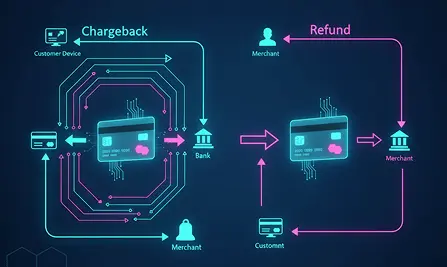
- Reading time: Reading time: 10 min. min.
Difference between chargeback and refund: key distinctions explained
Recurring card payments on debit: guide to setup and benefits Buyers often don’t see the difference between chargeback and refund. They use both mechanisms to refund money on a completed purchase. But for businesses, these concepts are very different, both in terms of return mechanics and legal aspects, including the impact on reputation and attitude on the part of providers. Understanding the chargeback and refund difference will allow entrepreneurs to effectively manage risks, improve customer service, and protect their financial stability. Payment reversal and refund: are they the same thing? Despite having a similar end goal – returning money to the customer – the mechanisms differ fundamentally in terms of who initiates them, the procedure involved, and the consequences. The table below shows the main differences between chargebacks and refunds. Criterion Refund Chargeback Initiator Seller (independently or at the buyer’s request) by agreement from the merchant Buyer (via bank or payment system) Mechanism Voluntary transfer of funds back to the customer’s card Enforced collection of funds via card-issuing bank Deadlines Usually 3–14 days Up to 180 days depending on the payment system and dispute circumstances Commissions No high commissions for the seller High commission ($15–$100+) plus possible penalties Need for bank involvement The acquiring bank is not involved Mandatory involvement of the customer’s card-issuing bank Reason for refund The seller’s internal policy is sufficient Requires proof of transaction illegality (documents, screenshots, call records, etc.) Impact on seller’s reputation Neutral Negative (increase in chargeback rate, risk of account blocking) Possibility of dispute No Possible How does a refund work? A refund is a voluntary return of money by the seller to the customer’s card. This operation takes place as follows: Customer request. The buyer requests a refund from the seller. Reasons may include defective goods, cancelled orders, discrepancies with the stated description, and other circumstances. Seller verification. The company reviews the refund request in accordance with its own refund policy. Sending a request. The seller sends instructions to the payment system or bank regarding the amount and reason for the refund. Refund. The client receives the money back, while the seller sets acceptable deadlines himself. This is usually 3-14 days. The main advantages of refunds for businesses are control over the return process, no penalties or fees, preservation of the company’s positive image, and direct contact with the customer, which helps to strengthen trust. How does a chargeback work? A chargeback is a much more complex procedure initiated by the customer themselves through the card-issuing bank. The mechanism includes the following stages: Customer application. The cardholder contacts their bank with a complaint. For example, in the event of fraud, non-delivery of goods, double debiting, etc. The bank initiates the process. The issuing bank launches the chargeback procedure, debiting the specified amount from the merchant’s account. Seller notification. The payment system notifies the merchant of the dispute. Representment. The seller has the right to present evidence of the legality of the transaction. For example, confirmation of delivery, customer consent, etc. Bank assessment. If the evidence is convincing, the amount is returned to the seller; otherwise, it remains with the customer. The main consequences of chargebacks for businesses are commissions and penalties for the seller, a deterioration in the chargeback rate rating (exceeding the threshold threatens the loss of bank acquiring), the need to collect and provide extensive documentation, and the loss of time and resources to resolve conflicts. Why do buyers choose chargeback instead of refund? Buyers sometimes deliberately resort to chargeback, despite the existence of a simple refund mechanism. Here are the main reasons for this behaviour: Distrust of the seller. If the store ignores requests or deliberately delays the consideration of returns. Lack of transparency in the return policy. Confusing application forms, long processing times, unclear requirements. Lack of communication with the store. Situations where it is impossible to contact the seller – store closure, fraudulent schemes. Desire to speed up the process. Some believe that the bank will handle it faster than the seller. Insufficient understanding of the difference. Many buyers do not know that a chargeback is a last resort, not an alternative to a regular return. It is important to note that sometimes the buyer can receive double reimbursement. For example, they first requested a refund and then initiated a chargeback. This is possible if the buyer decides that the seller has ignored the request. In practice, the funds are not received immediately, but with a delay of 3-14 days. If it happens that I got a chargeback and a refund, then one of the refunds may be disputed by the seller and debited from the customer’s card. Psychological aspects of choosing a chargeback It is important to note that the choice of a chargeback instead of a refund is often due not only to objective reasons, but also to psychological factors: Fear of losing money: the customer fears that the seller will refuse to voluntarily return the funds. Perception of fairness: contacting the bank is perceived as a fairer and more effective way to restore rights. Social approval: there is a widespread belief that chargeback is a simple and quick way to resolve a conflict. These points should be taken into account when developing a customer communication strategy. How can businesses minimise the risks of chargebacks and return issues? Effective risk management requires a comprehensive approach that includes the following steps. Simplify the return process Clearly state the return policy on your website. Provide users with a simple automated application form. Process returns quickly – within 3–5 business days. Improve communication with customers Respond to requests immediately. Provide customers with complete information about the status of their orders. Organise convenient customer support for urgent requests. Document every transaction Keep proof of delivery of goods. Keep records of telephone conversations and correspondence. Record electronic confirmations of customer consent. Work with customers Explain the difference between a refund and a chargeback. Recommend that they first request a regular return. Monitor chargeback metrics Constantly monitor the chargeback rate.

- Reading time: Reading time: 11 min. min.
Recurring card payments on debit: guide to setup and benefits
In today’s digital world, subscriptions are becoming an integral part of everyday life. According to recent research, the number of BNPL users will reach 91.5 million in 2025, and the annual increase in the total volume of regular payments is estimated at 9%. Recurring card payments, which are automated debits of funds according to a set schedule, are becoming increasingly important. Let’s take a closer look at how these payments work, what benefits they bring to businesses and customers, and how to organise their implementation effectively. What are recurring debit card payments? Recurring payments on debit card is the automatic debit of a certain amount at a predetermined time. This model is used in e-commerce, online services, online schools, and businesses where payment for subscriptions or other services is provided.Using regular payments frees customers from having to fill out a form for debiting money every time. It is enough to indicate your details once, familiarize yourself with the schedule and agree to periodic write-off. Using this model, a business can plan a budget and ensure a stable cash flow. How does it work in practice? The recurring payment process consists of a few simple steps: Customer authorisation. The user agrees to repeat charges once, for example, when registering on the platform or purchasing a subscription. Payment token storage. Instead of storing card numbers, tokenisation is used – replacing real data with a unique encrypted identifier that complies with PCI DSS requirements. Automatic debit. On the selected date, the system initiates the payment itself, debiting the required amount from the customer’s card. Funds crediting. The money is credited to the company’s account, and the client receives a notification of the transaction. Regular payment parameters The main parameters that determine the regular payment scheme: Frequency: monthly, weekly, quarterly or annually. Payment amount: fixed or dependent on the volume of services provided. Duration: indefinite (until cancelled) or limited in time. Notifications: automatic alerts to the customer about upcoming debits. Where are recurring payments used? Recurring payments are most common in the following areas: Online services (streaming, cloud storage, subscription software). Telecommunications (internet, television, mobile operators). Educational platforms (online courses, webinars). Fitness clubs and sports apps. Charitable donations. E-commerce (subscription boxes, cosmetics, food). Differences from direct debit There is often confusion between recurring payments from a card and direct debit. Below are the key differences. Criterion Regular payments from a card Direct debit Initiator Company (based on a saved token) Customer’s bank (under a signed mandate) Enrolment period 1–3 working days Up to 5 working days Customer management Via the service interface or bank Only through revocation of the mandate Commission Percentage of the amount, usually 1.5–3.5% Fixed rate + commission Flexibility Easy to change Requires mandate renewal Risk of chargebacks High Low Recurring card payments are ideal for digital products with international users, while direct debit is preferable for local markets with fixed tariffs. Who will be using the subscription model in 2025 Key industries and dynamics: SaaS and cloud services. In 2025, the market is estimated at $578 million. Media and entertainment. Streaming platforms are growing by 18% annually, with 60% of users having 2+ content subscriptions. E-commerce. Subscriptions for essential goods (cosmetics, food) – 35% growth, automation of repeat orders through recurring payments. Fintech. Regular investments and savings – 50% customer growth, micro-subscriptions for financial advice and portfolio analysis. Education. Online courses with monthly payments – 28% growth. Corporate subscriptions for staff training. Health and wellness. Fitness apps and telemedicine – 40% growth, subscription boxes with dietary supplements and vitamins. This growth is driven by the benefits that businesses gain from using the subscription model and implementing regular card payments. Accounting automation Reduction in accounting workload by up to 40%. Reduction in operating costs. Integration with CRM and ERP systems. Stable financial flow 85-90% accuracy in revenue forecasting. 60% reduction in cash gaps. Access to financial instruments for future payments. Business scalability Work with more than 70 currencies. Support for over 100 payment methods. Compliance with international standards (GDPR, PSD2, CCPA). Reduced customer churn Increased customer loyalty (70% stay longer than six months). Personalised notifications and promotions. Audience analytics and segmentation In-depth analysis of consumer behaviour. Testing of various pricing models (A/B testing). Creation of individual tariff plans (‘family’, student and other options). Security and legal transparency Automatic receipts and confirmations. Transaction history for dispute resolution. Compliance with tax obligations. Do you have any more questions? Fill out the form and we will contact you *By submitting this application, you consent to the processing of your personal data in accordance with the privacy policy. Recurring payments vs Direct debit Recurring payments and direct debit are two ways to automate periodic debits, but they have fundamental differences.Direct debit assumes that the recipient initiates repayment from the payer’s account based on a pre-issued order. The payer sets only general conditions, the amount and date of the debit may vary.Periodic payments are pre–programmed repayments for a fixed amount, which the payer sets independently.Advantages of regular pay: Full control of the payer: you set the amount, date and frequency of payment yourself. Transparency: there is no risk of unexpected write–offs – everything is strictly on schedule. Flexibility: it is easy to change or cancel a payment at any time. Security: you do not need to provide access to the account to third parties. Versatility: they work with cards and electronic wallets, do not require a bank mandate. Recurring payments provide more control and predictability, reducing risks for the payer. How to set up recurring payments: step-by-step instructions To successfully implement recurring payments, follow these simple recommendations Step 1. Select a payment provider Evaluate providers based on the following criteria: Support for the necessary currencies and payment methods. Commission rates and terms of cooperation. Availability of a high-quality API for integration. Step 2. Organise card tokenisation Store only tokens, not actual card numbers. Use modern data encryption. Update security certificates in a timely manner. Step 3. Determining the payment schedule Set an appropriate payment frequency.

- Reading time: Reading time: 7 min. min.
SEPA instant payments: understanding SCT inst and EPC schemes
In the era of digital transformation, speed and convenience of payments are becoming competitive advantages. SEPA is a revolutionary step in the evolution of European systems, enabling real-time transfers.Since its launch in 2017, the system has been rapidly gaining momentum: according to EPC data, more than 529 million people live in the SEPA zone, making 52-60 billion electronic payments annually. In this article, we will look at how instant transfers work in the eurozone, what SCT Inst is, and the role of the EPC in the development of instant transactions. What is SEPA SEPA (Single Euro Payments Area) is a single euro payments area comprising 27 EU + 3 EEA + 8 non-EEA countries. In 2025 Serbia in negotiation process in the zone, and in 2024, Montenegro and Albania joined SEPA. The goal of the single zone is to standardise and simplify non-cash transactions in euros.Key features of SEPA: Uniform rules for all participants. Standardised instruction formats. Reduction of cross-border transfer costs to the level of domestic transfers. Support for various types: credit transfers (SCT), direct debits (SDD), cards (SCD). SEPA has laid the foundation for innovation, including SEPA Instant Payments. What is EPC EPC (European Payments Council) is the governing body of the European payments industry, responsible for developing common rules and standards for SEPA.EPC functions: Coordination of the interests of banks, fintech companies and regulators. Developing payment schemes (e.g. SCT Inst). Ensuring the compatibility of payment systems within the SEPA zone. Promoting innovation (including EPC Instant Payments). The EPC acts as a ‘platform architect’, ensuring that all SEPA participants operate according to the same rules. What is the SCT Inst scheme? SCT Inst (SEPA Credit Transfer Instant) is an instant payment scheme within SEPA that allows funds to be transferred between accounts 24/7/365 in seconds.Here’s how SCT Inst works. The sender initiates the transaction via online banking or a mobile app. The system checks the availability of funds and compliance with the rules. The funds are instantly credited to the recipient’s account. Both parties receive confirmation in real time.The average processing time is no more than 10 seconds. The platform is available 24/7. Only one currency is used to receive funds – the euro. SCT Instant Payment is not just about speed, but a new standard of convenience for businesses and individuals. Key features of the SEPA instant payments 2025 rules In 2025, EPC instant payments updated the SCT Inst scheme rules, enhancing security and scalability. Key changes: Enhanced authentication. Improved identification. The process of revoking SEPA Credit Transfers (SCT) and SEPA Instant Credit Transfers (SCT Inst) is being tightened — only one revocation will be allowed for each transaction. Extended limits. The current limit has been increased from €100,000 to €1 billion, while providers can set their own limits on the upper amount. Integration with Open Banking. API support for seamless interaction with fintech services and PISPs. Fraud protection. Implementation of machine learning algorithms to detect suspicious transactions in real time. The <10 seconds rule is introduced. There should be a response regarding the SCT Inst operation by 5 seconds. If no response is received within 7 seconds, a negative decision is made. The latest when the PSP initiator can receive a response regarding the Inst SCT operation is 9 seconds. These rules are designed to ensure that SCT Instant Payment remains a reliable and scalable solution for the whole of Europe. Benefits and use cases of instant payments SEPA open up new opportunities for all market participants.Individuals receive instant transfers to friends and family without weekends, pay for services (utilities, internet) on the day of application, and make emergency transfers, for example, in case of accidents or illnesses. Businesses gain access to faster capital turnover, reduced cash gaps, instant payments to suppliers and employees, and improved customer experience, such as refunds for cancelled orders.Industry case studies: E-commerce. Instant refunds for cancelled orders. Logistics. Real-time payment for drivers’ services. Freelancing. Payments to contractors immediately after project completion. Insurance. Emergency payments for insured events. EPC Instant Payments also stimulate the development of innovative services – P2P transfers via messengers, automated transactions via smart contracts, integration with IoT devices, such as paying for parking via an on-board computer. Do you have any more questions? Fill out the form and we will contact you *By submitting this application, you consent to the processing of your personal data in accordance with the privacy policy. Want to implement SEPA in your business? The BillBlend payment gateway operates legally in the EU and is fully SEPA compliant. With it, you can: accept SCT Instant Payments in seconds; ensure round-the-clock payment processing; integrate instant transfers into your existing system; comply with all regulatory standards (PSD2, GDPR, PCI DSS) . Get a free consultation from BillBlend experts to learn how to connect SEPA Instant Payments to your website or app, choose a pricing plan tailored to your business, set up API integration without technical difficulties, and launch instant payments in no time. Don’t miss the chance to take your business to a new level of speed and convenience for your customers. Challenges of SEPA Instant Payments in 2025 Despite the progress in adopting SEPA, European banks face several persistent challenges in 2025: High implementation costs. Upgrading legacy systems to support real‑time processing demands substantial investment in technology and infrastructure. Operational complexity. Integrating instant payments with existing workflows requires reengineering processes and training staff, leading to operational disruptions. Fraud and security risks. Instant transactions leave less time for fraud detection, increasing vulnerability to scams and cyberattacks. Regulatory compliance. Keeping up with evolving EU regulations (e.g., PSD3) and cross‑border requirements creates administrative burdens. Profitability concerns. Thin margins on instant payments, combined with mandatory fee caps, strain revenue models, especially for smaller banks. These hurdles require strategic planning and collaboration across the financial ecosystem to ensure sustainable growth of instant payment services. Conclusion SEPA Instant Payments is not just a technology, but a new paradigm for Europe’s payment infrastructure. The SCT Inst scheme, supported by the EPC,