A gaming payment gateway is the payment infrastructure that processes purchases for video game platforms – premium game sales, in-game currency, subscriptions, and battle passes. Standard video game transactions are generally classified separately from gambling, although their risk treatment depends on the merchant’s business model, transaction flow, geography, fraud exposure, and chargeback history.
Operators building a checkout for a PC, console, or mobile title in 2026 need three things working together: a wide mix of payment methods including local and crypto rails, chargeback tooling built around instant digital delivery, and smart routing that recovers the transactions a single acquirer would otherwise decline.
This guide covers what genuinely separates gaming payments from betting and casino payments, how different monetization models change your risk profile, and what to look for before you commit to a provider.
What Is a Gaming Payment Gateway – and Is Gaming High-Risk?

Gaming payment providers authorize and settle transactions for video game studios and platforms, including premium purchases, downloadable content, virtual currency, subscriptions, and in-app purchases. Standard video game transactions are not automatically classified as high-risk. Acquirers assess each merchant based on its actual business model, transaction frequency, delivery method, target markets, fraud exposure, chargeback history, and the presence of wagering or prize-based mechanics.
The underlying driver is consumer behavior at checkout. Digital items deliver instantly, transactions happen in seconds with minimal friction, and that combination – good for conversion – is also exactly what fraud and buyer’s remorse disputes feed on.
Gaming vs Gambling – Why This Guide Isn't About Casino Payments
Here, gaming means video games – PC, console, and mobile titles monetized through purchases, subscriptions, and microtransactions. It does not refer to online casino, sports betting, or poker, which BillBlend covers separately.
Video gaming and gambling generally fall under different regulatory frameworks. However, the classification of battle passes, paid-entry competitions, loot-box mechanics, prize-based games, and other real-money features depends on the applicable jurisdiction and the role of payment, prize, and chance. Businesses offering these mechanics should obtain qualified legal advice in every market where they operate.
MCC 5816 vs MCC 7995 – How Video Games and Gambling Are Classified
Visa’s April 2026 Merchant Data Standards Manual lists MCC 5816 for digital games, including in-app purchases and games of skill but excluding games of chance. MCC 7995 applies to betting and games of chance involving prizes of monetary value. Fantasy sports may fall under MCC 5816 only in jurisdictions where they are not treated as gambling.
The final MCC is assigned by the acquirer based on the merchant’s actual business model, transaction flow, primary activity, and applicable law. Skill-based competitions are therefore not automatically assigned MCC 5816. Skill-based wagering classified under MCC 5816 may also be treated as a high-integrity-risk activity and subjected to enhanced underwriting and monitoring.
Payment Models in Gaming – What Different Operators Actually Need
Not every video game business monetizes in the same way, and the payment setup that works for one model may not suit another. The table below provides an illustrative comparison of four common models by transaction profile, billing pattern, and typical areas of operational risk.
| Model | Typical Transaction Profile | Common Dispute and Operational Risks | Billing Pattern |
|---|---|---|---|
| Premium / Buy-to-Play | One-time upfront purchase | Unauthorized, unrecognized, or disputed purchase | Single transaction |
| Free-to-Play / Microtransactions | Optional, repeatable one-time in-app purchases | Repeated unauthorized purchases, account takeover, card testing, and first-party misuse | Repeated one-time charges |
| Subscription / Game Pass | Monthly, annual, or other recurring payments | Renewal confusion, cancellation issues, and disputes over recurring charges | Recurring billing |
| Esports / Skill Games | Entry fees and, where permitted, prize payouts | Eligibility and identity verification, payout timing, disputes, and jurisdiction-specific classification | Entry-fee and payout cycle |
- Sources and methodology:
The table is an editorial synthesis based on the App Store and Google Play documentation on paid apps, one-time in-app products, and subscriptions; Visa guidance on digital-goods and recurring-payment disputes; Stripe guidance on card testing and account takeover; FTC enforcement materials concerning unauthorized in-app purchases; and Skillz, Visa, and UK Gambling Commission materials on paid-entry competitions, prizes, verification, payouts, and regulatory classification. It is not a card-network or industry benchmark. Transaction profiles and dispute patterns vary by title, platform, geography, audience, and merchant data.
- Sources:
Transaction size and frequency vary widely by title, platform, market, and audience. Premium games generally rely on fewer, higher-value purchases, while free-to-play models may generate a larger number of lower-value transactions. Merchants should assess dispute concentration using their own payment data rather than relying on universal ticket-size or chargeback assumptions.

Esports, Skill Games and Social F2P Microtransactions
Paid-entry esports and skill-game platforms combine payment acceptance with prize-payout flows, but their legal and payment classification is jurisdiction-specific. Whether a format is treated as a skill competition, gambling, or another regulated activity depends on the applicable law and on the role of entry fees, prizes, and chance. Operators should not assume that a skill-based label automatically places the business outside gambling regulation or under MCC 5816.
The payment mechanics differ from standard microtransactions in one important way: money flows in both directions. Players pay entry fees, and winners receive payouts, which means the platform needs payout infrastructure on top of standard checkout – something a lot of generic “gaming payment gateway” providers don’t handle well, since they’re built around one-directional purchase flows. Social F2P games sit closer to standard microtransactions but may involve higher-frequency, lower-value transactions. This pattern can increase exposure to card-testing attempts and other forms of automated payment fraud.
Payment Risks in Gaming and Digital Entertainment
Chargebacks in gaming follow a pattern that’s structurally different from physical retail, and understanding why matters more than memorizing statistics. When a customer disputes a shipped package, the merchant can point to a tracking number. When a customer disputes an in-game currency purchase, there’s no equivalent proof a traditional bank analyst finds convincing – server logs and transaction IDs get dismissed as insufficient evidence far more often than shipping confirmations do.
Three patterns drive most of the losses. First, friendly fraud: a player spends money in the moment, regrets it days later, and disputes the charge as unauthorized rather than requesting a refund. Second, what industry practitioners sometimes call the “parent trap” – a child makes purchases on a parent’s saved card, and the parent disputes the whole pattern as fraud once they notice the statement. Third, account and item resale scams, where a player buys a rare item or account from an unofficial third-party seller, uses it, and then disputes the original in-game purchase that funded it – leaving the game studio holding a chargeback for a transaction it fulfilled correctly.
The timing makes all of this worse. Dispute deadlines vary by card network, dispute condition, transaction type, and the date from which the period is calculated. Many Visa and Mastercard disputes may be initiated within 120 calendar days, while some circumstances allow longer periods. By that point, the player may already have consumed the virtual currency, subscription benefits, or unlocked content.
Payment Methods, Currencies and Crypto for Gaming
Cards remain the backbone of gaming payments, but a strong checkout stack layers in digital wallets, local bank-linked methods, and – with real caveats worth understanding – crypto. Access to 100+ payment methods gives operators the flexibility to localize checkout for different markets. The methods displayed to each customer should be selected according to geography, device, player preferences, conversion performance, and operational cost. Multi-currency support matters more here than in most verticals, since a mobile or PC title’s audience is global from launch day in a way that may not apply to a regionally focused retailer.
Where Crypto Actually Fits in Gaming Payments Today
Direct cryptocurrency acceptance remains limited on major video game storefronts. Steam stopped accepting Bitcoin in December 2017 because of transaction fees and price volatility. The current payment-method pages for the PlayStation Store and Nintendo eShop do not list cryptocurrency as a direct checkout option.
For independent studios and mid-size platforms that control their own checkout, cryptocurrency and stablecoin payment options may be available through payment partners, subject to geography, underwriting, consumer-protection requirements, and applicable regulation. Crypto acceptance is generally more practical in direct-to-consumer web checkout than in console storefronts, where supported payment methods are controlled by the platform. The current PlayStation Store payment-method list does not include cryptocurrency.
In-Game, SDK and Mobile Checkout
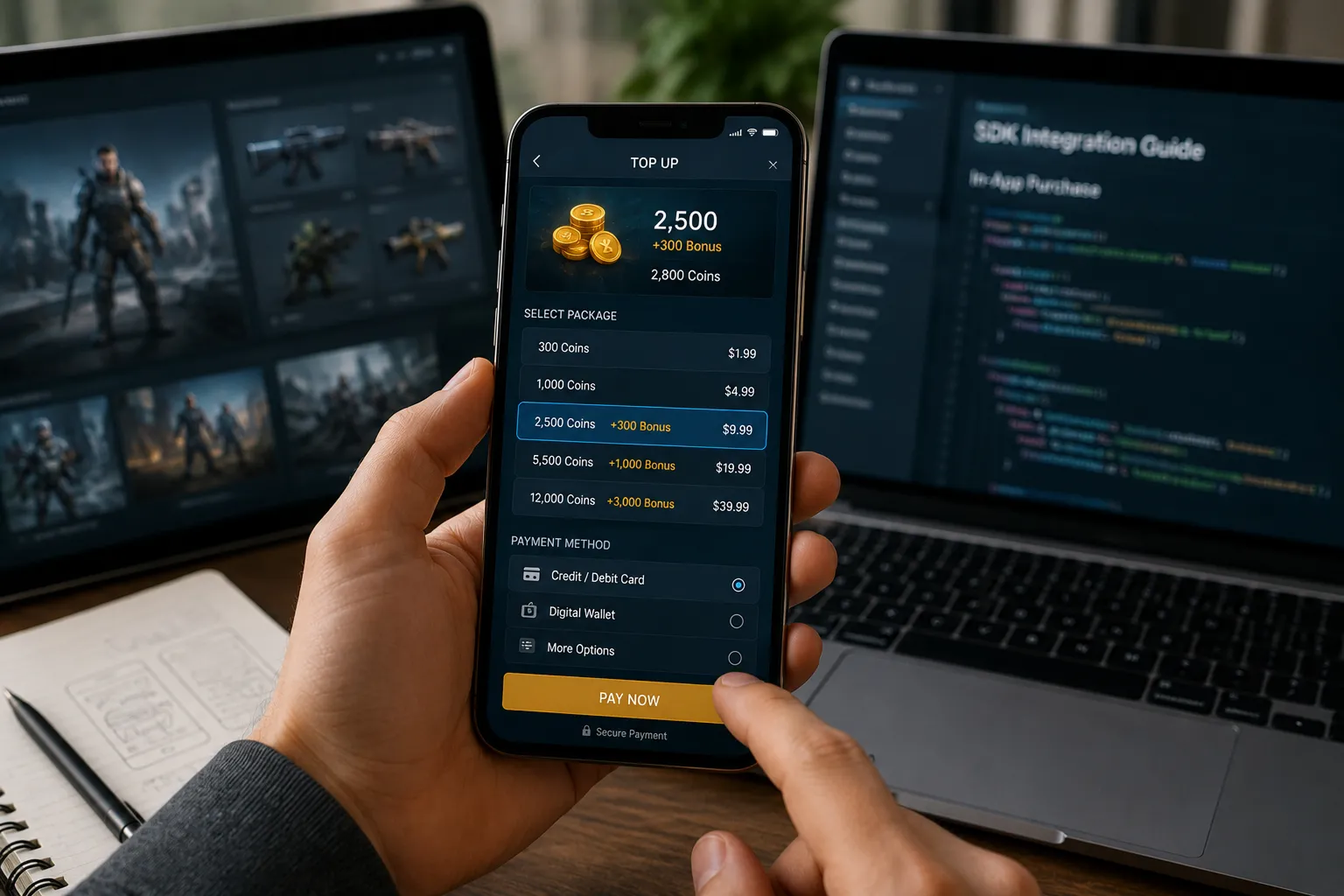
Mobile and console studios face a choice most PC and web-based gaming businesses don’t: sell through the platform’s built-in billing system, or route around it with a direct payment integration. The platform route is simpler to implement but comes at a real cost. Apple’s standard commission on in-app purchases is 30%. Developers with up to $1 million in proceeds may apply for the App Store Small Business Program, and approved participants receive a reduced 15% commission. Eligibility does not result in automatic enrollment: the developer must submit an application and complete Apple’s registration requirements. Google Play’s fee structure in the US, UK, and EEA changed on June 30, 2026. A Play service fee applies regardless of whether a transaction uses Google Play Billing, alternative billing, or an external web link. When Google Play Billing is used, an additional 5% billing fee applies. The service fee depends on the transaction type, annual earnings, program participation, and whether the transacting user’s install is classified as new or existing.
The availability of external checkout depends on the platform, storefront, and applicable program. External payment links are no longer limited to the EU and South Korea. Since May 2025, Apple has permitted apps distributed through the United States storefront to include buttons, external links, and other calls to action directing users to alternative purchase methods. Google Play also operates market-specific alternative-billing and external-link programs. Developers should verify the current rules and fees for every target market.
For SDK-based integrations specifically, the practical requirement is a lightweight checkout that doesn’t interrupt gameplay: players buying in-game currency mid-session abandon the purchase fast if the flow adds more than a step or two, which is exactly why velocity checks and fraud screening for this channel need to run invisibly in the background rather than through extra verification prompts.
Do you have any more questions?
Fill out the form, and we will contact you
*By submitting this application, you consent to the processing of your personal data in accordance with the privacy policy.
Fraud, Chargebacks, AML and KYC in Gaming
Chargeback management in gaming works best when it’s structural rather than reactive. Clear, recognizable billing descriptors matter enormously – a purchase in “Galaxy Legends” that shows up on a statement as “Alpha-Beta Holdings LLC” reads as fraud to a cardholder even when it’s entirely legitimate. Velocity checks that flag rapid repeated purchases, mandatory step-up authentication after unusual spending patterns, and consumption-proof logging (linking a payment ID directly to the in-game item it unlocked, timestamped) all give a studio real evidence when disputes do land.
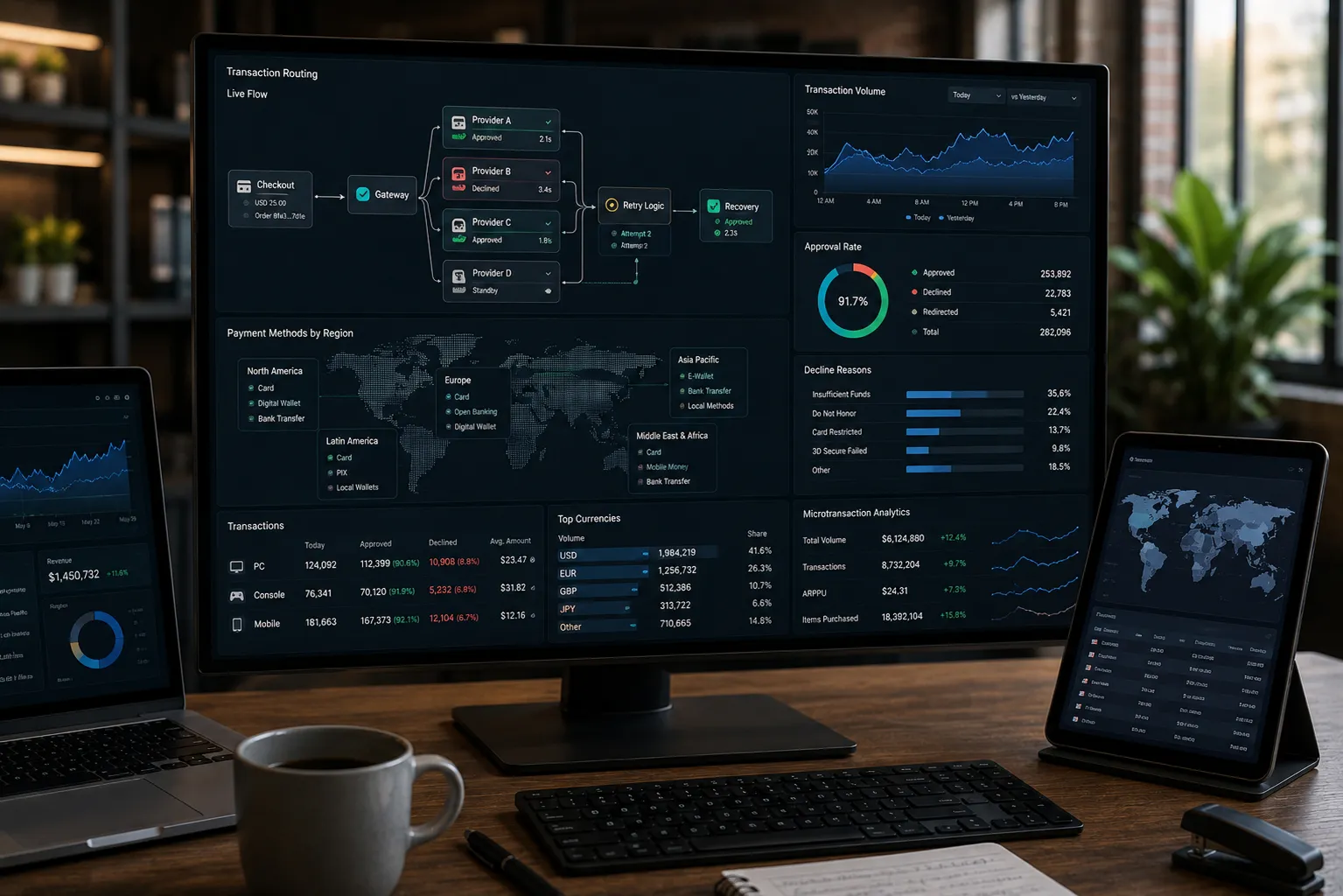
Smart routing and cascading do the heavy lifting on the approval side. Rather than sending every transaction through a single acquirer and accepting whatever gets declined, cascading automatically retries a declined transaction through an alternative processor, and well-tuned setups recover an additional 8 to 15% of volume that a single-acquirer setup would simply lose. That matters disproportionately in gaming, where a huge share of transactions are small enough that losing even a modest percentage to false declines adds up fast across millions of microtransactions.
AML, KYC, age-verification, and source-of-funds requirements depend on the business model, transaction flow, payment methods, jurisdiction, and regulated features. Standard purchase-only video game transactions may require fewer customer checks than licensed gambling products, while prize payouts, cash-outs, marketplaces, cryptocurrency transactions, unusual activity, and regulated real-money mechanics may trigger enhanced controls. The applicable requirements should be confirmed for every target market.
Integration – Getting a Gaming Payment Gateway Live
Onboarding a standard digital-goods merchant may be faster than underwriting a licensed gambling operator. However, paid-entry competitions, prize-based mechanics, wagering features, cash-out functionality, and other regulated models may require additional legal opinions, licences, policies, or market-specific documentation. Merchants should expect to provide business registration details, a description of the monetization model and transaction flows, expected volume, target markets, and information about fraud prevention.
Underwriting timelines vary by acquirer, jurisdiction, business model, requested payment methods, and documentation quality. Once approved, integration usually takes place through a REST API or SDK, with sandbox testing before launch. Studios using both platform billing and direct checkout should plan transaction reconciliation across channels from day one.
BillBlend for Video Game Payments
BillBlend offers a payment solution for video game studios and platforms alongside its separate casino, betting, and poker payment services. Through a single integration, merchants can access 100 payment methods and more than 70 currencies, including cards, e-wallets, bank transfers, and cryptocurrency options, subject to geography, underwriting, and partner availability. Because video gaming and gambling generally fall under different regulatory frameworks, the applicable licensing and compliance requirements depend on the game mechanics, payment flows, and target markets.
BillBlend combines real-time intelligent fraud detection and transaction monitoring with smart routing and cascading, which can help reduce avoidable declines and improve payment performance. Merchants also have access to transaction, decline, fraud, and chargeback reporting through the BillBlend dashboard.
The company supports merchants through integration, launch, ongoing payment optimization, and 24/7 customer support. The availability and configuration of specific payment methods and risk features are confirmed for each merchant setup.
For the full breakdown of BillBlend's gaming-specific solution, including pricing and integration details, see the dedicated gaming payment gateway page.
Frequently Asked Questions
What is a gaming payment gateway?
It’s the payment infrastructure that processes purchases for video game platforms – premium sales, in-game currency, subscriptions, and battle passes – built around the fraud and chargeback patterns specific to instant digital delivery.
Is video gaming considered high-risk like online gambling?
Not universally. Standard video game transactions are generally classified separately from gambling. The acquirer assesses risk based on the merchant’s business model, transaction flow, geography, fraud exposure, chargeback history, and the presence of wagering or prize-based mechanics.
What's the difference between MCC 5816 and MCC 7995?
MCC 5816 generally covers electronically delivered games, including in-app purchases and certain games of skill, while excluding games of chance. MCC 7995 applies to betting and games of chance involving prizes of monetary value. The final MCC is assigned by the acquirer based on the merchant’s actual business model and applicable law.
Can gaming platforms accept cryptocurrency?
Some video game platforms can accept cryptocurrency when they control their own checkout and their payment provider supports crypto in the relevant market. Availability depends on geography, underwriting, regulation, and platform rules.
How much do the App Store and Google Play take from gaming purchases?
Apple offers a reduced 15% commission to developers approved for the App Store Small Business Program, but participation requires an application and is not automatic. Google Play fees vary by region, transaction type, billing route, annual earnings, and program participation. From June 30, 2026, Google applies a separate 5% billing fee to transactions using Google Play Billing in the US, UK, and EEA. The applicable Play service fee varies by transaction type, annual earnings, program participation, and whether the user’s install is classified as new or existing.
Do video game platforms need full KYC like online casinos?
It depends on the business model and jurisdiction. Standard purchase-only video game transactions may require less customer verification than licensed gambling products. Prize payouts, cash-outs, marketplaces, crypto transactions, unusual activity, and regulated real-money mechanics may trigger enhanced KYC, AML, age-verification, or source-of-funds controls.