A casino payment gateway securely transmits payment data and transaction instructions between the operator’s checkout, payment processor, acquirer, and supported payment methods. In an integrated payment platform, gateway services may be combined with processing, fraud screening, player-withdrawal orchestration, reporting, and settlement support.
Online casinos are commonly treated as high-risk because of licensing requirements, fraud and dispute exposure, restricted acquiring coverage, and gambling-specific merchant classification. A scalable payment setup therefore requires suitable acquiring routes, relevant local and global payment methods, and fraud and chargeback controls designed for regulated gambling.
What Is a Casino Payment Gateway – and Why Are Casinos High-Risk?

A casino payment gateway connects the operator’s checkout with processors, acquirers, card networks, wallets, bank transfer systems, and other payment partners. It securely transmits deposit and player-withdrawal instructions and returns transaction-status information to the casino platform.
The broader payment stack may also include authorization routing, fraud screening, processing, settlement, and player-withdrawal services. Casino operators face additional underwriting because of gambling licences, fraud and dispute exposure, jurisdictional restrictions, and merchant category codes that can affect issuer and acquirer controls.
What Is MCC 7995?
MCC 7995 covers betting transactions such as casino gaming chips, lottery tickets, off-track betting, wagers, and certain other gambling-related activities. Visa also uses more specific codes, including MCC 7801 for government-licensed online casinos and MCC 7802 for government-licensed horse and dog racing.
The acquirer assigns the applicable MCC based on the operator’s activity, licensing status, jurisdiction, and card-network rules. Accurate classification matters because issuers and acquirers may apply different authorization, compliance, registration, and risk controls to different gambling categories.
Operators should confirm the applicable MCC and any card-network registration requirements with their acquiring partner during underwriting. Gambling-related MCCs may affect acquiring availability, authorization controls, compliance reviews, reserve terms, and transaction monitoring.
How to Choose an Online Casino Payment Gateway
Picking a payment solution provider for online casinos comes down to five practical criteria, rather than the generic checklist most vendors hand you:
- Approval performance backed by relevant data. Smart routing can improve authorization rates by directing transactions to the most suitable acquirer or payment route. The uplift varies by market, issuer mix, payment method, and implementation, so operators should request measured results from comparable regulated gambling merchants in their target regions.
- Geo-specific method coverage, since cards alone leave revenue on the table outside a handful of markets – more on this below.
- Crypto settlement options. Confirm which cryptocurrencies and stablecoins are supported, whether automatic fiat conversion is available, how settlement works, and which compliance controls apply.
- Compliance support. Verify the provider’s PCI DSS status, 3D Secure capabilities, transaction-monitoring tools, and ability to support the operator’s KYC, AML, SCA, and reporting workflows.
- Uptime and SLA guarantees. A checkout outage during peak hours costs real deposits, not just goodwill.
PCI DSS, AML, KYC, and SCA/PSD2 – What Actually Matters
Compliance requirements depend on the operator’s markets, license, payment methods, and role in the transaction flow. PCI DSS governs the protection of cardholder data, while customer due diligence, AML controls, and source-of-funds procedures arise primarily from gambling and financial-crime regulation. Payment providers may support these controls at the transaction layer, but they do not replace the operator’s own obligations.
In the EEA, Strong Customer Authentication requirements under PSD2 apply to in-scope payer-initiated electronic payments, subject to available exemptions and exclusions. The UK applies its own SCA framework under domestic payment-services rules, with the e-commerce implementation deadline having passed in March 2022.
For card deposits, 3D Secure is a common way to perform SCA. The exact authentication flow depends on the issuer, transaction characteristics, payment provider, and exemption status.
Regulatory enforcement across licensed gambling markets continues to demonstrate the importance of effective source-of-funds checks, customer due diligence, and transaction monitoring. Operators should incorporate these controls into payment design and ongoing risk management rather than treat them as post-launch requirements.
Payment Methods and Currencies for Online Casinos
Online casino payment strategies often combine cards, e-wallets, bank transfers, local payment methods, and cryptocurrency. The appropriate mix depends on the operator’s markets, licence, customer preferences, device usage, transaction size, and provider coverage. The number of methods advertised by a provider is less important than their actual availability and performance in the operator’s target regions.
Regional Playbook – Local Methods by Geography

Card-only checkout can limit payment coverage in markets where customers widely use bank transfers, wallets, vouchers, or other local methods. Operators should compare method availability and transaction performance separately for each target country.
Payment-method availability depends on the operator’s license, merchant category, acquiring partner, provider agreements, and local regulation. The table below shows methods operators may evaluate in selected regions; it does not mean that every listed method is available to every gambling merchant.
| Region | Payment methods to evaluate | What the operator should verify |
|---|---|---|
| Brazil | Pix and other authorised electronic transfers from a bank or payment account registered in the player’s name; credit cards are not permitted | Player-account ownership, permitted transfer methods, transaction limits, player identification, player-withdrawal support, and provider coverage |
| Mexico | SPEI transfers, OXXO vouchers, cards, approved wallets | Cash-voucher settlement, deposit confirmation time, refunds, player-withdrawal alternatives, and local acquiring |
| EEA | Cards with 3D Secure, open-banking payments, bank transfers, e-wallets | SCA treatment, exemptions, country coverage, settlement currency, and gambling restrictions |
| United Kingdom | Cards where supported, bank transfers, open banking, approved e-wallets | UK-specific SCA rules, gambling-payment restrictions, affordability and AML controls, and player-withdrawal compatibility |
| Latin America outside Brazil and Mexico | Local bank transfers, vouchers, wallets, cards | Country-specific provider coverage, local currency settlement, deposit success rates, and player-withdrawal rails |
| India | No payment processing for prohibited online money games | Exact product classification; permitted e-sports and social games are treated separately |

- Brazil.
In the regulated fixed-odds betting market, player deposits must be made by authorised electronic transfer from a bank or payment account registered in the player’s name; credit cards are not permitted. Pix is a major payment method for online betting. A 2024 Pay4Fun study covering bookmakers connected to its platform found that Pix accounted for 96.72% of the transactions analysed.
- Mexico.
Operators should assess how SPEI transfers and OXXO vouchers perform alongside cards for their own player base. Voucher deposits may also require a separate player-withdrawal method because cash-based payment instruments are not necessarily suitable for withdrawals.
- Europe.
Open-banking payments can complement cards and e-wallets in supported markets. Performance should be evaluated country by country using authorization, completion, deposit-conversion, refund, and player-withdrawal data.
- India.
The Promotion and Regulation of Online Gaming Act, 2025 prohibits online money games and related fund transfers. Its implementing Rules took effect on May 1, 2026. Payment availability therefore depends on whether the product is classified as prohibited real-money gaming, permitted e-sports, or an online social game.
Cryptocurrency Payments for Online Casinos
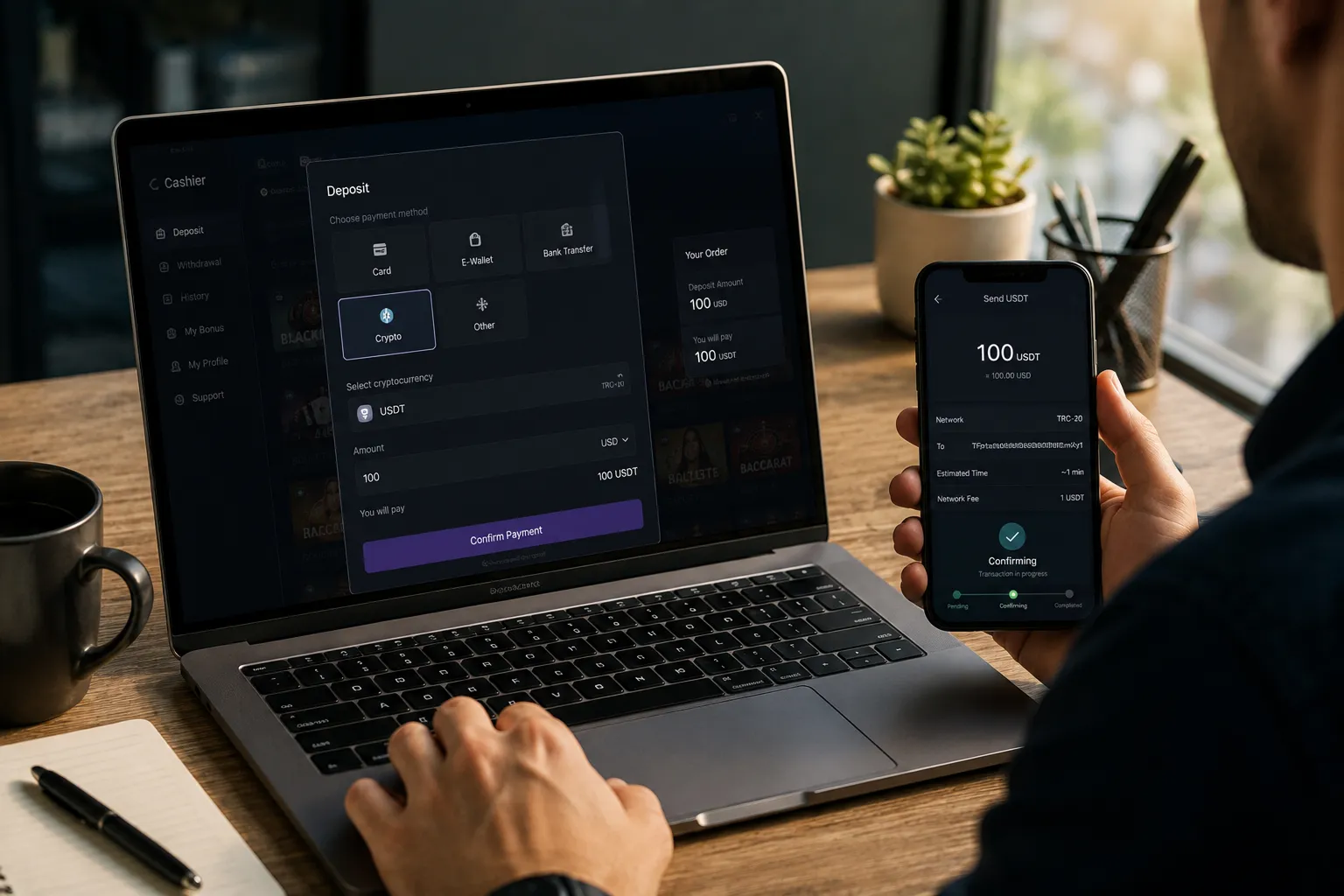
Cryptocurrency is considered separately because it is a payment model rather than a geographic market. Cryptocurrency can give casino operators an additional payment rail alongside cards, bank transfers, e-wallets, and local payment methods. Its main practical value is reduced dependence on card issuers and card-network authorization.
A card deposit must be approved by the customer’s issuing bank. The issuer may decline the transaction because of card settings, fraud controls, geographic restrictions, insufficient funds, the merchant category, or its own policy toward gambling payments. A crypto payment sent from a customer’s existing wallet follows a different route: the customer authorizes an on-chain transfer to the operator or payment gateway, so the transaction does not require approval from a card issuer.
This can help operators serve customers who already hold digital assets. It does not guarantee payment acceptance or provide a way around regulation. The crypto gateway may still apply merchant underwriting, wallet screening, sanctions controls, AML monitoring, jurisdictional restrictions, transaction limits, and source-of-funds checks. A customer who purchases cryptocurrency through a card-funded on-ramp may also face an issuer decline during that separate card transaction.
Crypto payments are generally push payments initiated by the customer. They do not use the conventional card chargeback process, which reduces exposure to card-specific first-party fraud and unauthorized-transaction disputes. Operators still need clear refund procedures, account-security controls, wallet-address verification, transaction monitoring, and customer-support records. Blockchain transfers can be difficult or impossible to reverse after confirmation, so mistakes and refunds require a defined operational process.
Bitcoin and other volatile assets may expose the operator to price movements between payment and settlement. Stablecoins such as USDT and USDC can reduce this volatility because their value is designed to track a fiat currency. Depending on the provider, the operator may receive settlement in cryptocurrency, stablecoins, or fiat after automatic conversion.
Before enabling crypto, operators should confirm supported assets and networks, confirmation requirements, exchange and network fees, settlement currency, conversion terms, player-withdrawal timing, refund procedures, wallet-screening controls, and geographic availability.
| Area | What the operator should verify |
|---|---|
| Supported assets | Cryptocurrencies, stablecoins, blockchain networks, and minimum transaction amounts |
| Conversion | Automatic fiat conversion, exchange rate, spread, conversion fees, and timing |
| Settlement | Settlement currency, merchant-settlement schedule, minimum settlement amount, and wallet or bank destination |
| Compliance | Wallet screening, KYC, AML monitoring, sanctions controls, and restricted jurisdictions |
| Confirmations | Number of blockchain confirmations required before crediting the player |
| Refunds | Refund workflow, supported return addresses, fees, and handling of price differences |
| Reconciliation | Transaction IDs, exchange rates, wallet records, and reporting in the merchant dashboard |
Crypto works best as one part of a diversified payment strategy. Cards and local methods remain important for mainstream users, while cryptocurrency can provide an additional route for customers who already hold digital assets.
Deposits, Player Withdrawals & Merchant Settlement
Deposits are the easier half of global casino payments. Player withdrawals are where most of the operational friction arises, and they are the part fewer guides cover in any real depth.

Withdrawal Controls, Due Diligence, and the Same-Source Rule
Licensed operators generally verify a customer’s identity before allowing real-money gambling. Additional checks may be required when risk indicators, transaction patterns, or legal obligations justify them. Depending on the applicable rules and the customer’s risk profile, these checks may include proof of address, source-of-funds information, and confirmation that the payment method belongs to the account holder.
Operators should not delay checks until withdrawal when the relevant information could reasonably have been requested earlier. Exact requirements depend on the applicable licence, jurisdiction, and identified risks.
Alongside that sits the same-source rule, sometimes called the closed-loop policy.
Many licensed operators apply closed-loop withdrawal controls, returning funds through the same payment method used for the deposit where this is supported and appropriate. This helps reduce fraud and limits the movement of funds between unrelated payment instruments.
The available player-withdrawal route depends on the card scheme, acquirer, jurisdiction, and payment method. Some card-processing arrangements support dedicated gaming-winnings disbursements, while others limit card credits and require excess winnings to be paid through an approved bank transfer, wallet, or alternative payout rail.
How Casino Payment Settlement Works
Settlement is the process through which processed player deposits are transferred to the operator after fees, refunds, chargebacks, reserves, currency conversion, and other contractual deductions are applied. It should be evaluated separately from transaction authorization: an approved deposit does not mean that the full amount becomes immediately available to the merchant.
The settlement schedule may be daily, several times per week, weekly, or based on another timetable defined in the merchant agreement. Payment providers may also apply a settlement delay before releasing funds. The exact timing depends on the acquiring arrangement, payment method, jurisdiction, processing history, currency, and risk profile.
Operators should confirm whether settlement is calculated on a gross or net basis. Under gross settlement, the provider transfers the processed amount and charges fees separately. Under net settlement, processing fees, refunds, reserves, chargebacks, currency-conversion costs, and other deductions are removed before the merchant settlement reaches the operator.
Currency structure matters for international casinos. A player may deposit in one currency while the operator receives settlement in another. This can create currency-conversion fees and exchange-rate exposure. Operators should confirm which presentment and settlement currencies are supported, how exchange rates are determined, whether conversion occurs at the transaction or settlement stage, and whether multi-currency balances are available.
Settlement also varies by payment method. Card deposits, bank transfers, e-wallets, vouchers, and cryptocurrency may have different confirmation times, merchant-settlement schedules, refund rules, and reconciliation records. Some methods support both deposits and withdrawals, while others require a separate payout rail.
Crypto settlement may be made in the original asset, a stablecoin, or fiat currency after conversion. The operator should verify confirmation requirements, network fees, exchange spreads, wallet-screening procedures, settlement destinations, and the timing of bank or wallet settlement transfers.
Reconciliation is essential when several payment methods and acquiring routes are used. The merchant dashboard or reporting API should show the original transaction amount, payment method, currency, applied exchange rate, processing fee, reserve deduction, refund or dispute adjustment, settlement batch, and final amount paid to the operator.
| Settlement item | Questions to ask the provider |
|---|---|
| Merchant-settlement frequency | How often are funds released to the operator, and are weekends or holidays excluded? |
| Settlement delay | How many business days pass between the transaction and merchant settlement? |
| Gross or net settlement | Which fees, reserves, refunds, and disputes are deducted before merchant settlement? |
| Settlement currencies | Which currencies can the operator receive, and when does conversion occur? |
| FX pricing | Which exchange rate, spread, and conversion fee apply? |
| Minimum settlement amount | Is there a minimum settlement balance or transfer fee? |
| Payment-method differences | Do cards, bank transfers, wallets, vouchers, and crypto follow different schedules? |
| Reconciliation | Are batch reports, transaction IDs, deductions, exchange rates, and merchant-settlement references available? |
| Account closure | How are unsettled funds and reserves handled after suspension or termination? |
Rolling reserves directly affect settlement because the withheld percentage remains outside the operator’s available balance until the contractual release date. Reserve terms should therefore be reviewed as part of the settlement structure, not only as a separate risk fee.
Rolling Reserves in Real Money – How Much Gets Frozen and How to Negotiate
A rolling reserve is an amount the acquirer withholds from settlement to cover potential chargebacks, refunds, fines, and other merchant liabilities that may arise after a transaction has cleared.
The reserve percentage, holding period, release schedule, review conditions, and treatment after account closure vary by acquirer and are documented in the merchant agreement. Operators should review the full commercial structure of the offer rather than assume that a standard casino-industry reserve applies.
| Area to review | What the operator should verify |
|---|---|
| Processing fees | Percentage rate, fixed transaction fee, monthly minimums, and pricing by card type or region |
| Reserve terms | Percentage, holding period, release schedule, review criteria, and treatment after account closure |
| Dispute costs | Chargeback, alert, representment, and card-network monitoring fees |
| Settlement terms | Merchant-settlement schedule, settlement delay, gross or net calculation, currencies, FX pricing, deductions, reconciliation, and treatment of unsettled funds after closure |
| Underwriting | Required licence, corporate documents, processing history, expected volume, and supported jurisdictions |
For example, assuming a stable monthly processing volume of $1 million and a fully accumulated reserve covering approximately three monthly processing periods, a 10% rolling reserve would represent around $300,000. This is a hypothetical cash-flow example, not a standard market term.
Some acquirers may review reserve terms after a period of stable processing and acceptable dispute performance. The timing, eligibility criteria, and outcome of any review are contract-specific. Merchants should request written details of the review process before signing the agreement.
Do you have any more questions?
Fill out the form, and we will contact you
*By submitting this application, you consent to the processing of your personal data in accordance with the privacy policy.
Fraud, Chargebacks, Compliance, and Licensing
Gambling chargebacks can arise from stolen-card fraud, account takeover, unrecognized billing descriptors, service complaints, purchase regret, bonus or withdrawal disputes, and first-party fraud after a player loses. The relative share of each category varies by operator, jurisdiction, payment method, customer segment, and dispute-classification process.
Clear billing descriptors, accessible customer support, transaction monitoring, and detailed account, deposit, withdrawal, and gameplay records can help reduce avoidable disputes.
Visa monitors card-not-present fraud and disputes through the Visa Acquirer Monitoring Program, or VAMP. From April 1, 2026, the excessive VAMP ratio is 1.5% in most regions and 2.2% in CEMEA.
The ratio combines reported fraud and disputes rather than measuring chargebacks alone. Merchant identification is also subject to monthly event-count and region-specific criteria.
VIP Accounts, Billing Descriptors, and First-Party Fraud
High-value accounts can create greater financial and account-takeover exposure because individual transactions and available balances may be larger. Operators may apply additional authentication and due-diligence controls when triggered by changes to player-withdrawal details, unusual account activity, higher-risk transaction patterns, or jurisdiction-specific requirements.
Casinos operating several brands under one licensing entity should ensure that each billing descriptor is recognizable and consistent with the brand shown to the player. Unclear descriptors can generate disputes even when the underlying transaction was authorized.
How Licensing Affects Payment Underwriting
Visa Compelling Evidence 3.0 and Mastercard First-Party Trust allow eligible merchants and issuers to use transaction, account, device, and customer-behavior data to address certain first-party fraud disputes. Availability and evidence requirements depend on the card network, dispute type, merchant category, and integration.
Payment-provider eligibility often depends on the operator’s license, target markets, and regulatory history. UKGC licensees are subject to the Commission’s Licence Conditions and Codes of Practice.
Malta’s framework distinguishes between B2C Gaming Service licences and B2B Critical Gaming Supply licences. Curaçao introduced a centralized licensing and supervision framework under the National Ordinance on Games of Chance, which took effect in December 2024.
Providers should assess each licence in the context of the operator’s permitted markets, business model, ownership structure, and compliance record rather than rely on a simple hierarchy of jurisdictions.
Integration – Getting a Casino Payment Gateway Live
Getting a casino payments platform live is mostly a documentation and underwriting exercise before it’s a technical one. Expect to provide business formation documents, your gambling licence, beneficial ownership details, prior processing history where available, and a completed risk questionnaire covering game types, average ticket size, and target markets.
Underwriting timelines vary by provider, acquirer, licence, jurisdiction, ownership structure, processing history, target markets, and the completeness of the application. Operators should ask the provider to confirm the expected review stages, outstanding documents, and estimated timeline after the initial assessment.
Once approved, the operator may receive access to a sandbox or test environment for deposits, player withdrawals, reporting, and webhook-based transaction updates, depending on the provider’s integration model.
BillBlend: Casino Global Payments in One Integration
BillBlend specializes in payment solutions for high-risk verticals, including casino, betting, poker, and broader iGaming businesses. The company states that a single integration can provide access to 100+ payment methods and 70+ currencies, including global cards, regional bank-linked methods, and cryptocurrency. Actual availability depends on the operator’s license, jurisdictions, merchant category, underwriting outcome, and agreement.
BillBlend’s materials describe real-time fraud detection, PCI DSS-certified infrastructure, chargeback-management tools, transaction-level reporting, and 24/7 support. Operators should confirm the specific fraud rules, player-withdrawal capabilities, settlement terms, reporting features, and service commitments included in their proposed integration.
For a full breakdown of BillBlend’s casino-specific solution, including pricing and integration options, see the dedicated casino payment gateway page.
Frequently Asked Questions
What is a casino payment gateway?
A casino payment gateway securely transmits deposit and player-withdrawal instructions between the operator’s platform and its payment partners. The broader payment solution may also include processing, acquiring, fraud screening, settlement, reporting, and player-withdrawal services.
Which MCC applies to online casinos?
The applicable code depends on operator’s activity, licensing status, jurisdiction, acquirer, and card-network rules. MCC 7995 covers many betting transactions, while Visa also uses MCC 7801 for government-licensed online casinos and MCC 7802 for licensed horse and dog racing.
How much does casino payment processing cost?
Casino payment processing is generally priced after underwriting. The offer may include percentage and fixed transaction fees, monthly minimums, dispute and alert fees, currency-conversion charges, settlement costs, and reserve requirements. Exact terms depend on the operator’s license, jurisdictions, payment methods, expected volume, processing history, and risk profile.
Why do casinos need rolling reserves?
Acquirers may use rolling reserves to cover potential chargebacks, refunds, fines, and other merchant liabilities that arise after settlement. The percentage, holding period, release schedule, and review conditions are defined in the merchant agreement.
Can online casinos accept cryptocurrency?
Yes, where cryptocurrency payments are lawful and supported by the operator’s provider. Depending on the gateway, customers may pay with Bitcoin, stablecoins, or other supported assets, while the operator receives settlement in crypto, stablecoins, or fiat. Operators should verify networks, confirmation requirements, conversion fees, wallet screening, refund procedures, settlement timing, and regional availability.
Is UPI still usable for online casino payments in India?
UPI cannot lawfully be used to process payments for prohibited real-money online gaming under India’s current framework. Permitted e-sports and online social games are treated separately, so payment availability depends on the exact product and its legal classification.
How can cryptocurrency reduce issuer declines for online casinos?
A crypto transfer sent from a customer’s existing wallet does not require authorization from a card-issuing bank. Card issuer decline rules therefore do not determine whether that on-chain transaction is accepted. The crypto gateway may still apply wallet screening, AML controls, sanctions checks, jurisdictional restrictions, and transaction limits.
How does casino payment settlement work?
Settlement is the transfer of processed funds to the operator after contractual deductions such as processing fees, refunds, chargebacks, reserves, and currency conversion. Merchant-settlement frequency, settlement delay, currencies, FX costs, and reconciliation depend on the provider, acquirer, payment method, and merchant agreement.