Adult-related businesses such as cam sites, VOD platforms, fan-subscription services, dating apps, and adult e-commerce often face stricter payment-provider eligibility and underwriting requirements than conventional e-commerce merchants. Mainstream providers such as Stripe and PayPal restrict or prohibit many adult-related categories.
This guide explains the fees, reserve terms, provider capabilities, and application requirements adult merchants should compare. The appropriate setup depends on the business model, content type, billing structure, operating regions, and the terms available from the provider and acquirer.
What Is an Adult Payment Processor?
An adult payment processor is a provider that supports underwriting and transaction processing for eligible adult-related business models. It may provide or integrate a payment gateway, merchant-account services, fraud tools, recurring billing, and dispute-management capabilities. The exact setup depends on the provider, acquirer, and jurisdiction.
Generalist payment providers often lack underwriting models and banking relationships designed for adult and other high-risk categories. Specialized providers assess factors such as expected dispute levels, content type, billing descriptors, age-compliance procedures, and processing history.
Card networks and acquiring banks apply stricter risk criteria to adult merchants than to conventional e-commerce businesses. Adult payment solutions therefore need to account for subjective disputes, privacy-related purchasing behavior, fraud exposure, and regulatory requirements that vary by jurisdiction.
Why Adult and Dating Platforms Are Classified as High-Risk

Adult and dating merchants are commonly treated as high-risk because underwriting considers multiple factors, including recurring billing, expected fraud and dispute levels, content policies, regulatory exposure, transaction volume, and processing history.
Visa monitors card-not-present fraud and disputes through the Visa Acquirer Monitoring Program, or VAMP. Where the acquirer itself is not identified as Above Standard or Excessive, the VAMP Excessive Merchant ratio threshold is 1.5% in Asia Pacific (AP), Canada, the EU, the U.S., and LAC, with at least 1,500 monthly fraud-and-dispute events. In CEMEA, the threshold is 2.2%, with at least 150 monthly events totaling at least USD 75,000. The VAMP ratio combines reported fraud and disputes rather than measuring chargebacks alone.
Three things drive this. One is friendly fraud – a customer disputes a legitimate charge because they don’t recognize the billing descriptor, forgot they signed up for a free trial, or just don’t want a partner or family member to see the purchase. Each chargeback reverses the disputed revenue and may also create processor fees, staff review costs, and additional pressure on the merchant’s dispute ratio. The total cost varies by processor, transaction value, and business model. Digital products can also be harder to defend in a dispute when the merchant cannot provide conventional shipping or delivery evidence. Clear access logs, login records, usage history, and customer communications therefore become especially important. And then there’s regulatory exposure, which we’ll get into later in this guide.
Why Stripe, PayPal, and Generalist Payment Providers Restrict Adult Merchants
Stripe prohibits pornography, adult services, and sexually explicit content. PayPal also restricts sexually oriented digital content and services. These policies reflect each provider’s acceptable-use rules, regulatory obligations, financial-partner requirements, and risk controls. A lawful business may still fall outside a provider’s permitted merchant categories.
These restrictions may apply even when the merchant’s activity is legal in its operating jurisdiction. Payment providers base eligibility decisions on their own acceptable-use policies, legal and regulatory obligations, financial-partner requirements, and risk exposure.
Eligibility can also be reassessed after onboarding as part of ongoing account monitoring. PayPal’s current terms allow it to hold funds for up to 180 days when reasonably necessary to protect against liability or following an Acceptable Use Policy violation.
Adult merchants should confirm before onboarding that the provider and its acquiring partners explicitly support the merchant’s exact content type, billing model, and operating markets. A specialized high-risk provider may be appropriate where mainstream providers do not accept the category, but the suitable setup depends on the merchant profile, jurisdiction, acquiring coverage, and commercial terms.
Must-Have Capabilities of an Adult Payment Provider
High-risk processors differ substantially in their underwriting practices, fraud controls, billing capabilities, and support for adult business models. When comparing providers, focus on five core areas:
- Real-time fraud protection – behavioral and device-level scoring that catches suspicious card testing and account-takeover attempts before they convert into chargebacks.
- PCI DSS compliance is mandatory for any provider touching cardholder data and is a baseline trust signal for banks and card networks.
- 3D Secure 2.0 – an authentication protocol that can reduce card-not-present fraud and may shift liability for certain authenticated or attempted-authentication transactions, depending on card-network rules and the transaction outcome.
- Recurring billing with retry logic – critical for subscription and membership models, where a single failed renewal shouldn't mean lost revenue.
- Chargeback management tools – automated alerts, pre-dispute resolution (like Ethoca or RDR-style alerts), and representment support.
These capabilities show whether the payment solution can support the merchant technically. The next step is to assess the provider’s underwriting, commercial terms, settlement arrangements, and contractual protections.
Why PCI DSS Compliance and Real-Time Fraud Detection Matter
Verizon’s 2024 Payment Security Report found that 14.3% of organizations in its 2023 assessment dataset achieved full PCI DSS compliance at interim validation. Verizon also noted that it was not aware of publicly disclosed cases in which an organization experiencing a confirmed payment-card data breach had been found fully PCI DSS-compliant at the time of the breach.
Adult Merchant Fees, Reserves & Underwriting Terms
Pricing for adult payment processing is usually determined after underwriting. The final offer may depend on the merchant’s business model, content type, operating regions, transaction volume, average ticket size, recurring-billing structure, processing history, and dispute profile. Merchants should review the full commercial structure of each offer, including processing fees, reserve terms, dispute costs, cross-border charges, and account fees.
| Pricing term | What the merchant should verify |
|---|---|
| Processing fees | Percentage rate, fixed per-transaction fee, minimum monthly charges, and pricing by card type or region |
| Reserve terms | Reserve percentage, holding period, release schedule, review conditions, and treatment after account closure |
| Dispute costs | Chargeback fees, alert fees, representment costs, and card-network monitoring charges |
| Cross-border costs | Currency-conversion markup, cross-border fees, and settlement-currency options |
| Setup and account fees | Integration, gateway, compliance, monthly maintenance, and termination fees |
| Underwriting criteria | Required documents, permitted content types, operating countries, billing models, processing history, expected volume, and dispute profile |
A rolling reserve is a risk-management mechanism in which the processor or acquirer withholds an agreed percentage of settlements for a defined period to cover potential chargebacks, refunds, and other merchant liabilities.
The reserve percentage, holding period, release schedule, and review conditions are established during underwriting and documented in the merchant agreement. A reserve may be reviewed after a period of stable processing, but any reduction or removal is contract-specific and should not be presented as automatic.
When comparing offers, merchants should assess reserve terms alongside processing fees. A lower headline rate may still create greater cash-flow pressure if a substantial portion of settlements remains unavailable for an extended period.

Payment Methods and Currencies for Adult Businesses
Adult payment stacks often combine several payment rails, including credit and debit cards, digital wallets such as Apple Pay and Google Pay, approved local bank-linked methods, and cryptocurrency where it is supported. The appropriate mix depends on customer geography, device usage, merchant classification, and provider underwriting.
Local Payment Method Availability by Region
Local payment methods can make checkout more familiar to customers, but their availability depends on the merchant’s jurisdiction, content category, merchant classification, acquiring bank, and payment-service provider. A method that supports ordinary e-commerce in a particular country may still prohibit adult content or other high-risk categories.
Adult merchants should therefore verify each payment method directly with the relevant acquirer or PSP before displaying it at checkout. Public Paytm merchant terms reviewed for this article restrict adult goods, services, or sexually suggestive content under certain service agreements, while bKash prohibits payments connected with pornography and erotic services. These restrictions should not be generalized across every product or merchant arrangement without reviewing the applicable terms. Merchants should obtain written approval for their exact content type, billing model, and business category.
When planning regional coverage, prioritize payment methods that the provider has approved in writing for the merchant’s exact content type, billing model, countries, and merchant category. Local-method coverage should be confirmed during underwriting rather than inferred from a provider’s general list of supported payment options.
Crypto as Part of a Diversified Adult Payment Stack
Cryptocurrency can complement cards and other approved payment methods within a diversified payment strategy. Settlement speed, supported assets, conversion options, fees, and compliance requirements vary by gateway and jurisdiction.
How Crypto Reduces Issuer Declines and Card-Rail Restrictions
Card payments depend on authorization from the cardholder’s issuing bank. The issuer can decline a transaction because of its risk controls, card settings, transaction characteristics, or restrictions associated with the merchant category.
A crypto payment sent from a customer’s existing wallet follows a different route. The customer transfers the funds on-chain to the merchant or payment gateway, without submitting the transaction to a card issuer for authorization. As a result, issuer decline codes and card-network controls that apply to card payments do not determine whether that crypto transaction is accepted.
Crypto does not remove compliance requirements. The provider, acquirer, or other relevant payment partner may still apply merchant underwriting, KYC and AML checks, sanctions screening, content restrictions, jurisdictional limits, and settlement controls. If the customer first purchases crypto through a card-funded on-ramp, that purchase still passes through the card authorization process and may be declined by the issuer. Crypto therefore works best as an additional payment rail for customers who already hold digital assets.
Stablecoins such as USDC and USDT can reduce exposure to price volatility. Depending on the gateway, merchants may receive settlement in a stablecoin, another cryptocurrency, or fiat currency. Supported assets, conversion terms, settlement speed, and regional availability should be confirmed with the provider.
For implementation details, see BillBlend’s guides to crypto payment gateways and alternative payment methods.
Do you have any more questions?
Fill out the form, and we will contact you
*By submitting this application, you consent to the processing of your personal data in accordance with the privacy policy.
Billing Models and MCC Codes by Adult Sub-Vertical
Payment risk varies across the adult industry and depends heavily on how each business charges its customers. The billing model influences common dispute scenarios, while the Merchant Category Code, or MCC, determines how the acquirer and card networks classify the merchant’s primary activity.
Understanding both factors helps merchants prepare for underwriting, choose suitable fraud controls, and reduce avoidable chargebacks.
Which MCC Codes Apply to Adult Businesses?
An MCC is a four-digit code used by card networks and acquiring banks to classify a merchant’s main business activity. The acquirer assigns the code during underwriting after reviewing the merchant’s website, content, products, billing model, and primary source of revenue.
Adult businesses do not choose their own MCC. The merchant must describe its activities accurately, and the acquirer determines the most appropriate classification. The following MCCs are illustrative. The final classification is assigned by the acquirer based on the merchant’s primary activity, content, products, and revenue model.
| Business model | Illustrative MCC | Typical coverage |
|---|---|---|
| Cam sites and live adult streaming | 5967 – Adult Content and Services | Live shows, digital adult content, tips, token purchases, and paid content access |
| Adult VOD and fan-subscription platforms | 5967 – Adult Content and Services | Website subscriptions, video streaming, pay-per-view content, and digital adult services |
| Dating and matchmaking platforms | 7273 – Dating Services | Online dating, matchmaking, and related membership services |
| Adult e-commerce | Product-specific retail MCC | Physical products such as lingerie, adult toys, accessories, and other merchandise |
Physical adult-product retailers do not automatically fall under MCC 5967. Their classification generally depends on the type of merchandise that generates most of their revenue. A miscellaneous retail code such as MCC 5999 may apply when no more specific retail category accurately describes the business, subject to the acquirer’s decision.
The billing model alone does not determine the MCC. For example, a token-based cam platform and a subscription-based adult video platform may both be classified under MCC 5967 because their primary activity involves digital adult content.
Merchants should disclose their content, products, transaction flows, and revenue mix during underwriting. Incorrect or incomplete merchant classification can lead to transaction declines, compliance reviews, or corrective action by the acquirer or card network. The applicable MCC and permitted transaction types should therefore be confirmed with the acquirer before processing begins.
Cam Sites – Tips and Token-Based Microtransactions
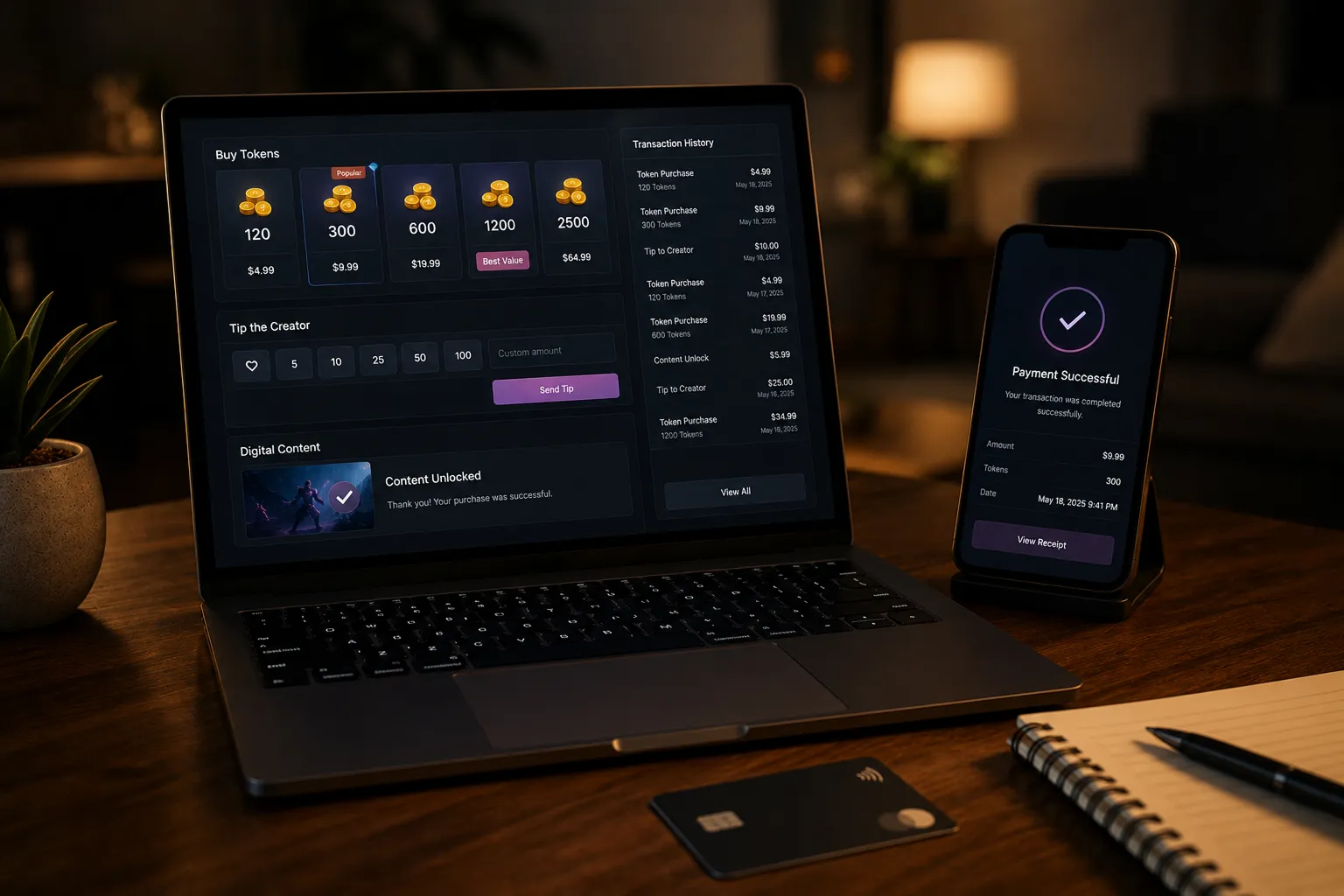
Cam platforms commonly use a prepaid token model. Customers purchase a token bundle and then spend the balance on tips, private shows, messages, or individual content unlocks.
These purchases are usually processed as one-time account top-ups. Common dispute triggers include impulse spending, purchase regret, unrecognized billing descriptors, unauthorized account access, and customers claiming that the expected service was not delivered.
Cam platforms can reduce disputes by using recognizable billing descriptors, displaying token prices clearly, recording account activity, and keeping logs of private-show access, tips, messages, and content usage. Limits on rapid repeat purchases can also help detect card testing and unusual spending patterns.
Platforms that primarily provide digital adult content are commonly classified under MCC 5967, although the final classification remains subject to acquirer review.
VOD and Fan Platforms – Subscriptions and Pay-Per-View Billing
Adult VOD and fan-subscription platforms usually combine recurring memberships with one-time pay-per-view purchases. Customers may pay a monthly subscription fee and make additional purchases for individual videos, messages, or premium content.
Adult VOD and fan-subscription platforms usually combine recurring memberships with one-time pay-per-view purchases. Customers may pay a monthly subscription fee and make additional purchases for individual videos, messages, or premium content.
Renewal disputes are a major concern for this model. Customers may forget about an active subscription, misunderstand the renewal terms, fail to recognize the billing descriptor, or claim that they cancelled before the payment date.
Clear subscription terms, pre-renewal notifications, accessible self-service cancellation, and confirmation emails can reduce these disputes. Merchants should also retain login records, content-access history, purchase confirmations, cancellation timestamps, and customer-support communications.
Platforms whose main service is paid access to digital adult content are generally associated with MCC 5967.

Dating and Matchmaking Platforms – Freemium and Recurring Models
Dating platforms commonly offer free registration alongside paid features such as unlimited messaging, profile promotion, advanced search filters, premium matching, and visibility boosts. Paid services may be sold through recurring subscriptions, one-time upgrades, or credit packages.
Disputes often arise when users do not recognize the descriptor, overlook automatic renewal terms, misunderstand which features are included, or continue to be billed after attempting to cancel.
Merchants can reduce these risks by presenting prices and renewal terms before checkout, sending payment confirmations, providing a straightforward cancellation process, and clearly explaining the difference between free and paid features.
Dating and matchmaking services are commonly classified under MCC 7273. The acquirer may apply additional requirements depending on the platform’s operating countries, moderation procedures, service model, and content.
Adult E-Commerce – One-Time Purchase Flows
Adult e-commerce businesses sell physical products such as lingerie, adult toys, accessories, and related merchandise. Their payment flows usually resemble conventional online retail, with one-time purchases, shipping, delivery tracking, returns, and refunds.
Typical disputes involve delayed or missing deliveries, damaged products, unclear refund conditions, unauthorized purchases, and customer expectations regarding discreet packaging.
Detailed product descriptions, clear delivery estimates, trackable shipping, neutral but recognizable billing descriptors, and transparent return policies can reduce these disputes. Merchants should also retain order confirmations, shipping records, proof of delivery, and customer-support correspondence.
Adult e-commerce merchants are generally classified according to their primary merchandise rather than under the digital adult-content MCC. The acquiring bank should confirm the appropriate retail code during underwriting.
Descriptor Management and Reducing Friendly Fraud
Billing descriptor clarity is one of the most underused levers for cutting chargebacks.
Friendly fraud occurs when a cardholder intentionally or accidentally disputes a transaction that they previously authorized. Mastercard and Javelin reported that approximately one in five disputes in 2025 stemmed from first-party or friendly fraud, although the share can vary substantially by merchant, billing model, and dispute classification.
Subscription and digital-content businesses may face particular exposure because customers can forget renewals, fail to recognize billing descriptors, or later regret a purchase. Reliable research does not establish a single adult-industry-wide percentage, so merchants should evaluate their own dispute data by reason code, billing model, and customer segment.
Practical prevention measures include a neutral but recognizable billing descriptor, clear renewal terms, pre-renewal notifications, accessible self-service cancellation, responsive customer support, and detailed records showing account access and content usage.
Age Verification, 2257 Compliance, and Payment Approval

Content compliance and payment approval are more connected than most guides let on. When a processor underwrites an adult platform’s account, it’ll typically ask about age-verification practices and recordkeeping as part of the risk assessment – non-compliance here creates legal exposure that eventually becomes the processor’s problem too.
18 U.S.C. 2257 Record-Keeping Requirements
Under 18 U.S.C. § 2257 and 28 CFR Part 75, covered producers of certain visual depictions have age-verification, recordkeeping, and labeling obligations. Records must generally be maintained for seven years from their creation or last amendment and for five years after the producer ceases business. Applicability depends on the organization’s role and the content involved, so businesses should obtain qualified U.S. legal advice.
This information is provided for general informational purposes and does not constitute legal advice. Requirements vary by jurisdiction.
State Age-Verification Laws and Their Impact on Underwriting
Separately from Section 2257, many U.S. states now require adult-content platforms to verify users’ ages before granting access. As of mid-2026, at least 25 states have such laws in effect, following the Supreme Court’s June 2025 ruling in Free Speech Coalition v. Paxton, which upheld Texas’s age-verification statute 6–3. For platforms operating across multiple states, that’s a real compliance patchwork to navigate. Processors increasingly want to see a documented approach to it before they’ll approve an account, since regulatory risk turns into banking risk pretty quickly.
How to Evaluate an Adult Payment Provider Before Signing
Technical features are only one part of the decision. Adult merchants should also evaluate the provider’s underwriting criteria, acquiring coverage, contract terms, settlement structure, and ability to support the business after launch.
Before signing an agreement, review the following areas:
- Merchant eligibility and content scope – confirm that the provider accepts the merchant’s exact business model, content type, billing structure, operating countries, and customer locations. Approval for dating services does not automatically cover cam platforms, adult subscriptions, or explicit digital content.
- Acquiring and geographic coverage – identify the acquiring banks and regions available for the account. Ask which countries, currencies, card brands, and local payment methods will be enabled after underwriting. General payment-method lists may include options unavailable to adult merchants.
- Pricing and reserve terms – review processing rates, fixed transaction fees, chargeback and alert fees, currency-conversion costs, monthly minimums, rolling reserves, and reserve-release conditions. All commercial terms should appear in the merchant agreement.
- Settlement arrangements – confirm the available settlement currencies, payout frequency, minimum payout amount, conversion costs, and expected transfer times. Merchants should also understand how refunds, disputes, and reserves affect the amount available for settlement.
- Underwriting requirements – request a complete document list before applying. The review may cover company ownership, website policies, performer records, age-verification procedures, billing terms, previous processing statements, chargeback history, and expected transaction volume.
- Implementation responsibilities – establish who handles gateway configuration, testing, payment-page setup, recurring-billing rules, webhooks, reporting, and migration from an existing provider. The agreement should also identify any third-party integrations required before launch.
- Support and escalation procedures – verify support hours, communication channels, expected response times, and access to a named account manager. Ask how urgent issues involving blocked transactions, delayed settlements, fraud spikes, or card-network monitoring are escalated.
- Account suspension and termination terms – review the circumstances that allow the provider to suspend processing, increase the reserve, delay settlement, or terminate the account. The contract should explain how remaining funds and reserves are handled after closure.
- Compliance responsibilities – clarify which checks are performed by the provider and which obligations remain with the merchant. These may include age verification, Section 2257 recordkeeping, content moderation, KYC and AML controls, sanctions compliance, and state-level access requirements.
A provider should be able to explain these terms before the merchant begins integration. Written confirmation is especially important for supported content, payment methods, reserve conditions, settlement arrangements, and account-termination procedures.
How to Apply for an Adult Merchant Account
Getting approved is as much a documentation exercise as a technical one. Most providers will ask for:
- Business formation documents, beneficial ownership details, and KYC/AML verification for company principals.
- A reviewed website, including a refund policy, a privacy policy, and an age-verification statement.
- Prior processing statements and chargeback history, if you have them.
- Bank account verification for settlement.
- A completed underwriting questionnaire covering content type, billing model, and expected volume.
Underwriting timelines vary by provider, jurisdiction, business model, and the completeness of the application. Adult merchants generally face a more detailed review than standard e-commerce businesses, particularly when the provider needs to assess content policies, age-verification procedures, performer records, recurring-billing terms, or previous processing history. Before beginning the integration, ask the provider to confirm the expected review stages, outstanding documents, and estimated timeline in writing.
BillBlend: A Payment Gateway Built for Adult Businesses
BillBlend is a high-risk payment gateway built specifically for verticals mainstream processors won’t touch – adult, dating, and content-subscription platforms among them. One integration gets merchants access to 100+ payment methods and 70+ currencies, spanning global cards, regional bank-linked methods, and a crypto option for borderless settlement, so there’s no need to stitch together separate providers for each market.
On the risk side, BillBlend combines real-time AI fraud detection, PCI DSS-certified infrastructure, and chargeback management tools built around subscription and recurring billing models, including retry logic that recovers failed renewals instead of losing them outright. Onboarding is handled end-to-end – documentation, a live merchant dashboard with transaction-level reporting, and 24/7 support from a team that already knows high-risk underwriting inside out.
For a full breakdown of BillBlend's adult-specific solution, including pricing structure and integration options, see the dedicated adult business payment processing page.
Frequently Asked Questions
What is an adult payment processor?
An adult payment processor is a provider that supports underwriting and transaction processing for eligible adult-related business models. It may also provide or integrate a payment gateway, fraud tools, recurring billing, dispute-management capabilities, and merchant-account services.
Why do Stripe and PayPal restrict adult businesses?
Stripe prohibits adult content and sexually oriented services. PayPal prohibits sexually oriented digital content and website subscriptions, while some mature-audience or dating categories may require prior approval. These restrictions can apply even when the underlying business is lawful and reflect each provider’s policies, regulatory obligations, financial-partner requirements, and risk controls.
How much do adult payment solutions cost?
Adult payment processing is usually priced individually after underwriting. The commercial offer may include a percentage-based processing fee, a fixed transaction charge, dispute and alert fees, cross-border or currency-conversion costs, monthly minimums, and reserve requirements. Exact terms depend on the business model, operating regions, transaction volume, billing structure, processing history, and dispute profile.
Can I accept cryptocurrency alongside cards for an adult business?
Yes. Most modern adult payment systems, including BillBlend, support crypto as one option within a broader payment stack.
How does 2257 compliance affect my ability to get a merchant account?
Processors treat documented age-verification and recordkeeping practices as part of underwriting, since non-compliance creates legal exposure that eventually lands on the banking relationship behind your account.
Do video game platforms need full KYC like online casinos?
Approval time varies by provider and application complexity. Complete corporate documents, clear website policies, processing statements, billing terms, age-verification procedures, and content-compliance records can help avoid delays. The provider should confirm an estimated timeline after reviewing the initial application.