Finding the best payment processor in 2026 means looking beyond headline rates: approval rates, local payment methods, settlement speed, and risk tolerance all matter. This guide compares 12 providers across fees, geographic coverage, chargeback management, and suitability for high-risk verticals, including iGaming.
What Is a Payment Processor vs. a Payment Gateway vs. a Merchant Account
A payment gateway encrypts and transmits card data from checkout to the payment network. A payment processor routes the transaction, talks to Visa and Mastercard, and moves funds between the issuing and acquiring banks. A Merchant of Record (MoR) goes further, assuming full legal, tax, and chargeback liability – Paddle and FastSpring are common examples.
| Role | Who Handles It | Example |
|---|---|---|
| Payment gateway | Encrypts & transmits card data to the network | Stripe Checkout, Adyen Terminal API |
| Payment processor | Routes transaction; moves money between banks | Worldpay, Nuvei |
| Merchant account | Holds settled funds before transfer to merchant | Acquiring bank |
| Merchant of Record | Assumes legal, tax, and chargeback liability | Paddle, FastSpring |
How We Picked the Best Payment Processors for 2026
Use this table to compare payment processors quickly before reading the full provider breakdowns below:
| Provider | Best For | Pricing | Settlement | Geo | Risk | Notable Feature |
|---|---|---|---|---|---|---|
| BillBlend | High-risk & iGaming | Custom (contact sales) | T+1 | 70+ currencies | High-risk specialist | Smart routing, 100+ APMs |
| Stripe | Developer SaaS | 2.9% + $0.30 US | T+2 | 46+ countries | Low-risk | Radar ML, 135+ currencies |
| PayPal | Consumer trust | 2.99%–3.49% + fixed fee | T+1 | 200+ countries | Low-risk | Buy now, pay later; buyer protection |
| Adyen | Enterprise omnichannel | Interchange-plus, ~$0.13 base | T+2 | 40+ countries | Enterprise | 250+ APMs |
| Square | Brick-and-mortar | 2.6% + $0.10 in-person | T+1–2 | US, CA, UK, AU, JP, FR, IE, ES | Low-risk | Free POS hardware |
| Worldpay | Retail & gaming | Custom interchange-plus | T+2 | 146+ countries | Medium + gaming | Gambling licenses |
| Airwallex | Cross-border | 0.5% FX + processing | T+1–3 | 150+ countries | Low-risk | Multi-currency wallets |
| Razorpay | India | 2% + GST (UPI: zero MDR) | T+1 | India | Low–medium | UPI 2.0, RBI-licensed |
| Helcim | Transparent pricing | Interchange-plus, volume discount | T+2 | US, CA | Low-risk | No monthly fees |
| Paysafe | Cash-online & prepaid | Custom (negotiated) | T+3–5 | 120+ countries | High-risk accepted | Skrill, Neteller, paysafecard |
| Nuvei | Gaming, forex, crypto | Custom interchange-plus | T+1–2 | 200+ markets | High-risk specialist | Native iGaming integrations |
| NOWPayments | Crypto-only businesses | 0.5% (no conversion) | Near-instant | Global (crypto) | Crypto | 350+ coins |
BillBlend – Best for High-Risk and iGaming Merchants
Mainstream processors routinely decline iGaming, gambling, forex, sports betting, lottery, adult, and other specialised merchants – BillBlend is built specifically for these verticals. Smart routing retries failed transactions across multiple acquirers; the company reports authorization rates of 94–96% for qualifying merchants, with results depending on market, acquirer mix, and risk profile. Coverage spans 70+ currencies and 100+ payment methods, from Indian UPI and Brazilian PIX to SEPA Instant and major e-wallets. Dedicated underwriting teams handle licensing requirements in Malta, Curacao, the Isle of Man, and Indian states where online gaming is regulated, while real-time chargeback alerts and adaptive fraud screening keep dispute exposure in check.

Stripe – Best for Developer-Led SaaS
Stripe offers the most thorough API documentation in the industry, ML-based fraud scoring (Radar) bundled in, and 135+ currencies. US card fees are 2.9% + $0.30; India domestic transactions are 2%. Gambling, most crypto exchanges, and adult content are generally restricted or prohibited; account holds on edge-case merchants are a documented risk. Stripe’s authorization tools can improve rates by 1–2% on eligible volume.
PayPal – Best for Consumer Trust
PayPal can increase conversion where shoppers prefer not to share card details with an unfamiliar site. Card processing via Braintree typically starts at 2.99% + a fixed fee; international transactions reach 4.4% plus FX conversion. Account holds and high cross-border FX costs are the main risks. PayPal generally restricts gambling activity; some jurisdictions may require prior approval.
Adyen – Best for Enterprise Omnichannel
Adyen combines in-store, online, and in-app processing under one platform, with interchange-plus pricing and a base processing fee of about $0.13/€0.13 plus interchange. The platform supports 250+ APMs and local acquiring in 40+ countries. Adyen typically requires $500K+ in monthly processing volume – making it a practical fit for enterprise scale only. High-risk categories get extra scrutiny; some verticals need prior approval and additional compliance review.
Square – Best for Brick-and-Mortar / Hybrid
Square provides free entry-level POS hardware and flat-rate in-person pricing at 2.6% + $0.15 on the Free plan (updated October 2025); online card payments are 3.3% + $0.30 on Free, and 2.9% + $0.30 on Plus/Premium plans. Available in the US, Canada, the UK, Ireland, Australia, Japan, France, and Spain (8 countries total).
Worldpay – Best for Retail and Regulated Gaming
Worldpay (now part of Global Payments following the January 2026 acquisition) holds acquiring licenses in regulated gambling jurisdictions and runs formal programs for licensed gaming operators where a licensed acquirer is a regulatory requirement. Interchange-plus pricing covers 146+ countries; all rates are negotiated.
Airwallex – Best for Cross-Border
Airwallex offers multi-currency accounts and low-cost FX (approximately 0.5% above interbank rate for major currencies, vs. 2–3% at banks), with local currency accounts in 40+ countries. Not available to high-risk merchants.

Razorpay – Best for India
Razorpay holds an RBI-authorized Payment Aggregator license and leads the Indian aggregator market. It supports UPI 2.0, net banking, cards, and e-wallets with T+1 settlement. The platform fee is 2% + 18% GST; UPI carries zero MDR for merchants, though platform fees may still apply. RBI e-mandate rules require pre-debit notifications 24 hours before each recurring charge.
Helcim – Best for Transparent Interchange-Plus
Helcim charges interchange-plus with volume discounts that apply automatically, with meaningful rate reductions kicking in around $50,000/month (based on a 3-month rolling average). It covers the US and Canada; high-risk is excluded.
Paysafe – Best for Cash-Online and Prepaid
Paysafe operates Skrill, Neteller, and paysafeCard – key in iGaming markets where players prefer not to expose bank credentials. Pricing is negotiated, and onboarding is slower than PayFac platforms.
Nuvei – Best for Global Gaming, Forex, and Digital Assets
Nuvei supports more than 700 local and alternative payment methods, 150 currencies, and payment coverage across more than 200 markets, with local acquiring in 50+ markets. It holds acquiring relationships in Malta, the Isle of Man, and key Latin American markets. Native back-office and PAM integrations reduce implementation time for gaming operators. Multi-acquirer smart routing delivers strong authorization rates for gaming transactions.
NOWPayments – Best for Crypto-Only Acceptance
NOWPayments supports 350+ crypto assets, with a 0.5% service fee for payments without conversion and 1% for payments involving conversion, excluding blockchain network fees. Near-instant settlement to a wallet and a non-custodial option are available. A complementary method for crypto-native audiences, not a card replacement.
Need a high-risk or iGaming payment setup? Contact BillBlend for a tailored quote.
Best Payment Processor by Use Case
- SaaS: Stripe Billing for self-serve subscriptions; Merchant of Record (Paddle) for international tax on digital products.
- E-commerce: Stripe or PayPal for low-risk. Adyen, where local acquiring in Southeast Asia or Latin America matters for authorization rates.
- Brick-and-mortar: Square for the US, Canada, UK, Australia, and Japan. Adyen or Worldpay for global enterprise retail.
- High-risk: BillBlend, Nuvei, or Paysafe. Mainstream providers terminate high-risk merchants, often without advance notice.
- iGaming and gambling: The best payment processing solutions for this segment combine licensed acquiring with e-wallet and prepaid support. BillBlend covers a wide jurisdictional range with smart routing built in; Nuvei adds native gaming integrations; Paysafe adds Skrill and Neteller.
- India: Razorpay, Cashfree, or PayU India for domestic businesses. BillBlend or Paysafe for gaming operators needing Indian UPI plus a risk-tolerant acquirer.
- Subscriptions: Stripe Billing or Chargebee for low-risk. Nuvei or BillBlend for high-risk categories with RBI e-mandate flows for India.
- Marketplaces: Stripe Connect or Adyen Platforms for split payments and multi-seller payouts.
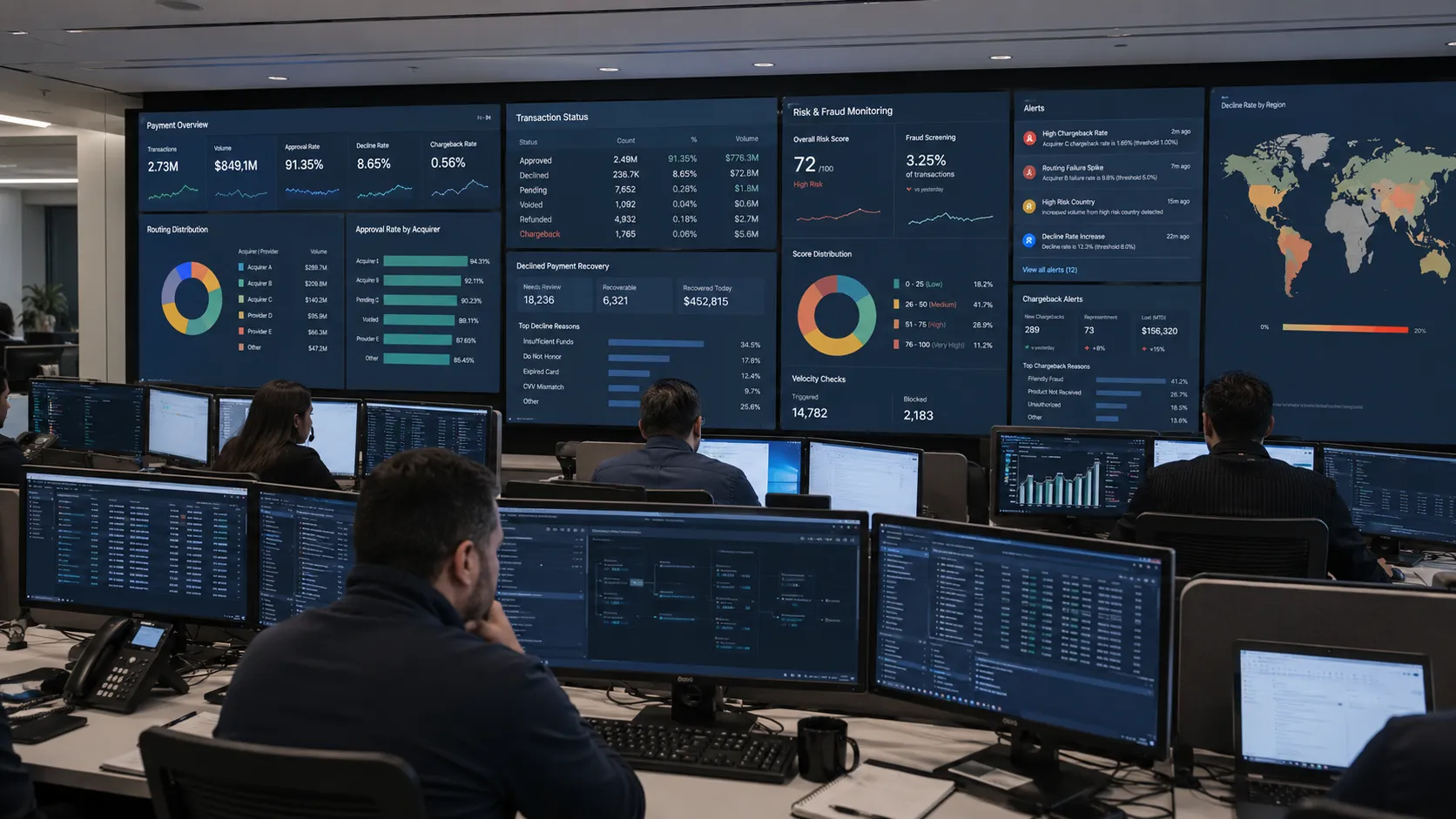
Payment Processing Fees Explained: What You Actually Pay
Every card transaction carries three cost layers: interchange, which is set by card schemes and is non-negotiable; assessment fees, charged by the network; and the processor markup, the only component the processor controls. Pricing models differ on that markup:
| Model | How It Works | Best For |
|---|---|---|
| Flat-rate | Single % + fixed fee regardless of card type | Low-volume merchants |
| Interchange-plus | Actual interchange + fixed processor markup | Growing merchants; full transparency |
| Tiered | Transactions bucketed into qualified/mid/non-qualified | Opaque; generally unfavorable |
| Subscription | Flat monthly fee + interchange at cost | High-volume, card-heavy businesses |
Beyond the headline rate, several fees can add up quickly:
| Fee Type | Typical Range | When Applied |
|---|---|---|
| Chargeback fee | $15–$35 | Per dispute |
| Retrieval fee | $10–$20 | Per information request |
| PCI non-compliance | Up to $100/month | If not PCI compliant |
| Monthly minimum | Varies | If below minimum volume |
| Batch fee | $0.10–$0.25 | Per settlement batch |
| FX spread | 0.5%–3% | Cross-border transactions |
| Rolling reserve | 5–15% held for 90–180 days | High-risk merchants |
At $500,000/month, moving from 2.9% flat-rate to 2.1% interchange-plus saves approximately $4,000 per month.
Security, Compliance, and Authorization Rates
- PCI DSS compliance
Modern processors reduce merchant scope through tokenization and hosted fields – raw card numbers never reach the merchant server. Non-compliance triggers fees and, in serious cases, loss of card acceptance.
- 3DS2
Risk-based authentication passes low-risk transactions without friction and steps up higher-risk ones. Required under PSD2 in the EEA; transfers fraud liability away from the merchant.
- Tokenization
Network tokens (Visa and Mastercard) replace raw card numbers and update automatically on card reissue – key for reducing involuntary subscription churn.
- Authorization rate
It’s a direct revenue metric. Smart routing retries declined transactions through an alternative acquirer. BillBlend reports authorization rates of up to 94–96% for certain high-risk and iGaming merchants through multi-acquirer cascading and adaptive routing; results vary by market, acquirer mix, and transaction profile.
Best Payment Processors and Gateways for High-Risk Businesses (iGaming, Gambling, Forex, Crypto)
Stripe, PayPal, Square, and Adyen generally restrict or prohibit gambling, most crypto exchanges, and adult content. Processing these verticals through a restricted platform can lead to account termination, frozen funds, and MATCH listing, – which can make card acceptance difficult for up to five years.
A dedicated high-risk payment processor holds a rolling reserve (5–10%, 90–180 days), works with banks that accept the vertical, and monitors chargeback ratios against card-network thresholds. Visa’s VAMP excessive threshold dropped to 1.5% (150 bps) on April 1, 2026, for North America, the EU, and Asia-Pacific (Latin America/Caribbean was already at 1.5% since April 2025); the metric combines fraud (TC40) and dispute (TC15) events on settled transactions, and the program excludes merchants with fewer than 1,500 monthly combined events.
Mastercard’s Excessive Chargeback Program generally applies when a merchant has at least 100 monthly chargebacks and a chargeback-to-transaction ratio of 1.5% or higher. Industry data suggests iGaming chargebacks typically run 2–4%, with friendly fraud comprising a majority of disputes. Real-time alerts and a fast response workflow are not optional.
Orchestration vs. a Single PSP
A single PSP gives one acquiring relationship. Orchestration platforms like Praxis or Finera aggregate multiple PSPs behind one integration. BillBlend achieves the same through its built-in smart routing layer, eliminating the need for a separate orchestration vendor.
The leading options for high-risk merchants are: BillBlend (dedicated underwriting, smart routing, 100+ APMs), Nuvei (native gaming integrations), Paysafe (Skrill, Neteller, paysafecard), and Worldpay, where regulation demands a licensed acquirer.
Do you have any more questions?
Fill out the form and we will contact you
*By submitting this application, you consent to the processing of your personal data in accordance with the privacy policy.
Payment Processing in India: What Makes It Different
UPI accounts for a large majority of retail digital payment volume, processing over 228 billion transactions in calendar year 2025 (up from 172 billion in 2024), with FY2025–26 volume crossing 241 billion – a nearly 12,000-fold increase since launch in FY2016–17. MDR on UPI is zero for merchants; aggregator platform fees of 2% + GST still apply.
- RBI compliance
Aggregators must hold an RBI Payment Aggregator license. The 2025 RBI Master Directions include data sovereignty requirements covering Indian transaction data storage.
- E-mandate
Pre-debit notifications must be sent 24 hours before each recurring charge. UPI Autopay mandates up to INR 15,000/cycle need no re-authentication; above that, UPI PIN is required.
T+1 settlement is the Indian standard – next-business-day settlement, faster than T+2 in most Western markets.
- Tokenization mandate
Raw card numbers cannot be stored post-transaction; network tokens are required in all compliant systems.
For domestic Indian businesses: Razorpay, Cashfree, or PayU India. For gaming operators needing Indian payment methods plus a risk-tolerant acquirer: BillBlend and Paysafe.

How to Choose the Right Payment Processor – Quick Checklist
For a deeper framework on how to choose the best payment gateway for your business, check these eight points before signing with any provider:
- Verify your category is permitted – read the acceptable use policy before integrating.
- Model your true effective rate: interchange + markup + chargeback fees + FX at your actual card mix.
- Confirm local payment method support for each key market.
- Clarify the settlement timeline – T+1 vs. T+3 is a material cash-flow difference at scale.
- Negotiate rolling reserve terms upfront if you are in a high-risk category.
- Ask for authorization rate data for your transaction type; smart routing availability matters.
- Evaluate chargeback management – real-time alerts and 3DS2 coverage are standard requirements.
- Test the quality of pre-sales support; it predicts post-integration responsiveness reliably.
Final Verdict and Recommendations
For low-risk businesses, Stripe offers the strongest combination of developer tooling, global reach, and integrated billing. Adyen is the enterprise-grade upgrade for businesses processing more than $1M per year. Helcim delivers the most transparent pricing in North America without monthly commitments.
For India, Razorpay covers the full domestic payments stack – UPI 2.0, RBI compliance, e-mandate flows, and T+1 settlement.
For high-risk and iGaming operators, BillBlend leads on jurisdictional coverage and smart routing. Nuvei is the strongest alternative for native gaming integrations. Paysafe is irreplaceable, where Skrill and Neteller dominate. The best payment processing solution is one that approves transactions consistently, keeps you compliant, and provides real support when needed.
Talk to BillBlend about your iGaming or high-risk payment needs – get a custom solution today.
FAQ
What is the difference between a payment processor and a payment gateway?
A payment gateway encrypts and transmits card data; a payment processor moves the money between banks and settles funds to the merchant. Most platforms combine both functions, but they remain technically distinct services.
What is the average payment processing fee in 2026?
Low-risk US e-commerce: 2.9% + $0.30 flat-rate; 1.8–2.4% effective under interchange-plus at moderate volume. High-risk merchants pay 3.5–5%+ to cover the elevated chargeback risk premium required by acquiring banks.
Which provider settles funds fastest?
UPI in India settles T+0 to T+1. Most US processors default to T+1 or T+2. BillBlend targets T+1 for high-risk merchants. Crypto settlement via NOWPayments is near-instant to a wallet.
What makes a merchant "high-risk"?
Card networks classify merchants as high-risk by vertical (gambling, adult, forex, crypto), business model (recurring billing, digital goods), chargeback history, and geography. The result: higher fees, rolling reserves, and stricter monitoring.
Which payment processor should I use for iGaming?
An iGaming payment processor must route transactions through a licensed acquirer in the target jurisdiction, support e-wallet and prepaid methods, and provide real-time chargeback management. BillBlend, Nuvei, and Paysafe are the main options.
What is the top payment gateway for India?
Razorpay for domestic Indian businesses: RBI-licensed, UPI 2.0 native, T+1 settlement, e-mandate compliant. For gaming operators needing Indian payment methods plus a risk-tolerant acquirer: BillBlend.
Can I switch payment processors without causing downtime?
Yes, with planning: run both providers in parallel, routing new transactions to the new one while migrating card-on-file tokens. Expect the process to take two to four weeks for a clean switch.