What Is a Payment Gateway?
Types of Payment Gateway: Hosted, Embedded, and Direct API
| Type of payment gateway | How it feels in practice | Best fit | Main tradeoff |
|---|---|---|---|
| Hosted redirect or hosted payment page | The customer pays on a page controlled by the provider | Merchants seeking a fast launch and potentially reduced PCI DSS scope, depending on the implementation | Less control over checkout design |
| Embedded hosted fields or iFrame | The payment form appears inside the merchant checkout | Merchants that care about smoother UX and fewer redirects | More work for developers and more implementation risk |
| Merchant-hosted card-data flow / direct card-data API | The merchant collects payment data and sends it through API | Larger teams with strong engineering and compliance resources | Highest PCI DSS and security responsibility |
What Is a Payment Processor?
Payment Gateway vs Payment Processor
| Question | Payment gateway | Payment processor |
|---|---|---|
| What does it mainly do? | Securely handles or transmits payment requests from checkout | Helps move the transaction through authorization, capture and settlement steps |
| Where does it sit? | Website, app, hosted checkout, payment link or virtual terminal | Behind the checkout, connected to processing and acquiring routes |
| What does the merchant configure? | Payment form, API keys, tokenization, 3D Secure flow, payment methods | Capture logic, response handling, processing reports and routing settings |
| What can fail there? | Token issue, checkout timeout, API error, authentication or redirect failure caused by the gateway, merchant integration, 3DS provider, or issuer authentication service | Authorization-message failure, malformed response, capture or batch-processing error, clearing issue, or reporting mismatch |
| How is it priced? | Percentage fee, fixed transaction fee, interchange-plus or blended rate, feature add-ons | Pricing varies widely and may combine gateway, processing, acquiring, scheme, authentication, cross-border, and dispute-related fees |
| What does it not solve alone? | Underwriting, MCC approval, reserves, payout holds | Checkout UX and payment-form behavior |
Payment Gateway vs Payment Processor vs Acquirer vs Aggregator
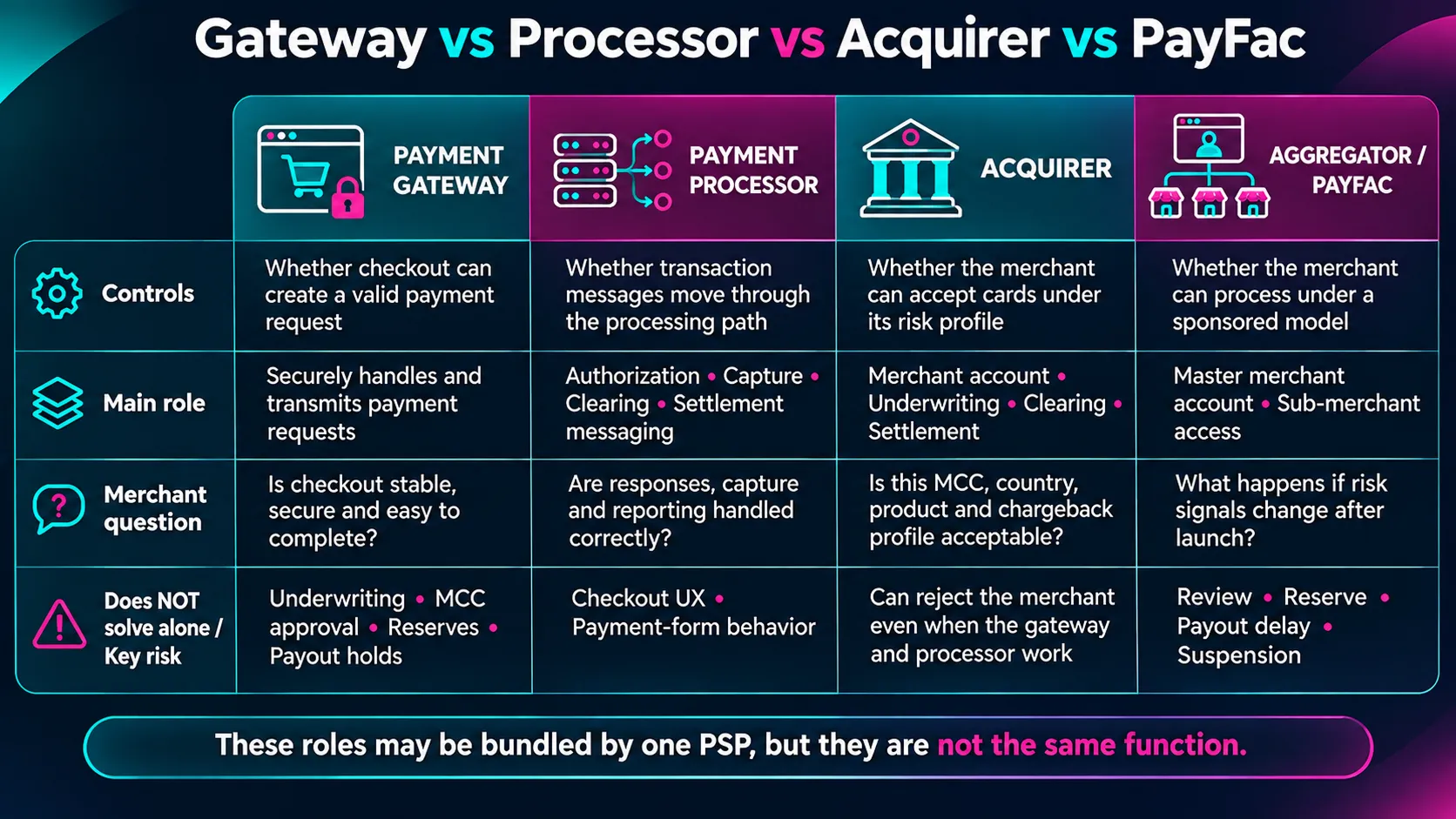
| Role | What it really controls | What merchants should ask |
|---|---|---|
| Payment gateway | Whether checkout can create a valid payment request | Is the checkout stable, secure and easy for customers to complete? |
| Payment processor | Whether transaction messages can move through the processing path | Are responses, capture, records and reporting handled clearly? |
| Acquirer / acquiring bank | Whether the merchant can accept card payments under this risk profile | Is this MCC, country, product and chargeback profile acceptable? |
| Aggregator / PayFac | Whether the merchant can process under a sponsored model | What happens if risk signals change after launch? |
Trying to map your own stack onto these four roles? A payment gateway provider that will actually name the acquirer behind your account makes this far easier.
What Is a Payment Service Provider (PSP)?
How a Card Transaction Moves From Checkout to Settlement
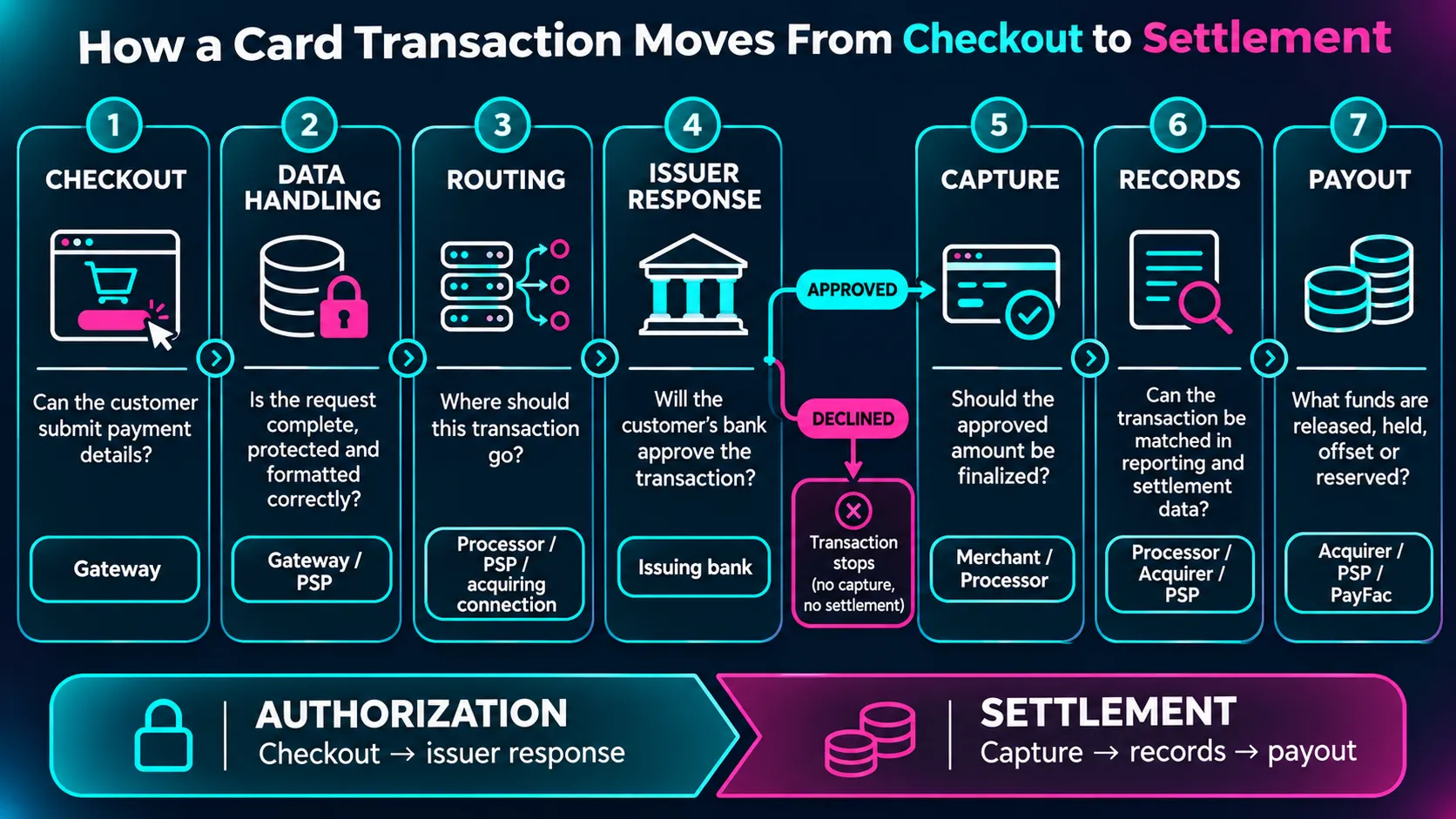
| Stage | What is being decided | Main layer involved |
|---|---|---|
| Checkout | Can the customer submit payment details? | Gateway |
| Data handling | Is the request complete, protected and formatted correctly? | Gateway / PSP |
| Routing | Where should this transaction go? | Processor / PSP / acquiring connection |
| Issuer response | Will the customer’s bank approve the transaction? | Issuing bank |
| Capture | Should the approved amount be finalized? | Merchant / processor |
| Records | Can the transaction be matched in reports and settlement data? | Processor / acquirer / PSP |
| Payout | What funds are released, held, offset or reserved? | Acquirer / PSP / aggregator |
Payment Failures, Issuer Declines, and Account Holds: Diagnosing the Layer
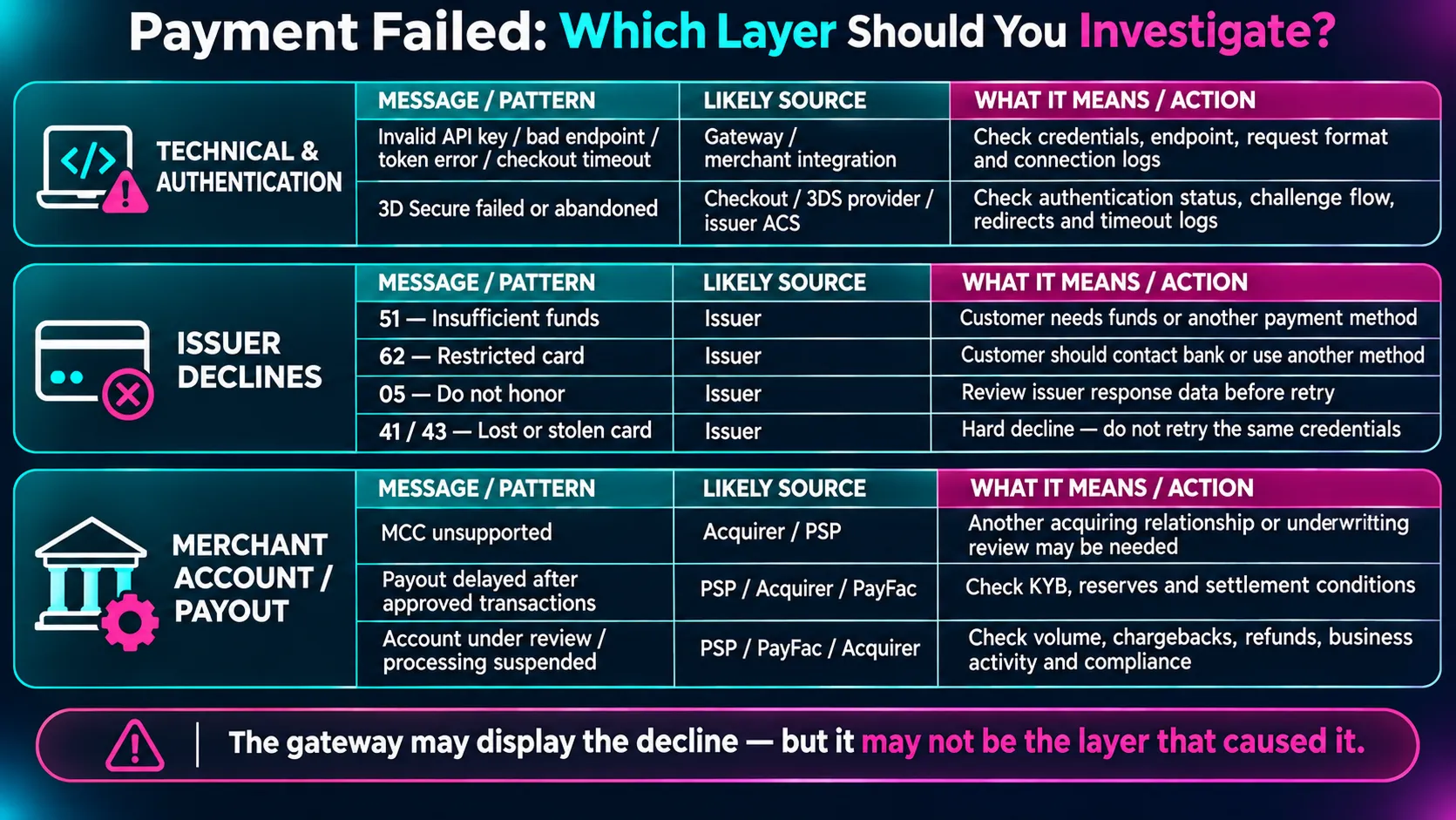
| Message or pattern | Likely source / where to investigate | What it means / what to do |
|---|---|---|
| 1. Technical and authentication failures | ||
| Invalid API key, bad endpoint, token error, checkout timeout | Gateway / merchant integration | Check credentials, endpoint, request format, and connection logs. The request may not have reached processing. |
| 3D Secure failed or abandoned | Merchant checkout / 3DS provider / issuer's Access Control Server (ACS) | Check the authentication status, challenge flow, redirects, and timeout logs. The customer may have abandoned the process, or authentication may have failed for technical or issuer-related reasons. |
| 2. Issuer authorization declines | ||
| “Insufficient funds” (code 51) | Issuer | The available balance or credit is insufficient. The customer may need to add funds or use another payment method. Any retry must follow the applicable network rules. |
| “Restricted card” (code 62) | Issuer | The card is subject to restrictions. Ask the customer to contact their bank or use another payment method. |
| “Do not honor” (code 05) | Issuer | A generic decline without a specific explanation. Check any additional issuer response data and the provider's retry guidance before attempting another authorization. |
| “Lost card” / “Stolen card” (codes 41/43) | Issuer | Hard decline. Do not retry using the same card credentials. |
| 3. Merchant-account, reserve, and payout issues | ||
| Merchant category or MCC unsupported | Acquirer / PSP | The business type, MCC, country, or product falls outside the provider's acceptance policy. Another acquiring relationship or underwriting review may be needed. |
| Payout delayed after approved transactions | PSP / acquirer / PayFac | Check KYB status, reserve requirements, settlement schedules, and payout conditions. An approved transaction does not guarantee immediate payout. |
| Account placed under review or processing suspended after launch | PSP / PayFac / acquirer | The provider may be reviewing changes in transaction volume, chargebacks, refunds, business activity, or compliance status. Confirm the reason and required corrective steps. |

Merchant Account, MCC Code, and High-Risk Underwriting
Do you have any more questions?
*By submitting this application, you consent to the processing of your personal data in accordance with the privacy policy.
The Reason Accounts Freeze: Aggregators and PayFacs
What You Actually Sign: Contract, Funds, and Liability
- a gateway provider that supplies checkout connectivity;
- a PSP that bundles gateway, processing, reporting, and settlement support;
- a PayFac or aggregator that sponsors access;
- a direct acquirer that provides the merchant account.
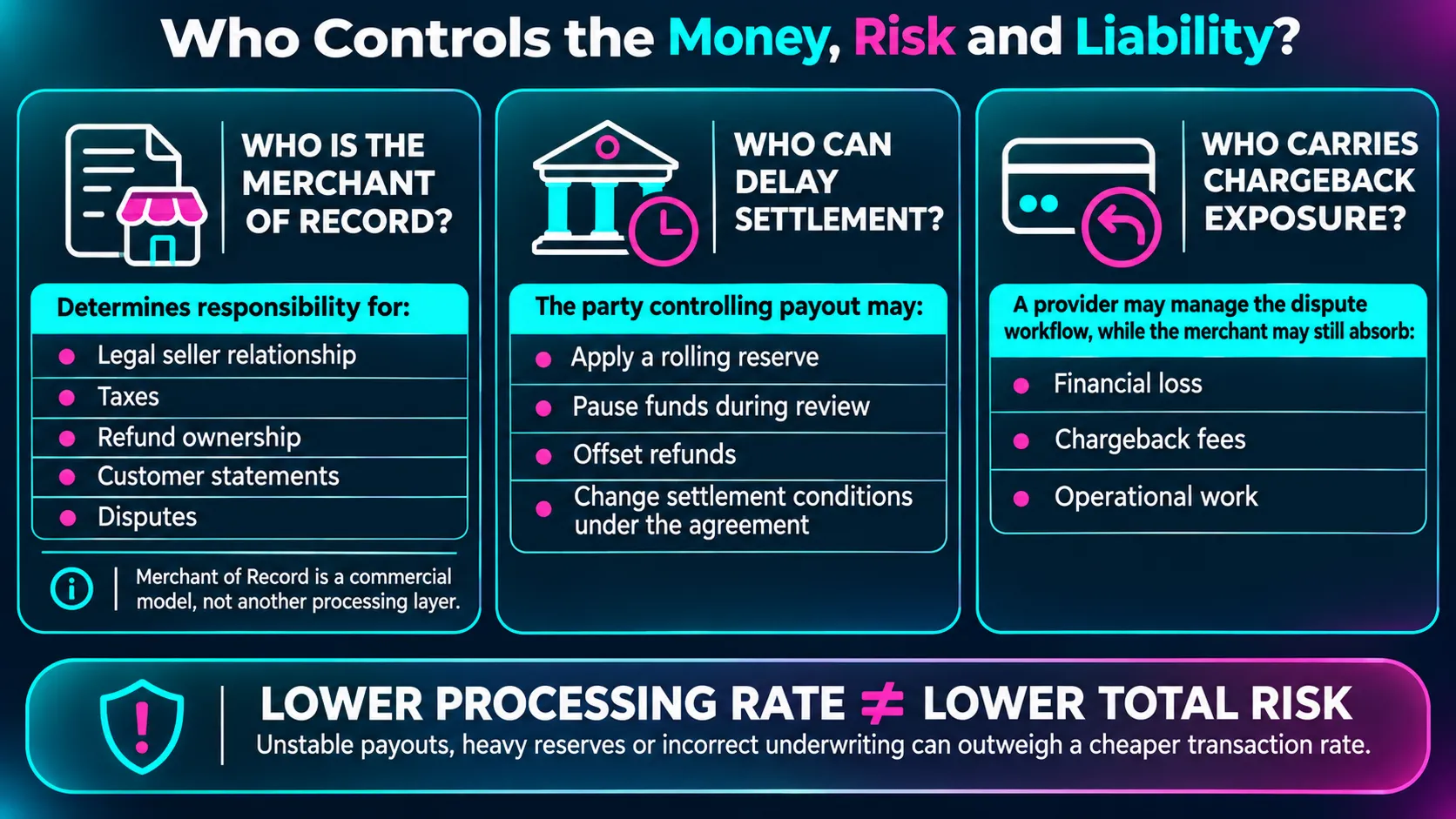
Note on Merchant of Record (MoR): A merchant of record is not another processing layer. It is a commercial model in which a third party becomes the legal seller to the customer and assumes defined responsibilities for payments, taxes, refunds, and disputes.
- Who is the merchant of record?
- Who can delay settlement?
- Who carries chargeback exposure?
High-Risk Stack: Several Acquirers Under One Gateway
- one gateway or routing layer;
- several acquiring relationships;
- separate MIDs and billing descriptors for genuinely separate brands or business lines;
- routing by country, BIN, issuer, card type, currency, amount and risk score;
- retry logic for recoverable soft declines;
- reporting by provider, route, issuer, geography and decline code.
If your decline data does not show whether the problem sits with the issuer, acquirer, processor, or route, BillBlend can help map the payment chain before you replace the wrong provider. Talk to the BillBlend team for a free review of your setup.
Payment Processor and Gateway Examples: Who Is Actually What
| Brand | How to think about it | What matters |
|---|---|---|
| Stripe | PSP with gateway and processing functionality; acquiring-related capabilities vary by country and product | Strong integrated setup, but restricted-business rules still apply |
| PayPal | Wallet, PSP, gateway and merchant-account-style solution depending on product | Convenient, but PayPal’s account rules and risk policies matter |
| Amazon Pay | Checkout method and payment processor: Amazon processes the payment and can hold funds | Amazon's own reserve and payout rules apply, on top of the merchant's main stack |
| Authorize.net | Payment gateway | Often connects merchants to processors and merchant accounts |
| Adyen | Enterprise PSP/acquirer/processor/gateway-style platform depending on region | Often used by larger merchants needing global acquiring and local methods |
| Mastercard / Visa | Card networks | They connect issuers and acquirers; they are not ordinary merchant gateways |
Payment Processor vs Payment Network: Where Visa and Mastercard Sit
Payment Costs: Look Beyond the Transaction Rate
Payment Security: Encryption, Tokenization, PCI DSS, and 3D Secure
- Encryption protects payment data during transmission.
- Tokenization replaces sensitive card details with tokens, reducing the need to store actual card numbers.
- PCI DSS sets security requirements for businesses and providers that handle cardholder data.
- 3D Secure adds cardholder authentication through the issuing bank when required.
How to Choose the Right Setup
- Does the provider support your MCC code and vertical?
- Which acquiring banks sit behind the setup?
- Who holds funds before payout?
- What triggers a rolling reserve?
- Can transactions be routed across several acquirers?
- Does the provider support smart routing and cascading?
- What happens if one acquirer stops supporting the vertical?
- Who handles chargebacks and representment?
- Can local payment methods be added without rebuilding checkout?
Before signing, ask the provider to confirm its acquiring coverage, reserve policies, and payout terms in writing.
What High-Risk Merchants Need From a Payment Provider
Speak with BillBlend to review your current payment stack and discuss potential issues affecting transaction approvals or payouts.