Look, crypto isn’t some fringe experiment anymore. By 2026, it’s just part of how money moves globally. We’re talking about a $3–5 trillion sector here – one that affects millions of people, every day.
If you’re running a business – online retail, iGaming, whatever – you probably already know this: accepting crypto isn’t optional anymore. It’s about liquidity. It’s about keeping customers who expect it. And honestly? The regulation question isn’t “if” anymore. It’s “how fast will MiCA and similar frameworks actually land?”
Here’s the data: Worldpay’s 2025 report says global crypto spend is set to more than double – $16 billion in 2024, hitting $38 billion by 2030. What’s pushing that? Stablecoins. Big institutions finally getting involved. Infrastructure that actually works. Toss in clearer rules and AI catching fraud before it happens, and yeah – growth makes sense.
McKinsey’s report from the same year adds context: stablecoins alone are moving ~$30 billion a day now. That’s not speculation – that’s real payments. In 2025, real-world volumes for these methods hit around $390 billion annually. Mostly B2B. So no, crypto payments aren’t just a “maybe” for cross-border or programmable use cases anymore. They’re becoming the default for a lot of businesses that need speed, lower fees, and fewer intermediaries.
What is a Cryptocurrency Payment Solution?
A crypto payment gateway is a financial technology bridge enabling merchants to accept digital assets (like Bitcoin, Ethereum, or USDT) and receive either an equivalent amount in fiat currency (USD, EUR) or keep the funds in crypto. Unlike traditional card processing, a crypto payment gateway runs on a decentralised ledger (blockchain technology). This eliminates the need for intermediary banks, significantly reducing transaction fees and removing the possibility of fraudulent chargebacks.
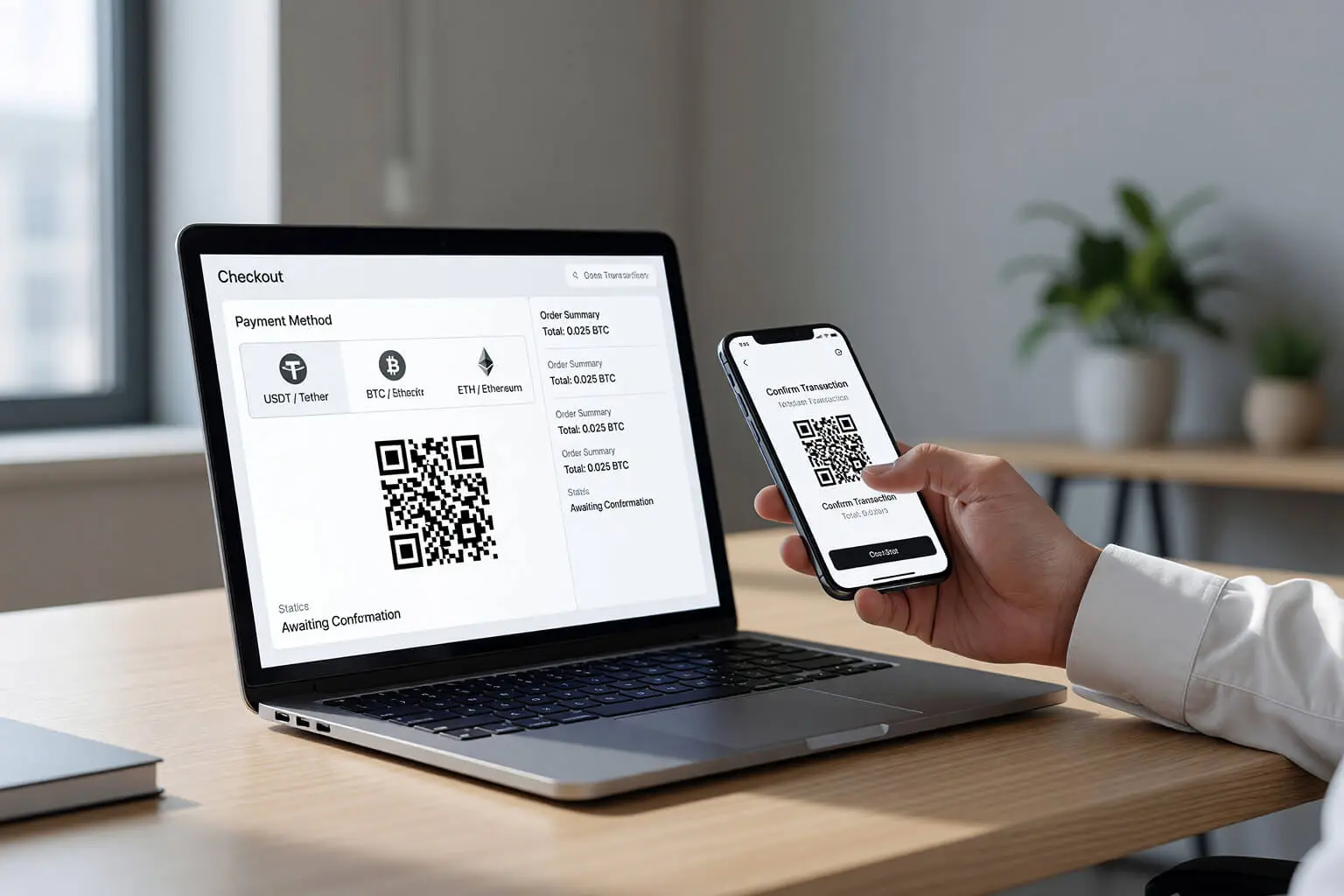
Core Components:
- The Gateway: the user interface at the e-commerce checkout.
- The Processor: the backend that handles transaction validation on the blockchain.
- Liquidity Provider: the service that manages real-time exchange between crypto and fiat.
Modern crypto payment gateways go beyond simple “send and receive” protocols. Today, they function as sophisticated financial layers that handle complex tasks such as real-time fiat conversion and automated tax reporting. The primary appeal for a business owner lies in the decentralized nature of the ledger; when a transaction occurs, it is broadcast to thousands of nodes, making it virtually impossible to alter or fake.
This creates a “trustless” environment where you don’t need to trust a central bank to verify that funds exist – the code handles verification instantly. For merchants battling chargeback fraud, this means a drastic reduction in operational overhead and complete protection from “friendly fraud”, which costs the e-commerce industry billions annually.
History and Evolution of Crypto Payments
The journey of crypto payment gateway integration has seen three distinct “waves”:
- The Genesis Era (2009-2015): dominated by Bitcoin enthusiasts. Transactions were slow, and volatility was extreme.
- The Infrastructure Wave (2016-2022): the rise of Ethereum and smart contracts. The birth of early crypto payment processors like BitPay and the first generation of stablecoins.
- The Institutional Era (2023-2026+): this is the current phase, defined by the entrance of giants like BlackRock (ETFs), the dominance of USDT/USDC for cross-border payments, and the arrival of institutional-grade security features.
The most significant shift in the evolution of crypto payments occurred with the “DeFi Summer” of 2020 and the subsequent institutional embrace in 2024. During this period, we saw the transition from “Store of Value” (bitcoin as digital gold) to “Medium of Exchange” (stablecoins on fast networks).
The introduction of the Lightning Network for Bitcoin and the transition of Ethereum to Proof-of-Stake (PoS) were the technical catalysts that allowed for the high-throughput required by global retail. By 2026, crypto payment gateway integration is no longer a fringe IT project but a core treasury management strategy for Fortune 500 companies.

Types of Crypto Payment Solutions
There’s no one-size-fits-all model here. You have to pick based on your risk appetite and how your ops actually work.
- Crypto-to-Fiat (Auto-Settlement): you take crypto, but the gateway swaps it to fiat instantly. Volatility? Not your problem.
- Crypto-to-Crypto: you hold the assets. Makes sense if you're paying suppliers or staff in crypto anyway.
- Custodial vs. Non-Custodial: with custodial, they manage the keys (easier). Non-custodial means you do (more control, but more responsibility).
Then there’s the Layer-1 vs. Layer-2 question. Layer-1 (Bitcoin, Ethereum mainnet) is secure, sure. But let’s be honest–it gets slow and expensive during peak times.
That’s why most gateways default to Layer-2s now–Polygon, Arbitrum, Lightning Network. We’re talking thousands of transactions per second for less than a cent each. For merchants, this is huge. It means you can actually accept micro-payments for digital goods without fees eating all your margin on a $5 purchase.
Comparison of Top Providers (2026)
With AI-driven security, stablecoin adoption in real-world transactions, and emerging agentic commerce, the competitive landscape for payment providers has become highly dynamic.
Today’s merchants have diverse options, each with unique features suited to transaction volumes, risk profiles, regulatory needs, and liquidity depth.
Here are the leading providers in 2026, with a focus on customer-facing service, global partnerships, and performance in specialized and crypto-native scenarios.
| Provider | Type | Best For | Fiat Settlement | Key Features | Verdict |
|---|---|---|---|---|---|
| BitPay | Direct Processor | Enterprise / Compliance-heavy | Yes (USD/EUR/GBP) | 10+ cryptos, instant settlement, PCI-compliant, invoicing tools | Reliable veteran, but strict compliance chokes non-standard payment flows |
| NOWPayments | Direct Processor | SMEs / Multi-Crypto | Yes (Auto-conversion) | 150+ coins, 30+ blockchains, no KYC for small volumes | Great for testing crypto, easy setup, but limited risk tools |
| CoinGate | Direct Processor | E-commerce / Retail | Yes (50+ fiat) | Lightning Network, payment buttons, Shopify/Woo plugins | Excellent UX for EU retail, not built for complex, high-volume markets |
| Cryptomus | Direct Processor | Specialized iGaming | Yes (Flexible) | No KYC threshold, anonymous options, multi-wallet support | Good for privacy-focused niches, but single-point dependency |
| BVNK | Institutional Rail | Regulated B2B / Banks | Yes (Multi-currency) | MiCA-regulated, stablecoin rails, high-speed remittances | Best for compliant enterprises, overkill for agile merchants |
| 0xProcessing | Direct Processor | Crypto / Specialized Verticals | Yes (Fiat conversion) | 65+ cryptocurrencies, 14+ blockchains, Web3 wallets, recurring payments | Top choice for crypto acceptance in specialized digital markets |
*Settlement via connected gateways – we auto-route to the optimal provider for best rates and approvals.
The “hidden” factor in comparing payment solutions is liquidity depth. A provider might have a great API, but if it cannot handle a $500,000 conversion without significant slippage, it fails mid-market B2B needs.
Orchestration layers like BillBlend solve this by routing each transaction to the gateway with the best real-time exchange rate and highest approval odds – maximizing fiat value for every digital asset processed. For merchants operating in challenging environments, this redundancy isn’t a luxury – it’s the difference between a completed payment and a lost customer.

How to Integrate Crypto Payment Solutions
Integration has become significantly more streamlined. Most businesses follow a 3-step process: API Integration, plugins (for Shopify/WooCommerce), and no-code links.
Technical teams should prioritize SDK and API integration that supports “Web3 Connectivity.” This allows users to pay directly from their browser-based wallets (like MetaMask or Phantom) without manually copying and pasting long wallet addresses. This “one-click” crypto checkout has been shown to reduce cart abandonment by up to 25% in the crypto-native demographic.
Additionally, the integration should always include a “Wrong-Chain Protection” feature. This is a common pain point where a user sends USDC via the Ethereum network to a Solana address; a high-quality crypto payment gateway will detect this mismatch and prevent the transaction before the funds are lost.
Security, Regulations, and Compliance
Operating a crypto payment gateway for business requires strict adherence to international standards like KYC/AML and multi-signature authorization.
Under MiCA compliance, the “Travel Rule” has become a global standard. This requires crypto payment gateway providers to share information about the origin and destination of every transaction above a certain threshold. While this may seem to contradict the “anonymity” of crypto, it is actually the key to mass adoption.
By satisfying KYC and AML requirements, accepting crypto payments can now be fully audited and accepted by traditional accounting firms and tax authorities. For a business, this removes the legal “grey area” and allows for the seamless movement of funds from a cold wallet into a corporate bank account.
Benefits
- Lower Fees: traditional cross-border wires cost 3–5%; crypto costs <1%.
- Speed: real-time settlements 24/7/365 – no bank holidays or weekend delays.
As per Worldpay’s analysis, the overall digital payments ecosystem (including crypto) is set for massive expansion, with crypto spend specifically projected to hit $38 billion globally by 2030 – highlighting the opportunity for businesses to adopt chargeback-free, real-time crypto solutions.
One of the most overlooked benefits is T+0 Settlement. In the traditional world, when a customer pays via credit card, the merchant might wait 3 to 7 days for the funds to actually be “cleared” and available for use. With real-time settlements via blockchain, the money is yours the moment the transaction is confirmed (usually within 60 seconds).
This drastically improves cash flow management. The challenge, however, remains the “user education” barrier. While stablecoins like USDT are easy to understand, explaining “gas fees” or “network congestion” to a non-technical customer still requires a well-designed UI/UX at the e-commerce checkout.
Objective Case Studies
Specialized iGaming Operator (via 0xProcessing)
An iGaming operator in a competitive market faced constant deposit failures with traditional fiat payments. High rejection rates came from bank blocks, 3-D Secure issues, preset limits, redirects to third-party pages that broke user experience, and frequent chargebacks due to friendly fraud. Acceptance rates hovered around 60%, processing took 120–150 seconds, and support was overloaded with “deposit not received” tickets.
By integrating 0xProcessing’s crypto payment gateway – with white-label embedded checkout and static wallets (each player gets a unique permanent wallet address) – they achieved:
- Acceptance rate increased from ~60% to 96%, eliminating bank/issuer blocks, address entry errors, and 3-D Secure failures.
- Payment processing time dropped from 120–150 seconds to under 1 minute.
- Support inquiries reduced by 40% thanks to transparent tracking, fewer errors, and simplified repeat deposits.
- Chargebacks are completely eliminated, as blockchain transactions cannot be reversed, cutting revenue loss from disputes and reserved funds.
- Fully branded, no-redirect experience preserved player trust and immersion.
This proves crypto payments solve core pain points in iGaming – high friction, GEO restrictions, and chargeback overhead – turning them into a fast, high-conversion solution.

FAQ
Is it safe for B2B businesses to pay with cryptocurrency?
Short answer: yes – if you’re using a regulated gateway. With things like MiCA compliance and AI catching suspicious activity in real-time, crypto payments aren’t the wild west anymore. They’re auditable, traceable, and honestly, in some ways safer than traditional wires.
What about crypto's crazy price swings?
Fair concern. But most serious gateways offer instant conversion to fiat – so the moment a customer pays in crypto, it’s locked in at USD/EUR/whatever. You never actually hold the volatile asset unless you want to.
Can I run subscriptions or recurring billing with crypto?
Yep. Modern gateways use smart contracts to handle this. Customer approves once, and the contract automatically pulls the agreed amount of stablecoins at each billing cycle. No manual invoicing, no chasing payments.
What if the blockchain just… stops working?
It’s rare – major networks like Ethereum or Solana run at 99.99% uptime – but it can happen. Good gateways have fallback logic: if one chain slows down or fails, they’ll route the transaction through another network or a Layer-2 solution automatically. Your checkout doesn’t freeze; the customer barely notices.