
Efficient B2B payments matter more now than ever. It’s not just about keeping the books balanced anymore – it’s a strategic move. As 2026 rolls on, the old ways of handling business transactions are slowly fading out. Manual processes, paper trails, endless waiting? Companies are ditching that for automated platforms. And it’s not just about cleaner records. Getting paid faster, cutting down on operational costs, feeling a bit more secure when trading across borders – those are the real wins.
According to Fortune Business Insights, global B2B transaction value is expected to jump from around $109.39 trillion in 2026 to roughly $282.48 trillion by 2034. That’s about 12.6% growth year over year. A big reason for that growth? Modern B2B payment methods simply cost less than traditional wires or checks. Add in the worldwide shift to ISO 20022, and you’ve got the foundation for a major upgrade in how money moves globally. And this is only the start: demand for instant cross-border transfers is set to take off.

History and Evolution of B2B Payments: From Paper to Protocols
Historically, B2B transactions evolved more slowly than those in the consumer sector (B2C). However, in the past decade, digital commerce has received unprecedented attention from businesses, and corporate trade relations are being transformed on a scale never seen before.
The Manual Era (1950s–1990s)
For decades, paper checks reigned in the B2B world. Although they were slow to process and expensive, these payment methods exposed payers to fraud risks. Reconciliation was done manually, which meant it could take weeks to complete.
The Early Digital Backbone (2000s–2015)
The advent of wire transfers (SWIFT) and ACH payments marked B2B’s first foray into electronic payments. Though faster than mail, these “data-poor” modes meant that a payment could arrive without necessary context (invoice numbers or tax details), resulting in severe back-office friction.
The Integration Wave (2016–2024)
This period was characterized by the rise of B2B payment integration with ERP systems (Enterprise Resource Planning). The focus shifted to invoice processing automation, enabling “straight-through processing” (STP) in which payments were triggered and reconciled with minimal human intervention.
The Intelligent Orchestration Era (2025–2030+)
We are now in the age of autonomous finance. Real-time AI monitoring watches for signs of fraud, and minute-long global transaction settlements are made possible by blockchain technology. The entire concept has shifted from single-gateway solutions to B2B payment platforms that act as orchestration layers, combining multiple service providers to optimize performance on every transaction.
What Is a B2B Payment Solution?
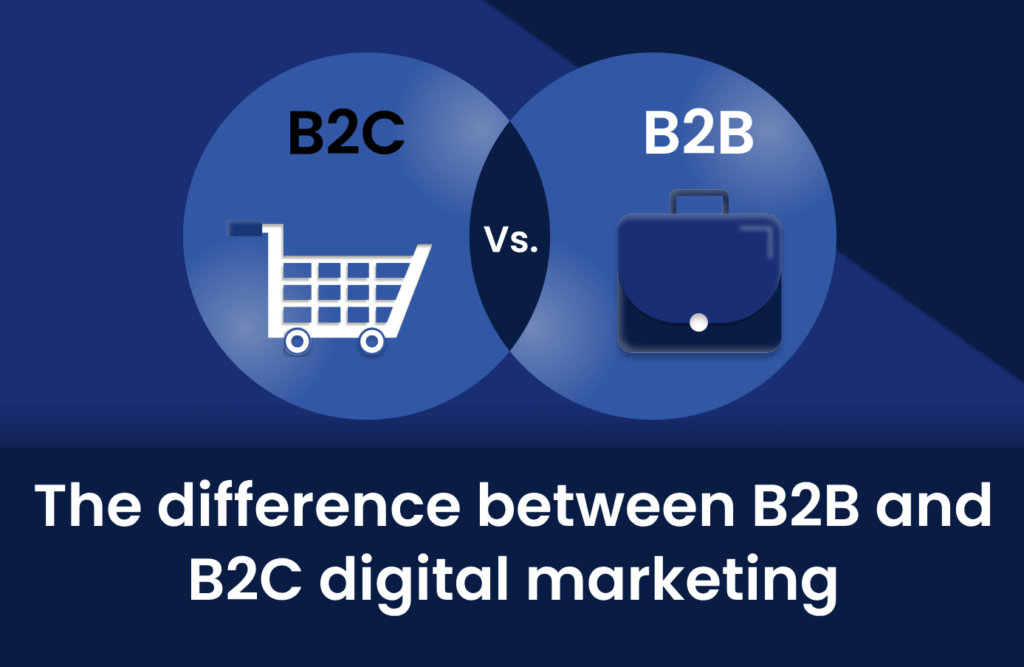
When two businesses trade, the payment side of things works a lot like consumer transactions – just bigger, slower, and with more steps. Think about it: when you buy something online, it’s usually one click, done. B2B? Not so simple. We’re talking larger sums, multiple people needing to approve the payment, and terms that can stretch out 30, 60, even 90 days. It’s a whole different game.
With a selection of B2B payment solutions available for businesses today, the free movement of funds is only the beginning. They provide a complete infrastructure for:
- Creating and Processing Invoices: Automation of the billing cycle.
- Compliance: Ensuring AML and KYC requirements for all payments.
- Data Richness: Adding extensive metadata to payments so that automatic reconciliation is possible.
- Currency Management: Managing FX (Foreign Exchange) for cross-border payments with minimal spread.
Types of B2B Payment Solutions
You can’t build a solid financial stack relying on just one payment method. It doesn’t work that way. Companies mix different B2B payment options depending on what they need right now – how fast the money needs to move, what it costs, and where it’s going.
ACH Payments & eChecks
Same-Day ACH kept picking up steam through 2026. Just in 2025, it handled 1.4 billion payments worth $3.9 trillion – up 16.7% in volume, 21.4% in value year-over-year. When speed matters (payroll, urgent vendor payments), this is often the default pick.
Wire Transfers (SWIFT & ISO 20022)
The ISO 20022 migration finally wrapped up in late 2025 – Fedwire in July, SWIFT cross-border in November. Big deal? Yeah. Wires now carry rich, structured data instead of bare-bones instructions. That means back-office teams spend less time manually matching payments and more time actually using the data.
Virtual Cards (VCC)
Virtual cards are blowing up in B2B. Market size: ~$22.92B in 2025, heading toward $60.06B by 2030 (roughly 21% annual growth). Why? Two words: security and control. You can set limits, lock to a vendor, kill the number after use. Way harder to abuse than a plastic corporate card.
Blockchain & Stablecoin Settlements
Look, in complex or cross-border sectors, blockchain isn’t a buzzword anymore – it’s table stakes. Stablecoins like USDT or USDC let you skip the whole correspondent banking maze. Payments settle in minutes, not days. And the fees? Often pennies compared to wire transfer costs. For certain use cases, it’s a no-brainer.
Comparison Table: B2B Payment Methods 2026
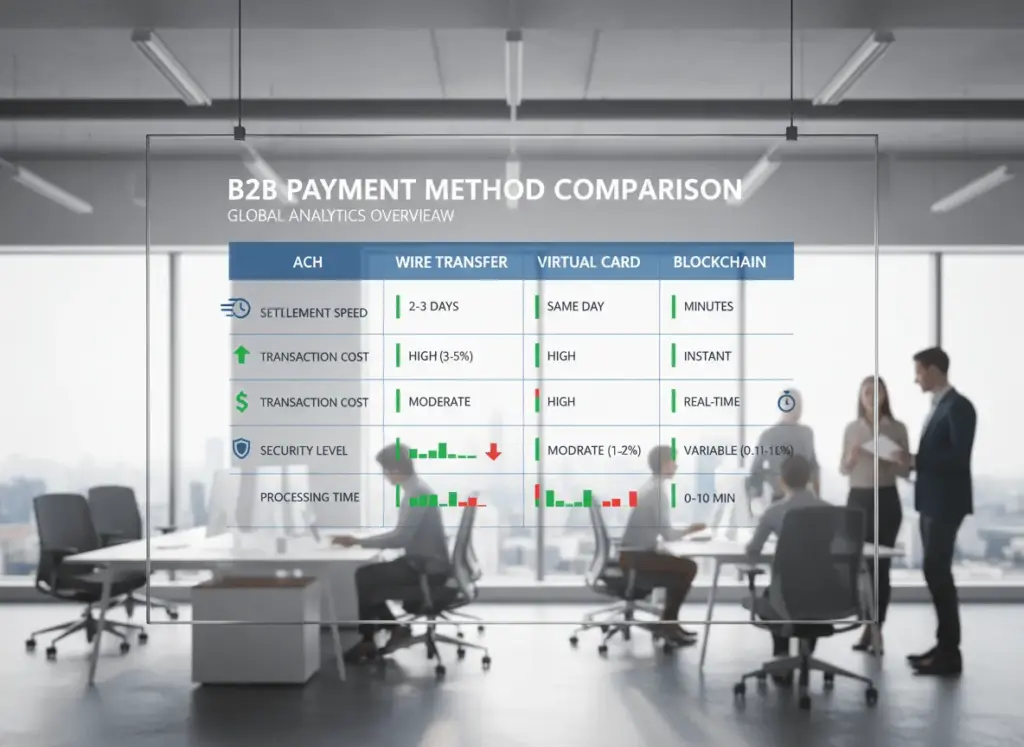
To help businesses select the most suitable method for their specific needs, the table below compares the major B2B payment options across key criteria such as settlement speed, transaction fees, data richness, and security level.
| Method | Settlement Speed | Transaction Fees | Data Richness | Security Level |
|---|---|---|---|---|
| ACH / SEPA | Same Day | Very Low | Medium | High |
| Wire Transfers | 1–4 Hours | High ($25–$50) | Exceptional (ISO 20022) | Ultra-High |
| Virtual Cards | Instant | 2–3% (Interchange) | Very High | Exceptional |
| Digital Wallets | Instant | Medium | High | High |
| Blockchain | < 10 Minutes | Ultra-Low (< $1) | High | Cryptographic |
This comparison clearly shows that while traditional methods like ACH and wire transfers remain reliable for certain use cases, emerging options such as virtual cards and blockchain settlements offer superior speed, lower costs, and enhanced security – especially for cross-border and complex transactions.
Global Trends in B2B Payments 2026
In 2026, real-time infrastructure, artificial intelligence, and embedded finance will reshape B2B payments once again. The latest wave of changes is directly leading to faster cash flows, lower costs for fund-transferring companies, and greater clarity into company operations than ever before.
The Ascendancy of Real-Time Payments (RTP)
RTP networks are now a fact of life in almost every major economy by 2026. The capability to move money across thirteen metropolises or twenty states every 24 hours means no more regular “Weekend Downtime” in commerce and finance. For corporations, this level of control over cash flow and working capital is indispensable.
Financial Operations: AI/ML
At present, AI monitoring has become a standard option in B2B payment platforms. The primary uses for AI include:
- Cash Flow Forecasting: by analyzing historical data, AI tools predict precisely when vendors are likely to pay. For instance, the system analyzes 365 days of historical payment patterns between cash in and cash out for your biggest clients – all while legacy accounting documents are digitized and audited by machine, eliminating manual processing and physical print-outs.
- Automated Reconciliation: this feature matches 99% of incoming payments to invoices without human intervention.
- Fraud Prevention: AI audits B2B payment processing for suspicious patterns that no human auditor would easily detect.
Embedded B2B Finance
The ongoing blurring of distinctions between payment and credit continues. Today’s B2B payment solutions offer businesses “Buy Now, Pay Later” (BNPL) options, enabling companies to pay their vendors on the spot while spreading costs over 30- or 90-day periods in a form that is both expedient and beneficial.
Benefits of Modern B2B Payment Solutions
The ROI of implementing B2B payment automation is clear and can be quantified very easily:
- Operational Efficiency: by automating invoice processing and reconciliation, companies can reduce their manual work by 60–80%. This automation means finance teams are freed up to focus on strategic planning, financial analysis, and business growth initiatives rather than simple administrative tasks in accounting and finance.
- Fraud Reduction: organizations that have taken this approach have seen substantial decreases in the number and severity of fraud incidents when control measures were updated automatically (Nacha and AFP Payments Fraud Survey 2025). Some have reported up to 75% fewer fraudulent incidents thanks to modernized systems with better controls by default and real-time oversight requiring human attention only when trouble threatens cross-border transactions.
- Improved Vendor Relationships: fast, transparent payments lead to better supplier terms and discounts.
- Global Reach: a company with a strong B2B payment gateway or orchestration layer can enter new regions such as Latin America and Asia Pacific without needing to build local bank relationships.
Challenges in B2B Payments
Despite the advancements, businesses still face significant hurdles:
- Regulatory Complexity: AML compliance and KYC guidelines vary drastically from country to country, making global cross-border payments a legal minefield.
- Legacy System Integration: many large enterprises still struggle with ERP integration, as their internal systems are decades old and not designed for real-time APIs.
- Cybersecurity Threats: as payments become faster, so do the attacks. Business Email Compromise (BEC) and sophisticated phishing remain the top threats in 2026.

How to Choose a B2B Payment Solution
Picking a B2B payment provider? Don’t just go with the first option. Here’s a quick 10-point checklist to make sure you’re choosing something that’ll actually last:
- Native ERP Integration: first things first – does it plug directly into what you’re already using? SAP, NetSuite, QuickBooks? If it doesn’t connect, you’re just adding more work.
- Security Features: multi-factor authentication, virtual cards support – basic stuff, but you’d be surprised how many providers skip this.
- Global Corridor Coverage: you’re targeting Mexico, India, or the EU? Make sure the provider actually has liquidity there. No point signing up if they can’t move money where you need it.
- ISO 20022 Support: the standard’s already here. Is their system ready, or are they still playing catch-up?
- Fee Transparency: are the transaction fees clear upfront? Or will you find out later about hidden intermediary bank charges? Ask.
- Scalability: peak season hits and volume jumps 10x – can their system handle it, or will everything slow to a crawl?
- Automated KYC/AML: onboarding new vendors shouldn’t take weeks. How fast can their system actually get someone approved?
- Real-Time Reporting: do you get a live view of your global cash flow? Or are you waiting on end-of-day reports that are already outdated?
- Support for Alternative Methods: blockchain, stablecoins, whatever’s next – can it run alongside traditional ACH, or do you have to pick one?
- Orchestration Capability: last but not least: does it let you route payments smartly between multiple providers? That flexibility matters more than you think.
The Strategic Future of B2B Payments
Where are B2B payment solutions heading? Really, it comes down to three things: instant, integrated, and intelligent. By 2030, the companies that make it will be the ones seeing payment processing as a strategic asset, not just some back-office cost.
You get there by embracing automation, making sure your ERP integration runs deep, and using orchestration tools – BillBlend, for example. That’s how you build a financial engine resilient enough to handle market volatility.
In global trade, having the most capital doesn’t make you the winner anymore. It’s about how efficiently you move that capital. Want to stay competitive over the next decade? Modernizing your B2B payment system today is probably the best move you can make.

FAQ
Why is it important to know the difference between B2B and B2C payments?
One-off immediate payment is typically B2C. B2B payments involve larger values, multiple approval stages, “net terms” (extended payment periods), and detailed reconciliation data.
Why are virtual cards safer than traditional corporate cards?
Virtual cards have limited scope and are assigned to only one vendor. Therefore, should the details fall into the hands of a fraudster for any reason, those cards cannot be used elsewhere or for other purposes, significantly reducing conventional fraud risk.
How does ISO 20022 affect my accounting team?
ISO 20022 makes automated matching possible. This means that your B2B payment system can automatically match a payment to an invoice number and tax ID, which saves the accounts receivable team hours of manual work.
Are there currently operational applications for blockchain technology in B2B trade?
Yes. In 2026, many B2B payment providers will use stablecoins (USDT/USDC) to settle international invoices. It is faster, cheaper, and provides a permanent, immutable audit trail for AML compliance.
Does BillBlend handle the transfer of my funds?
No. BillBlend is an orchestration platform. Your chosen B2B payment gateway or bank handles your funds. BillBlend provides the logic, routing, and consolidated reporting for all those transactions.
How can B2B payment automation help boost my cash flow?
Automation reduces Days Sales Outstanding (DSO) through automatic invoice reminders and faster digital payment processes, meaning your bank account receives money days – or even weeks – earlier.