
2026, and most businesses are running multiple PSPs to grow. Does it work? Mostly. But you’re also dealing with rising costs, approval rates that won’t cooperate, and a checkout experience that changes depending on which provider’s in the loop. Still, when you get it right, that multi-provider setup can actually drive some serious revenue – and companies that master the juggling act often uncover new ways to boost it even further.
The payment orchestration market was estimated at $1.40-1.70 billion in 2023-2024 and is expected to hit up to $6-9 billion by 2030 using conservative probabilities (CAGR ≈ 20-24.7%). Payment orchestration is essentially a tech layer that handles multiple payment providers simultaneously. As e-commerce went global and things got more complicated, businesses needed payment infrastructure that was both reliable and efficient.

History and Evolution
A modern payment orchestration platform, born of global complexity and developed with the highest standards, provides resilient, efficient and intelligent infrastructure for payments.
In the early 2010s
By relying on a single PSP, businesses risked downtime and limited support for local payment methods (e.g. PIX (a Brazilian instant payments system), BLIK). This resulted in high cart abandonment rates when they expanded beyond their home country or region.
2010-2015: The First Payment Aggregators
Layer Spreedly began to pick up significant market share as a dedicated payment orchestration layer, offering agnostic abstraction over multiple PSPs, a unified interface to the outside world, lower complexity and basic routing/failover for multi-PSP strategies.
Early 2020s: Standardization of Multi-PSP Strategies
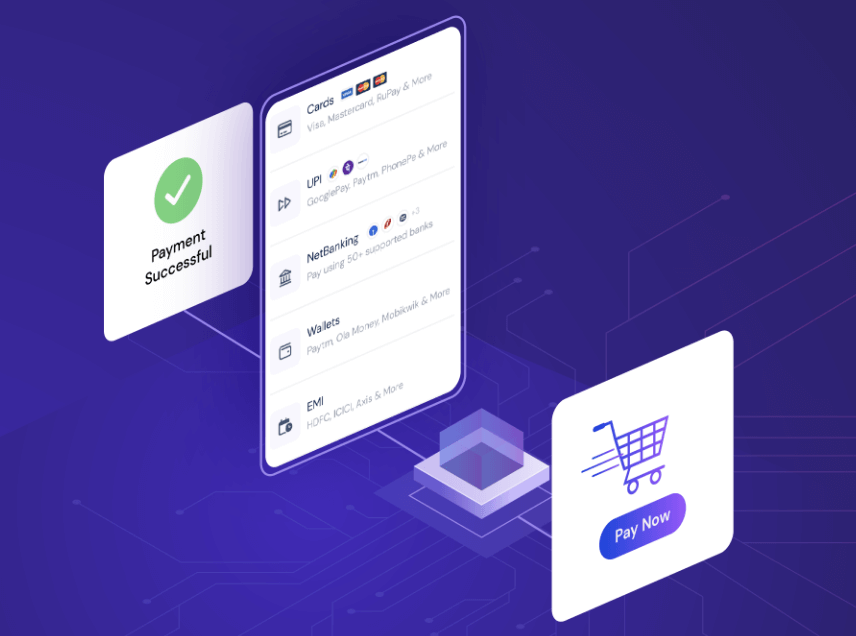
Multi-PSP setups became standard for scaling businesses. Maintaining separate integrations for 5-10+ payment orchestration providers imposed heavy engineering burdens, leading to specialized payment orchestration solutions that consolidated connections, enabled smarter routing, boosted approval rates, and mitigated single-provider risk.
2021-2024: Integration of AI and Machine Learning
AI/ML transformed payment orchestration software into dynamic systems featuring real-time analytics, enhanced fraud detection, and smart routing based on multiple variables to optimize paths and minimize declines.
2026: The Era of Intelligent Orchestration
Platforms now deliver real-time analytics, autonomous AI routing, advanced fraud prevention, automated compliance, and personalized transaction handling – essential for operating at global scale.
2025 and beyond: ISO 20022 standardisation and CBDCs
Since the coexistence period for SWIFT MT and ISO 20022 ended on November 22, 2025, ISO 20022 became the global standard for richer data exchange and improved compliance in payments. This does not mean that every business will achieve innovative benefits though. There is increasing support between orchestrators and creators of payment systems. CBDCs, stablecoins, and tokenized assets are pulling hybrid flows together to form an independent ecosystem for instant settlement.
How Payment Orchestration Works: The Details
In 2026, a payment orchestration system executes a fast (under 2–3 seconds end-to-end) multi-layered process using REST APIs and webhooks for asynchronous updates. This maximizes approvals, reduces costs, minimizes declines, and provides fault tolerance.

Payment Initiation and Universal Checkout Payment
A complete backend function that signals success or failure during transaction operations has a number of implications for different actors in the market. The merchant frontend sends a unified API request (POST/payments or /sessions) containing card/token, amount, currency, IP/location information, device fingerprint, payment method preferences and metadata.
Currently, most transactions, which include only one write to disk, create the queued record in 100-500 ms.
Risk & Compliance Pre-Checks
The transaction passes through risk engines:
- AI/ML fraud scoring (velocity, BIN, geolocation, behavior; may integrate Sift/Forter)
- 3DS/SCA/PSD2 decision (frictionless or challenge)
- AML/OFAC screening, velocity limits, country restrictions
Such synchronous calls take 200-800 ms. Suspicious or non-compliant transactions are blocked immediately.
Dynamic Routing Optimization
Dynamic rules + ML evaluate:
- BIN/issuer, country, currency, amount
- Real-time PSP metrics (approvals, latency, fees, uptime)
- Historical BIN/region/method performance
- Cost vs. approval trade-offs
- Business priorities (e.g., local acquirer preference)
Cached rules enable decisions in <100 ms; the platform selects the primary PSP + ordered fallbacks.
Transaction Attempt (Primary Route)
A normalized request is sent to the chosen PSP/acquirer with an idempotency key. The PSP processes authorization (often with 3DS); response arrives in 300-1500 ms (average ~500-800 ms for cards).
Failover, Cascading & Intelligent Retries
On soft decline, timeout, or recoverable error:
- Automatic failover to the next PSP (cascading within the same session)
- Custom retry logic per decline code
- Circuit breakers temporarily pause failing PSPs
This adds latency of 200-1000 ms per attempt; a full cascade may add 1-3 seconds.
Tokenization, Capture & Settlement
On approval:
- Network tokenization replaces the PAN (Visa/Mastercard) for future transactions
- Secure vault stores tokens (PCI compliant)
- Capture (immediate or delayed) and settlement are handled
- Multi-PSP reconciliation occurs via reports/webhooks (settlement typically takes 1-3 days)
Post-Transaction: Reconciliation, Analytics & Feedback
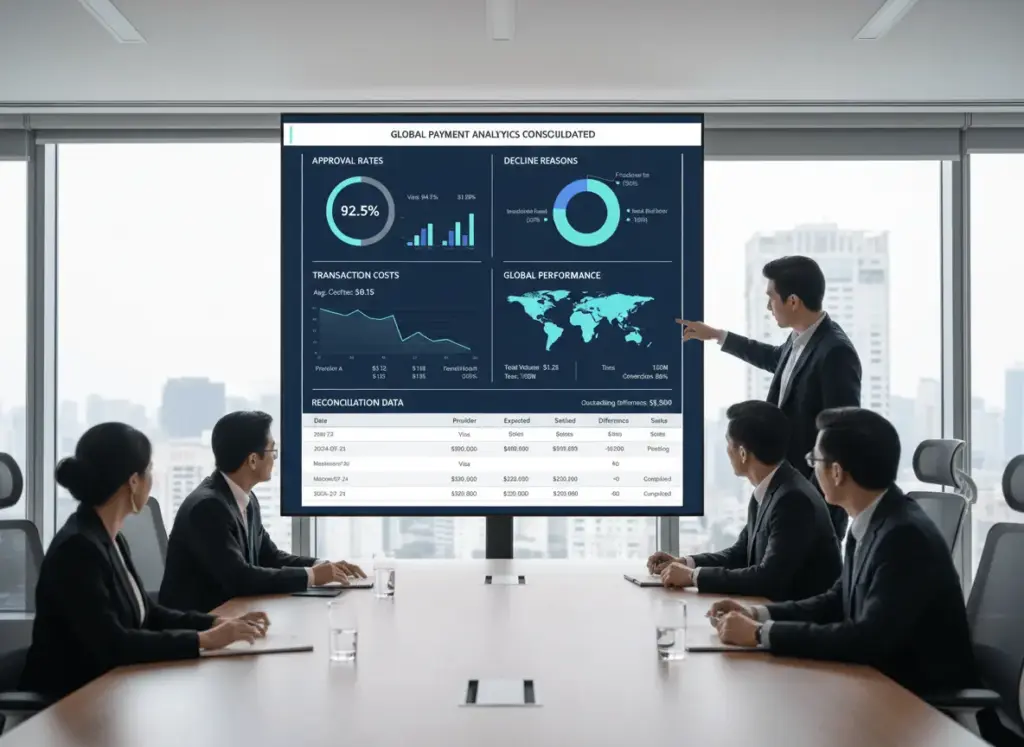
A unified dashboard aggregates data across providers. Webhooks notify the merchant of success/failure for fulfillment. Outcomes feed into the continuous ML loop to refine routing models and metrics.
This real-time workflow handles risk, routing, failover, and reconciliation automatically. That’s what sets modern orchestration tools apart from basic gateways. It protects merchants from relying on a single provider, helping them secure higher approvals, lower costs, and smoother global payments.
Global Trends in Payment Orchestration 2026
Payment orchestration trends in 2026 position it as the predictive, multi-rail backbone of global commerce. Driven by AI acceleration, PSD3/PSR/Open Banking advancements, MiCA/GENIUS Act regulations, and mainstream adoption of digital-native assets – providing resilience, cost control, and seamless cross-channel experiences.
AI and Machine Learning for Predictive Routing
ML models leverage huge datasets (historical approvals, real-time PSP metrics, intuitive signals) for adaptive, predictive routing. Under heavy loading, callback processing ensures prompt and accurate decisions.

Embedded Orchestration for Banking (SAP/NetSuite), ERP and Core Systems
Native payment flows auto-route invoices directly into ERP systems (NetSuite, SAP), CRMs, treasury or banking apps. A single middleware makes silos disappear, allowing finance teams to operate seamlessly on their payment management across traditional rails, modern fiat and its chains.
Influence of Open Banking and A2A Payments
Low-cost bank-to-bank A2A flows gain traction via PSD3 APIs and instant payments (fees 0.1-0.5% vs. 1-3% for cards). Hybrid routing incorporates consent management, real-time settlements, and lower-friction cross-border options – supported by anti-monopoly measures that foster competition and optimization.
The Growth of Stablecoins and CBDCs
Regulated stablecoins (under MiCA, GENIUS Act) and emerging CBDCs support cross-border, B2B, and treasury use cases. Platforms offer native tokenized asset support with 24/7 blockchain-backed settlements and hybrid traditional/on-chain rails.
No-Code and Low-Code Configuration
Drag-and-drop tools enable non-technical teams to configure workflows, routing rules, fraud thresholds, and fallbacks quickly (e.g., Primer, Gr4vy), reducing development time and accelerating adaptation to market or regulatory changes.
Network Tokenization as a Core Standard
Visa/Mastercard network tokenization is essential for CNP and recurring transactions, delivering automatic credential updates, ~3%+ authorization uplift, and reduced PCI scope. Issuers increasingly prioritize tokenized flows, making embedded vaults and updater systems imperative.
Omnichannel Orchestration
Unified stacks ensure consistent routing and methods (cards, wallets, A2A, stablecoins) across online, mobile, in-app, in-store, IoT, voice, and emerging channels, with centralized analysis for resilience and frictionless experiences.
Benefits and Challenges of Payment Orchestration
Payment orchestration benefits include higher approvals, lower costs, faster expansion, and simplified operations – though it requires careful implementation and vendor management.
Primary Benefits for Businesses
Increased Approvals
Through smart routing, retries, local acquiring and tokenization (generally 3-8%, up to 40% in LATAM complex verticals), you can win 5-15% more approvals than before. This reduces declines and significantly increases sales.
Reduced Cart Abandonment and Enhanced Conversion
With the payment gateway providing seamless payment support for many different local methods (PIX, BLIK, iDEAL, Alipay), you can enable the right experience for local merchants everywhere. This lowers abandonment rates across the board and generally results in higher sales.
Cost-Effective
Dynamic routing can choose the most cost-effective processor, avoiding high inter-regional interchange fees (1-3%) and including failover for maximum productivity. Savings often outweigh platform costs per transaction within mere months.
Unified Dashboard for Operations & Reconciliation
A single dashboard provides everyone with clear reporting on the entire company, real-time analytics as well as unified settlements. It substitutes many dispersed information access systems, improving both financial and operational efficiencies.
Time to Market
Ease of configuration means new methods or markets launch in days/weeks using pre-built connectors rather than months of custom coding.
Key Challenges to Consider
- Complex initial setup and integration
- Need for separate agreements with underlying PSPs/acquirers and SLA management
- Heightened data security and compliance demands – orchestrators handling cardholder data require PCI DSS Level 1 compliance
For merchants with $10M+ annual volume, the best payment orchestration platform in 2026 delivers strong ROI through higher approvals and lower fees, outweighing implementation challenges with proper strategy and KPI tracking.
Security and Regulatory Considerations
Leading platforms employ layered defenses, continuous monitoring, encryption, tokenization, and adaptive compliance to counter advanced fraud and attacks.
PCI DSS Level 1 Compliance for Orchestrators
Platforms handling cardholder data must achieve PCI DSS Level 1 (v4.0.1) as service providers: annual QSA assessments, quarterly ASV scans, penetration testing, and full implementation of 12 core requirements. Top providers (Spreedly, BridgerPay, BlueSnap, etc.) maintain PCI Level 1 + SOC 2 Type II, reducing merchant PCI scope via tokenization/vaulting.
Role of 3DS in Orchestration (Frictionless vs. Challenge Flows)
3DS2 supports SCA under PSD2 while preserving conversion: frictionless flows use contextual data for background authentication (reducing abandonment by 70-85% compared to 3DS1), while challenge flows trigger verification only for suspicious transactions via embedded iframes/SDKs. Orchestrators dynamically route to issuers favoring frictionless outcomes and apply exemptions (low-value, recurring).
Impact of PSD3 on Routing and Open Banking
PSD3/PSR (accelerating in 2026) strengthens open banking, fraud rules, and API reliability: high-performance bank APIs with fallbacks, expanded A2A/instant payouts, tighter fraud timelines, liability shifts, centralized consent dashboards, and increased PSP diversity for cost-optimized multi-rail routing. Orchestrators integrate PSD3-compliant APIs and open banking providers for smarter, lower-cost flows.
Data Processing Nuances Across Jurisdictions (GDPR, LGPD, CCPA)
Global platforms comply with overlapping privacy laws:
- GDPR (EU) emphasizes lawful basis, minimization, consent/DPIAs, rights, and 72-hour breach notification
- LGPD (Brazil) mirrors GDPR with opt-in focus
- CCPA/CPRA (California) requires opt-out for sales/sharing and strong security
Solutions include configurable data residency, anonymization, granular consent, audit logs, and tokenization.
Top-tier orchestration in 2026 combines PCI Level 1 security, intelligent 3DS, PSD3 readiness, and jurisdiction-specific privacy controls for secure global scaling.
Types of Payment Orchestration Platforms
There is no single solution for everybody. Different web applications are suited to different control levels, industries, and customization needs. Make an appropriate selection for your tech stack and expansion goals.
Merchant-centric platforms
For the larger enterprise market that has its own unique requirements in terms of general-purpose and in-scope actions. These platforms were designed to help companies be more productive by having rich no-code and low-code integrations and supporting the entire business of self-service, in-house teams that can dynamically adjust rules.
Agnostic third-party orchestrators
These layers are not influenced by any company but merely route traffic to the right providers. Their absolute priority is flexibility, cost and performance optimization.
Industry-specific solutions
Designed for specialized, highly-regulated industries (iGaming, Crypto, Forex, etc.): business-friendly chargeback protection, advanced fraud tools, and dealings with specialized acquirer banks.
Good options keep a fine balance of pre-built connectivity and customizable flows (unified charging, industry-specific routing, etc.).

Comparison of Top Providers: 2026 Market Leaders
Payment orchestration providers list includes leading solutions across categories:
| Provider Type | Example Provider | Key Features | Target Market |
|---|---|---|---|
| Enterprise Orchestrator | Primer / Gr4vy / IXOPAY | AI smart routing, no-code workflows, universal checkout, advanced analytics & ML | Fortune 500, global retail, high-growth e-commerce & SaaS |
| Specialized Verticals Specialist | BillBlend | Advanced fraud detection, BIN analysis, chargeback defense, specialized acquirers | iGaming, crypto, betting, nutraceuticals, adult |
| Agnostic Layer | Spreedly / Hyperswitch | Unified API, 100–120+ PSP connections, pure orchestration & tokenization | Mid-market SaaS, marketplaces, dev-heavy teams |
| Niche / Regional Provider | Akurateco / Corefy / Norbr | Deep local methods (PIX, BLIK, iDEAL), regional acquiring & tax compliance, white-label | LATAM/EMEA expansion, emerging markets, hospitality & marketplaces |
Match provider strengths to needs: e.g., PIX depth for Brazil or subscription + tokenization for global SaaS.
BillBlend: Orchestration for Specialized Markets
BillBlend is a specialized orchestration layer for borderless commerce, sitting above multiple PSPs/rails to deliver control, risk distribution, and no lock-in.
Target Industries
- iGaming & online casinos
- Sports betting
- Crypto exchanges & wallets
- Forex & CFD trading
- Nutraceuticals, adult, and other specialized e-commerce verticals
Specialized for high chargebacks, PSP blocks, aggressive fraud, complex KYC/AML, and uptime demands.
Key Capabilities
- ML-driven smart routing: Real-time optimal PSP selection (BIN, geo, amount, rates, fees, risk)
- Automatic failover & cascading: Instant reroute, intelligent retries, circuit breakers
- 100+ methods & rails: Cards, local (PIX, BLIK, UPI), e-wallets, bank transfers, native crypto
- Advanced built-in anti-fraud: Real-time scoring, device fingerprinting, velocity, BIN analysis, behavioral modeling
- Regulatory & compliance tools: Automated disputes, chargeback evidence, AML screening, configurable rules
- Exceptional uptime: Multi-region setup, geo-distributed failover, provider rotation (99.99%+ availability)
BillBlend transforms payment friction into reliable, scalable performance.
How to Choose a Payment Orchestration Platform
This is a long-term strategic decision. Audit current pain points (declines, abandonment, PSP issues), then evaluate against this 10-point checklist.
Checklist for Choosing a Payment Orchestration Platform
- Coverage of current and target PSPs/gateways (pre-built connectors to 100+ for scalability)
- Support for local payment methods (deep integration with PIX, BLIK, iDEAL, UPI, etc.)
- Smart routing and optimization (AI/ML-driven, configurable rules, transparent logic)
- Failover, cascading & retry mechanisms (automatic, session-based, circuit breakers)
- API quality and latency (clean REST API, good docs, sandbox, <200-500 ms decisions)
- ERP/backend system compatibility (NetSuite, SAP, Odoo plugins, webhooks, batch exports)
- Real-time analytics and reporting (unified dashboard, decline analysis, per-PSP metrics)
- Security & compliance (PCI DSS Level 1, PSD3 readiness, GDPR/LGPD/CCPA, tokenization)
- Fees and total cost/ROI (subscription + per-transaction; payback via approvals/fees savings)
- Implementation speed, support & optimization (fast go-live, dedicated tuning team)
Prioritize your top 3-5 pain points during demos/PoCs. Select a platform that converts payment complexity into competitive advantage.
Case Studies
Case Study 1: European Retailer Achieves Global Performance Leap
A mid-sized European fashion/electronics retailer deployed orchestration in late 2025 to address low cross-border approvals (approximately 78%) and high abandonment in LATAM/EMEA due to missing local methods.
With AI-driven smart routing, local acquiring (PIX, iDEAL), network tokenization, and intelligent retries:
- International authorization rates rose to 92% (+14 percentage points)
- Transaction fees dropped 18% via cost-optimized selection
- Cart abandonment fell sharply, driving revenue growth without added marketing
Case Study 2: Specialized iGaming Operator Scales Securely in LATAM
A LATAM-focused online gambling/sports betting operator integrated a specialist orchestrator (e.g., BillBlend) in 2025 amid PSP blocks, chargeback volatility, and approval dips.
With intelligent traffic distribution, advanced fraud scoring, BIN analysis, automatic failover, and crypto support:
- LATAM approval rates surged 40% (from the mid-60s to over 90% in key markets)
- Avoided widespread restrictions via provider rotation/redundancy
- Reduced chargeback exposure through enhanced dispute tools and risk-aware routing
These examples demonstrate measurable 2026 ROI: +14-40% approval lifts, lower fees/chargebacks, and secure scaling in retail and specialized verticals.
FAQ
What exactly is payment orchestration?
A technology layer connecting merchants to multiple PSPs, gateways, and methods via one unified API. It automates routing, security, failover, reconciliation, and optimization to boost approvals, cut costs, and ensure resilience.
How does it improve approval rates?
Smart routing sends transactions to the optimal PSP based on real-time data (BIN, location, amount, performance), while failover, cascading retries, local acquiring, and network tokenization handle declines and boost success. In optimized scenarios (especially complex or cross-border flows), this can deliver 5-15% uplifts (typically 3-8% overall, often 2-5% from active optimization), significantly reducing false declines and involuntary churn for substantial revenue recovery.
Is it just another payment gateway?
No. Gateways connect to one/few processors. Orchestration sits above multiple, coordinating them with smart logic, unified API, failover, and analytics – like an intelligent manager.
What are the costs?
Usually monthly fees ($500-$5,000+) and/or per-transaction ($0.05-$0.15). Savings from higher approvals, lower fees, and reduced engineering often offset costs quickly.
Can it help with chargebacks?
Yes. Built-in fraud detection, risk scoring, automated disputes, transaction trails, and risk-aware routing reduce chargeback ratios by 15-30% and improve representment success.
What is smart routing logic?
Rules, algorithms, and ML select the optimal processor using BIN/IIN, amount, geography, time, real-time performance, historical data, and cost-success trade-offs.
What does network tokenization mean?
It replaces card PANs with secure Visa/Mastercard tokens, enhancing security, auto-updating credentials, raising approvals (~3%+), and lowering PCI scope.
Why is omnichannel support important?
It ensures consistent experiences across web, mobile, in-store, and emerging channels from one stack – unifying methods, routing, and data to avoid fragmentation and lift conversion.
What are the minimum volume requirements?
No strict minimum, but strong ROI typically starts at $10-15M annual volume (~$1M+ monthly). Smaller volumes benefit from easier integrations and local methods.
How long does integration take?
2-6 weeks for most using pre-built connectors; basic setups in days/weeks. Full optimization (rules, failover) usually 4-12 weeks – faster than direct multi-PSP integrations.
Can I use it with my existing PSP?
Yes. It layers on top, normalizes APIs, adds smart routing/failover across existing and new providers, and enables gradual diversification without replacing legacy systems.
How does it handle refunds and chargebacks?
Refunds route through the original/fallback PSP via unified API for consistent reconciliation. Chargebacks get centralized tracking, automated evidence, dispute workflows, and risk-reducing routing.
Does it support subscriptions/recurring payments?
Yes. Network tokenization + account updater, smart dunning (intelligent retries), failover for recurring attempts, and lower involuntary churn – often integrates with subscription tools.
What key metrics should I track post-implementation?
- Authorization/approval rate (overall + per PSP/region/method)
- Transaction success rate
- Decline reasons breakdown
- Involuntary churn/failed recurring payments
- Effective cost per transaction
- Chargeback ratio & representment win rate
- Checkout conversion/cart abandonment rate
- Revenue recovered from retries/failover
Monitor via dashboard; review monthly and A/B test routing rules.