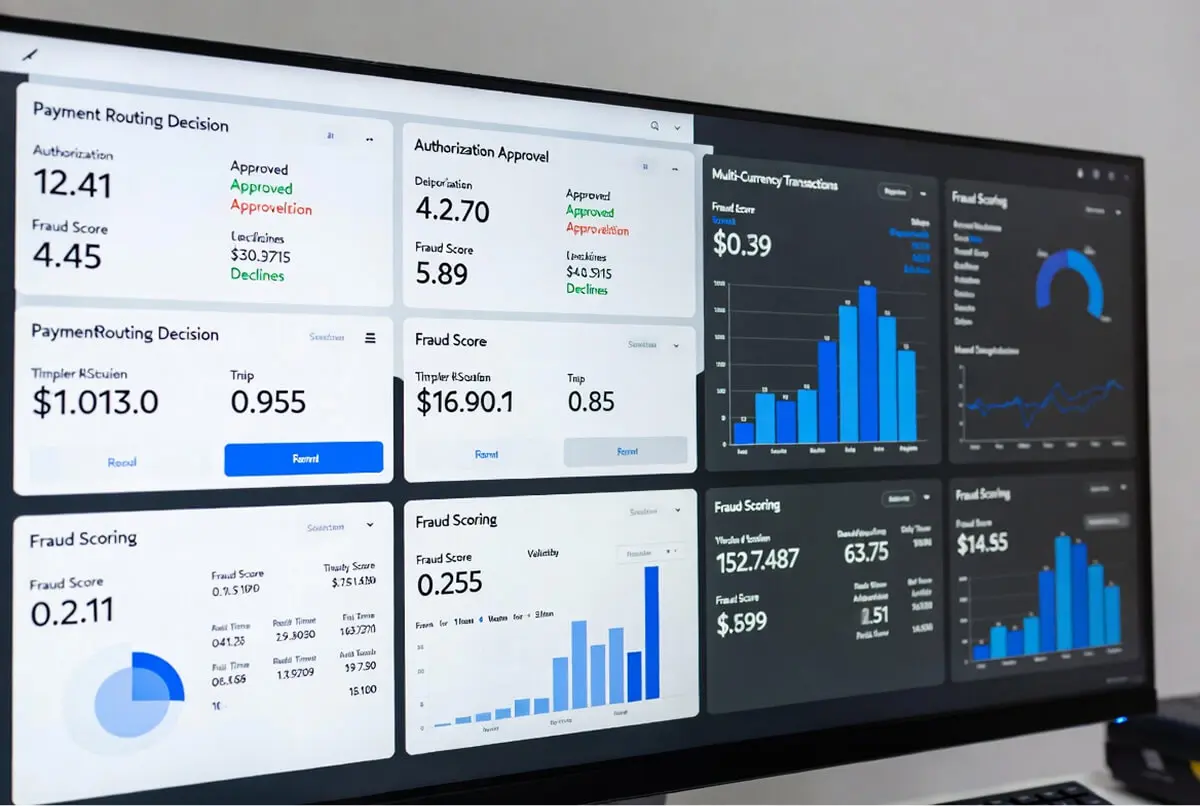
Let’s take a quick detour into the world of payments and talk about PSPs. A pay service provider, often called a PSP for short, is essentially the bridge between a business and the financial system, helping make transactions happen whether they’re online or in person. Essentially, any company acting as a payment system provider takes on the role of orchestrating the flow of funds, data, and risk decisions between customers, merchants, and the financial networks that move money.
These are the companies that sit quietly between your checkout page and the wider banking world – handling all the behind-the-scenes work like authorizing payments, routing them to the right place, managing settlements, processing refunds, and keeping risk in check.
It’s 2026, and PSPs are having a real moment. As e-commerce keeps growing, more and more businesses are looking for smarter, more scalable ways to handle things like refunds, reconciliation, and cross-border payments – automatically and without the headache.
If you strip away the marketing and the buzzwords, a modern PSP is responsible for a lot more than just “taking cards online.” Here’s what the job actually looks like from end to end:
First, they handle all the ways people want to pay. Cards, obviously. But also digital wallets like Apple Pay or Google Pay. Bank transfers. And all those local payment methods that everyone uses in different countries – the ones that would be a huge headache to integrate one by one.
Then there’s the routing piece. When someone hits “pay,” the PSP takes that data and figures out where to send it. Which acquiring bank should handle this? How do we get the fastest response from the card issuer? Underpinning all of this are payment network providers like Visa, Mastercard, and local schemes – they set the rules and infrastructure that make it possible for transactions to flow securely between banks, acquirers, and issuers.
That routing happens in milliseconds, and getting it right makes the difference between a successful sale and a declined transaction.
Risk controls run in parallel. While the payment is moving, the system is also checking for fraud. Looking at velocity – is this person trying to pay 20 times in 30 seconds? Checking device signals. Running authentication workflows. All before the customer even finishes blinking.
Settlement is the part people forget about. Actually moving the money. From the customer’s bank to the merchant’s account. Managing the timing of when funds get released. Supporting payouts on schedules that work for the business. Not glamorous, but absolutely critical. For businesses that manage high volumes of seller payments – like marketplaces or gig platforms – a specialized payout service provider can automate fund distribution, handle multi-currency settlements, and ensure money lands where it needs to, when it needs to.
And operations? That’s the daily grind. Refunds when something goes wrong. Chargebacks and disputes when customers call their bank. Reporting so merchants actually understand what’s happening. Reconciliation exports that play nice with accounting software. Ledger-friendly data so finance teams don’t lose their minds at month-end.
While PSPs cover a wide range of operational and technical functions, it is equally important to understand where their responsibility typically ends. A payment service provider does not replace all financial or operational systems within a business.
In most setups, PSPs do not manage taxation, accounting classification, inventory control, or customer service processes. They also do not fully assume responsibility for a merchant’s internal access management, business-level KYC obligations, or regulatory reporting outside of transaction processing.
In practice, this means responsibility is shared. The PSP secures transaction flows, infrastructure, and compliance tooling, while the merchant remains accountable for how payments are initiated, monitored, and reconciled internally. Understanding this boundary early helps prevent unrealistic expectations and operational gaps as transaction volumes grow.
Not all PSPs work the same way. The “best” option depends on your risk profile, geography, and integration needs.
You onboard quickly under a shared setup. This is common for SMBs and early-stage ecommerce. Tradeoff: risk rules can be stricter, and some controls are standardized.
These providers bundle gateway-like functions, processing connections, risk tooling, and settlement operations. You get one platform, one contract, and usually one API.
Designed for larger merchants with high volumes, multiple entities, and cross-border complexity. Often includes advanced routing, custom risk logic, and local acquiring.
Optimized for subscriptions, marketplaces, digital goods, travel, or high-risk categories – usually with purpose-built dispute handling, billing logic, and reporting.
In “embedded finance,” payment capabilities are integrated into a platform’s own product so end merchants get payments as a feature, not a separate vendor relationship. This is where payment as a service providers come in – they offer the infrastructure that lets platforms embed payments directly into their products without building and maintaining the underlying complexity themselves.
Each PSP model introduces different trade-offs that are often overlooked during early-stage selection.
Aggregator PSPs simplify onboarding but commonly apply standardized risk rules. This can result in sudden account reviews or transaction holds during traffic spikes. Full-stack PSPs reduce vendor complexity but increase dependency on a single provider’s uptime and pricing structure.
Enterprise and direct-acquiring PSPs offer greater control, yet they typically require longer onboarding, higher technical involvement, and dedicated compliance resources. Vertical-specific PSPs solve niche problems effectively but may limit flexibility when a business expands beyond its original model.
Platform and embedded PSPs shift much of the operational burden to the platform itself. While this improves merchant experience, it significantly increases compliance, monitoring, and support responsibility at the platform level.
Choosing a PSP model is therefore less about feature lists and more about risk tolerance, operational maturity, and long-term growth plans.
People often mix these terms. Here’s the cleanest way to separate them.
PayPal also emphasizes that gateways and merchant accounts have different roles, and PSPs often simplify these moving parts under one service umbrella.
There are a number of myths that often come up when businesses are looking at comparing PSPs, gateways and merchant accounts.
A common misconception is that PSPs are the same as banks. The fact is that the banks and card networks are critical to settlement and authorization, with the PSP being an orchestrator rather than a replacement.
A payment gateway and nothing more is also a misconception. Gateways are, for one thing, secure data pipes; they’re not built to do risk management, payouts, disputes or compliance at scale.
And last, the merchant accounts are frequently confused with full payment solutions. A merchant account gives you settlement, but no controls on fraud, multi-method acceptance or tooling.
Making these differences clear early avoids making architectural blunders that are costly to undo.
The PSP isn’t just “checkout tech.” It’s increasingly a growth dependency:
Stripe’s PSP overview frames this shift as a move toward unified acceptance + operational tooling, not just processing.
Some payment infrastructure providers focus less on consumer-facing checkout and more on optimizing complex transaction flows, risk management, and settlement logic across regions. Platforms like BillBlend are designed for businesses that require flexible routing, advanced risk controls, and operational visibility beyond standard PSP abstractions.
Many PSPs now embed machine learning into fraud detection – scoring transactions using behavioral signals, device context, and velocity patterns to reduce false declines while stopping abuse. This is not magic: the practical outcome is fewer chargebacks and higher approval rates when tuned well.
Blockchain is not replacing card networks. The real 2026 trend is narrower:
For most merchants, it’s a complementary layer rather than a primary acceptance mechanism.
Customers expect consistent experiences across web, mobile, and even in-person. PSPs respond with unified customer profiles, tokenization, and “one identity across channels.”
PSPs are increasingly packaged inside platforms (marketplaces, SaaS, vertical apps). That reduces merchant friction but raises the bar for compliance, reporting, and dispute tooling.
For merchants, these trends translate into a shift from configuring fixed payment rules to continuously managing and tuning transaction risk. AI-driven fraud systems require ongoing oversight, performance monitoring, and adjustment, turning risk management into an operational process rather than a one-time setup.
These systems are an input to, not a determinant of, the checkout experience; what they are doing is providing strength around reconciliation, audit and cross-border settlement transparency. Unifying the omnichannel identity reduces friction for known users, but increases the demand for uniform data on multiple front-end systems.
Embedded finance models also further disentangle software and financial infrastructure. More and more businesses consume payment services, pass the risk of compliance and transactional integrity on to platforms.
In other words, PSPs are driving payment from a back-end utility towards becoming a dynamic control layer – with direct and significant impact on revenue stability and indeed customer experience.
By 2026, the PSP landscape has become highly segmented. Rather than a single “best” provider, the market is shaped by platforms optimized for different merchant sizes, geographies, and operational complexity. The list below highlights widely used and influential PSPs, categorized by their primary strengths and typical use cases.
This list reflects market presence and positioning, not a ranking by quality or pricing. In practice, many large merchants use multiple PSPs or combine a PSP with orchestration and risk platforms to avoid vendor lock-in and improve resilience.
If you step back and look at how payments have changed over the last few years, one thing becomes pretty clear: they stopped being just a way to accept money somewhere along the way. By 2026, payments have quietly become the foundation that digital businesses are actually built on. Volumes keep climbing, regulators keep tweaking the rules, and money moves so fast now that the old playbooks just don’t work anymore.
There was a time when choosing a payment provider was about counting checkboxes. Apple Pay? Check. Klarna? Check. Done. Those days are gone.
What actually matters now is what happens after the customer hits “pay.” Smart routing. Retrying failed transactions at the right moment. Handling refunds and disputes without turning it into a nightmare for everyone involved. These days, we don’t ask “how many payment methods do you support?” We ask “can you actually manage the full lifecycle of a transaction, or are you just moving money from A to B?”
Real-time payments and direct bank transfers are taking over everywhere. They’re cheaper, they’re faster, customers love them. What’s not to like?
Here’s the thing nobody talks about enough: when money moves instantly, it usually doesn’t come back. No chargebacks, no second chances. That means risk decisions have to happen in milliseconds, and if you get it wrong, the money’s gone. Speed is fantastic, but it forces everyone to level up their game on the risk side. It keeps us up at night, honestly.
For a long time, payment security meant building a wall. Keep the bad guys out, job done. In 2026, that feels like ancient history.
Security is now baked into everything. It’s in how we authenticate users, how we spot weird patterns before they turn into real problems, how we stay compliant, and how we keep the whole machine running smoothly. It’s not a separate function you hand off to a team in the corner. It’s just part of how payments work now.
Companies got smart about building payments directly into their products. Not just bolting them on at the end, but weaving them into the actual customer experience. Total control over how everything looks and feels.
But here’s the trade-off: when you open up that many doors, you have to watch every single one. API security isn’t some technical problem for engineers to figure out anymore. It’s a business risk. One weak spot and things go sideways fast.
Every transaction, every decline, every customer who gives up – it’s all sitting there, full of signals about what’s actually happening in your business. The companies winning in 2026 are the ones actually looking at that data. Not just collecting it.
Why are we losing sales in this region on weekends? Why did disputes spike last month? When product teams, finance teams, and support teams can all see the same picture, problems get fixed fast. It sounds obvious, but you’d be surprised how many people still ignore it.
Remember when everyone panicked about new regulations coming down the pipeline? That panic is over. Strong authentication, data protection rules, messaging standards – it’s all just part of the daily routine now.
Being compliant doesn’t make you special anymore. It just means you’re still in the game. Baseline expectation.
We’re seeing more and more businesses move away from putting everything on one payment provider. Instead, they’re mixing and matching. Using one provider for resilience, another for a specific region, a third as backup.
It’s more work to set up, sure. But when someone’s system goes down on a Friday afternoon – and it happens – you sleep a lot better knowing you’ve got options.
If you zoom out, all of this points to the same conclusion: payments are infrastructure now. Like electricity or water. You don’t need them to be flashy. You need them to be solid, reliable, and actually under your control.
The businesses getting it right? They’re the ones obsessing over the messy details. Watching the data. Building flexible systems. They’re the ones who’ll still be growing when the next curveball comes.
Payment terminology is often used interchangeably, but these components serve distinct roles within the payment stack. A payment processing service provider focuses specifically on the transaction execution layer – handling authorization, clearing, and settlement with card networks and banks. While often bundled into a full PSP, some merchants choose to work with standalone processors for greater flexibility or to optimize routing.
Understanding the differences helps businesses design scalable and compliant payment architectures.
In practice, these roles are often bundled. A PSP may include gateway and processing capabilities, while PayFac models embed payment acceptance directly into platforms. For merchants, the key distinction lies not in labels, but in who controls risk, compliance, onboarding, and transaction flows.
Regulatory requirements continue to shape how payment services are designed and operated across regions. In Europe, authentication and consumer protection rules have a direct impact on checkout flows, risk controls, and transaction approval rates.
PSD2 requires Strong Customer Authentication (SCA) in key scenarios (account access, electronic transactions, and certain remote actions). The EBA clarifies these triggers and their application.
The PCI Security Standards Council confirms that the previously future-dated requirements became effective on March 31, 2025 and are now fully enforceable.
Federal Reserve Financial Services announced completion of the ISO 20022 migration for the Fedwire Funds Service in July 2025.
Ignoring regulatory requirements rarely results in immediate failure, but the long-term impact can be severe. PCI DSS non-compliance may lead to higher transaction fees, mandatory audits, or termination of card acceptance privileges.
In regions governed by PSD2, inadequate Strong Customer Authentication support often manifests as declining approval rates rather than explicit penalties. Over time, this silently erodes conversion and customer trust.
The transition to ISO 20022 affects data quality rather than transaction validity. PSPs that fail to adapt risk creating reconciliation blind spots, increasing manual effort for finance teams and slowing dispute resolution.
In all cases, responsibility is shared. While PSPs provide compliant infrastructure, merchants must ensure correct implementation and operational discipline.
Sometimes a PSP is exactly right. Sometimes you want a more modular stack.
A mid-market retailer expands into new regions. Key blocker: local preferences (wallets, bank rails) and currency conversion.
A subscription service struggles with failed renewals and chargebacks.
In both scenarios, the choice of a PSP was driven by architectural priorities rather than short-term cost considerations. The eCommerce retailer prioritized rapid market entry and reporting consistency, favoring a unified PSP model over multiple regional integrations.
The subscription business focused on lifecycle automation and risk reduction. Tokenization, smart authentication routing, and retry logic were architectural decisions enabled by the PSP, not standalone features.
The subscription business focused on lifecycle automation and risk reduction. Tokenization, smart authentication routing, and retry logic were architectural decisions enabled by the PSP, not standalone features.
These examples highlight a recurring pattern: PSP selection is ultimately an infrastructure decision that shapes how easily a business can adapt to change.
With so many payment solution service providers in the market, the challenge isn’t finding options – it’s choosing the right fit for your business model, geography, and risk tolerance.
Both Stripe and PayPal emphasize evaluating security, method coverage, and integration approach when choosing a PSP.
A PSP is best understood as managed infrastructure: it can shorten time-to-market, expand method coverage, and reduce operational load – especially as compliance and data standards evolve in 2026+. If you’re evaluating providers, prioritize method coverage, fraud tooling, reporting quality, and regulatory readiness over “lowest headline fee.”
Picking the right payment setup isn’t just about choosing a provider – it’s about deciding how money will actually move through your business.
If you’re rethinking your current PSP, dealing with cross-border headaches, or tightening up risk controls, BillBlend can help you design a payment system that fits how your business operates and the rules you need to follow.