
In the modern digital economy, the traditional dominance of credit and debit cards is rapidly fading. What were once called alternative payment methods are now the primary choice for the majority of the world’s population. As of 2025, alternative payment methods (APM) account for more than two-thirds of global e-commerce transaction value, transforming how businesses – especially those in verticals with complex payment needs, such as iGaming, betting, and international B2B – operate across borders. Digital wallets already accounted for 53% of e-commerce transaction value in 2024 and are expected to reach 65% by 2030.
For any business aiming to scale globally, understanding the shift toward alternative payment solutions is no longer optional. According to Statista Digital Payments Outlook 2026, the volume of digital payments is projected to exceed $36 trillion by 2030 with a CAGR of 7.63% starting from 2026, with digital wallets and A2A transfers remaining the main growth drivers. This guide provides a comprehensive deep dive into the types of APMs, regional dominance, and how platforms like BillBlend are helping merchants navigate this complex ecosystem.

The Evolution of Payments: From Plastic to Pix
To figure out where we are going, we also need to be clear about how we arrived here. Visa and Mastercard have been, for many years, the world’s main transaction processors. But since the last decade of the 20th century, mobile payments for travelling abroad emerged on the scene.
- In the era of physical plastic and centralized banking (1950s-1990s), there was no such thing as the Internet. (You actually had to go into a bank if you wanted cash – which seems unimaginable today.)
- The 2000s saw the rise of "alternative" payment methods, with PayPal as a prime example.
- In the 2020s, smart cities rely on mobile currencies like India's UPI and Brazil's Pix, plus blockchain for cross-border payments – an upgrade from traditional wires.
Because we used to be dependent on paper contracts and telephone calls in order for things to get done, the transition from “plastic” to digital was not just more convenient. Meanwhile, the number of people in emerging markets grows relentlessly, but traditional banking is too slow and expensive to serve them with legacy systems. This led to the “Great Decoupling,” where payment technology separated from traditional bank accounts.
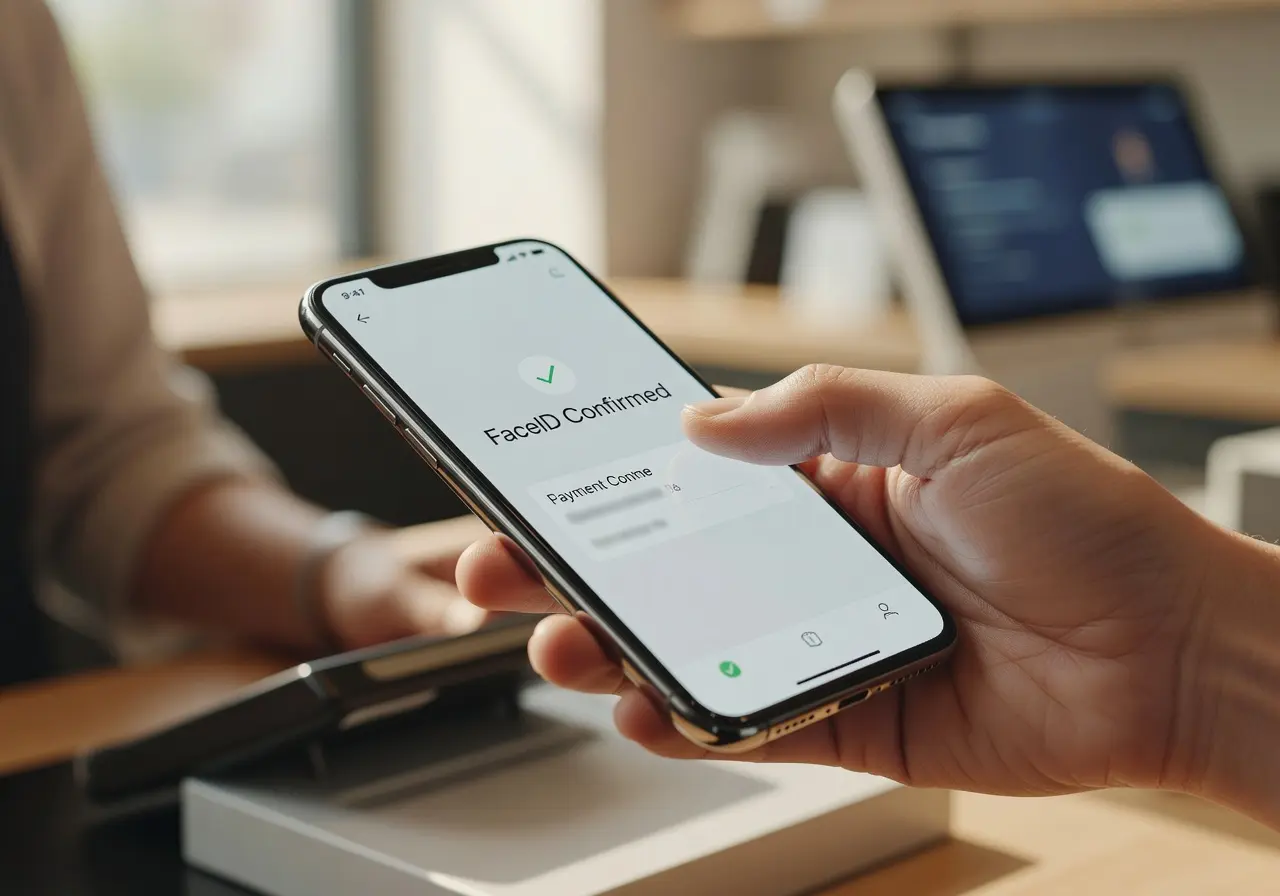
For instance, the adoption rates of mobile money in Sub-Saharan Africa and A2A systems in India (UPI) happened because these regions bypassed the “card era” entirely. Today, we see a similar shift in developed markets, where consumers are choosing digital wallets not because they lack cards, but because the tokenization and biometric security (FaceID, fingerprint) of a smartphone offer a far superior user experience compared to a physical piece of plastic.
By 2026, the integration of AI into these protocols will mean that your alternative payment system will not just execute a transaction, but will also choose the most cost-effective and secure path for it automatically.
Types of Alternative Payment Methods (APM)
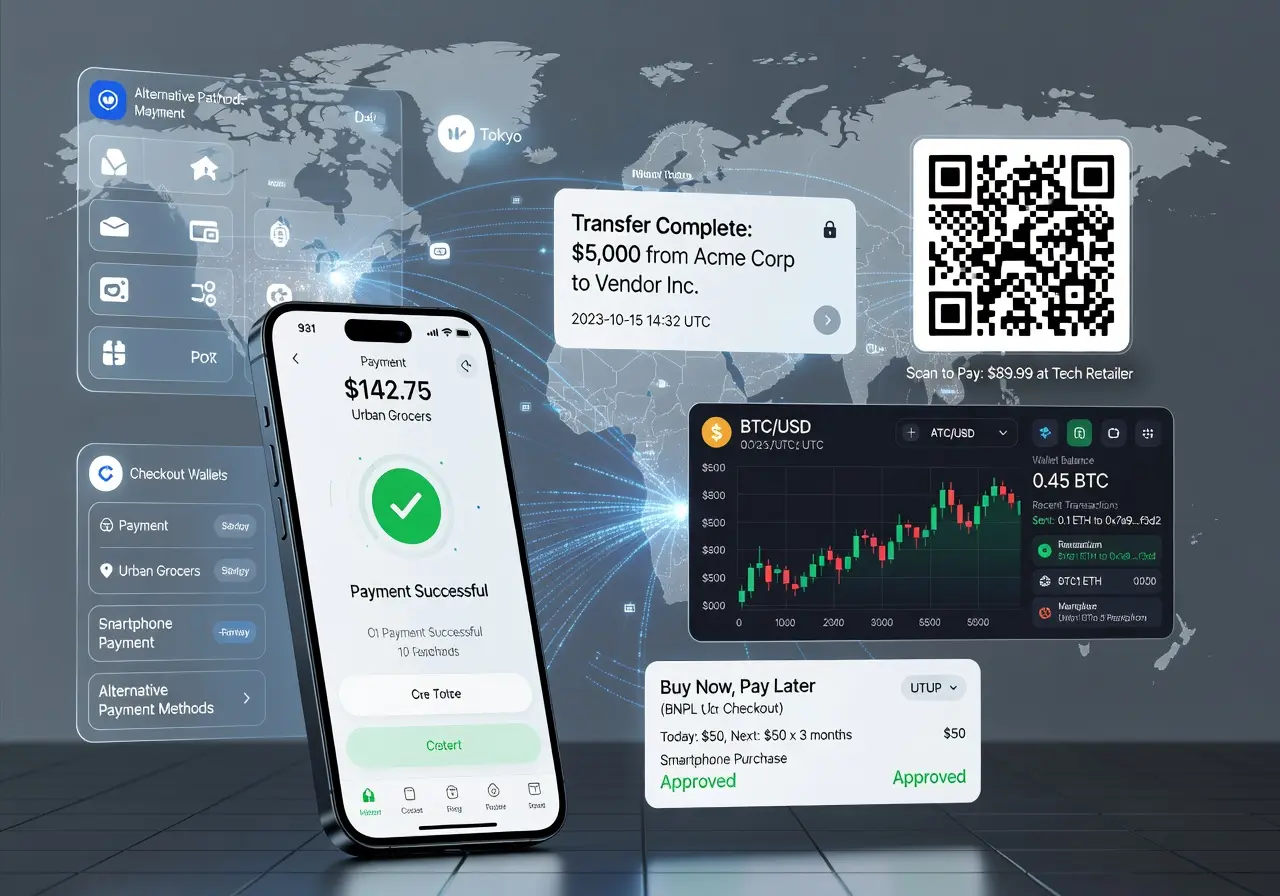
To compete with industry leaders like Stripe, a merchant must offer a diversified checkout. Below is a detailed breakdown of the most influential APM examples used today.
Digital Wallets (E-wallets)
Digital wallets like Apple Pay, Google Pay, and Alipay have become the “super-apps” of the payment world. They utilize tokenization to protect sensitive data, making them more secure than physical cards.
According to McKinsey’s Global Payments Report, digital wallets already account for a significant and growing share of POS transactions in many markets, with leading regions seeing adoption rates well above 30%. Their share continues to expand rapidly in both physical retail and e-commerce, driven by convenience, speed, and security features.
Account-to-Account (A2A) & Real-Time Payments
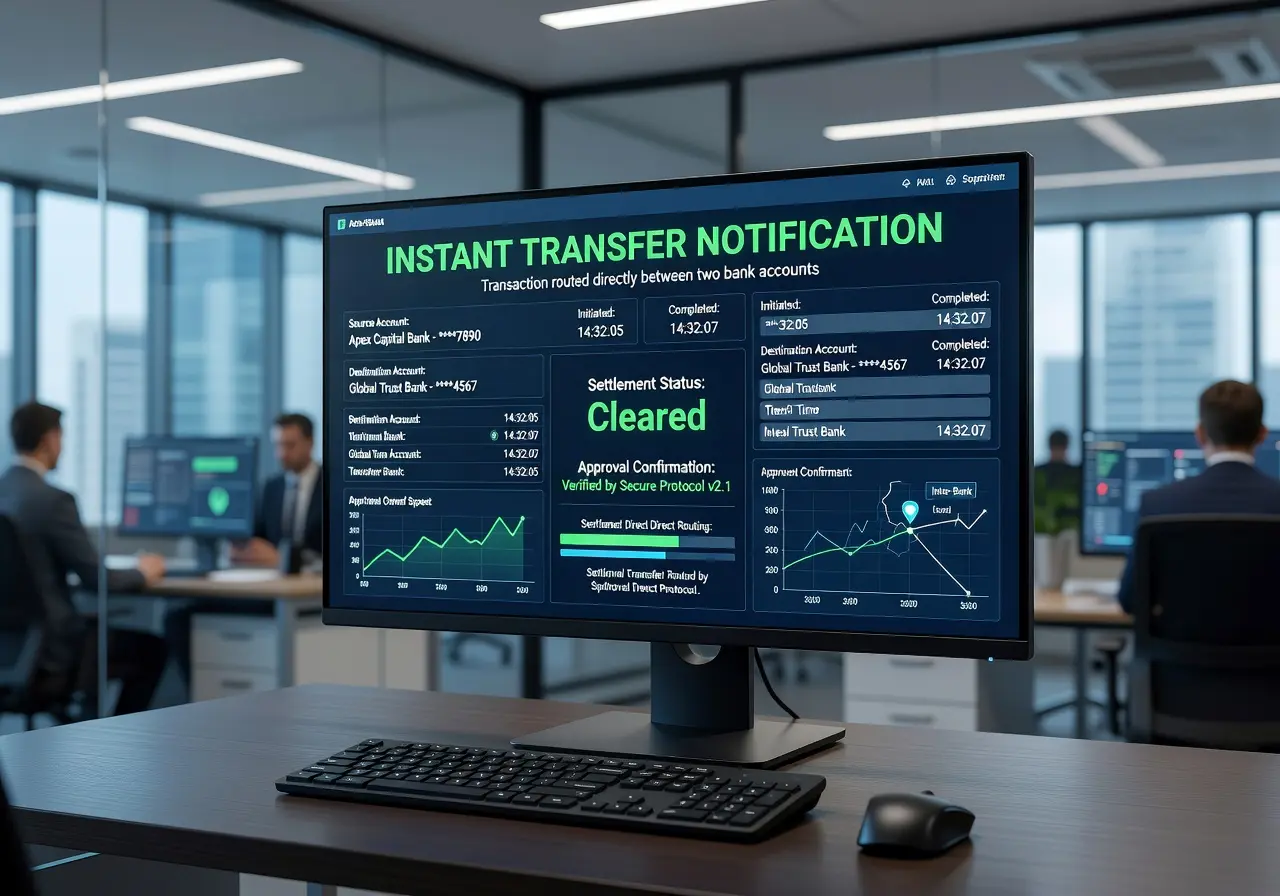
A2A payments allow for the instant transfer of funds directly from the buyer’s bank to the merchant’s bank. This bypasses credit card networks entirely, significantly reducing interchange fees. In Europe, this is powered by Open Banking (PSD3), while in India, UPI has set the global gold standard for volume.
Buy Now, Pay Later (BNPL)
BNPL has revolutionized the retail and B2B space by offering payment installments. Providers like Klarna and Affirm allow consumers to spread costs, which increases the Average Order Value (AOV). Research shows that BNPL can increase conversion rates by up to 30% for high-ticket items.
Cryptocurrency and Stablecoins
For companies in restricted industries like betting, cryptocurrencies provide secure, borderless payments whose status is beyond dispute. Cryptocurrency offers a payment method that is borderless and irreversible. Stablecoins are particularly popular for B2B cross-border payments in late 2020s like USDT and USDC, which combine the speed of crypto transactions with low price volatility.
Prepaid Vouchers & Cash-Based Systems
Systems like Paysafecard or OXXO Pay remain vital for financial inclusion. They allow cash-reliant customers to generate a digital code or voucher to pay for online services, ensuring that no segment of the market is excluded.
Comparison Table: Selecting the Right Method
Choosing the right APMs requires a balance between user friction and operational cost. While a digital wallet might offer the highest conversion rates, the interchange fees can be higher than a direct A2A transfer. For merchants prone to chargebacks in the betting and casino niches, the priority shifts toward “push payments” – methods where the customer initiates the transfer, effectively eliminating the possibility of fraudulent chargebacks.
The following table compares the leading alternative payment options based on the criteria most critical for global scaling in 2025.
| Method | Global Popularity | Settlement Speed | Chargeback Risk | Security Level |
|---|---|---|---|---|
| Digital Wallets | 50%+ and growing | Instant | Medium | Very High (Biometric) |
| A2A / RTP | High (Regional) | Instant | Very Low | High (Bank-level) |
| BNPL | Medium | Instant (to Merchant) | Medium | High |
| Crypto/Stablecoin | Rapidly Growing | Near-Instant | Zero (Irreversible) | Ultra-High (Blockchain) |
| Traditional Cards | Declining | 2-7 Days | High | Medium (PCI DSS) |
The data clearly shows that “one-click” convenience often comes with a trade-off in merchant fees. However, for a B2B business, the priority might be the settlement speed of a stablecoin (USDT) or a bank-to-bank transfer over the instant gratification of a consumer wallet. It is also important to note that alternative payment systems are not mutually exclusive.
A modern “winning” checkout stack typically includes a mix: 1-2 global wallets for trust, 2-3 localized payments (like Pix or iDEAL) for regional reach, and at least one crypto-gateway for borderless high-ticket transactions. This multi-layered approach is the only way to maintain approval rates above 90% in a volatile global market.
Global Preferences by Region: A Strategic Breakdown
A “one-size-fits-all” approach to payments is a recipe for failure. Checkout.com reports that 56% of consumers will abandon their cart if their preferred local method isn’t available.
North America: The Shift to Mobile
While the US was slow to adopt APMs, the tide has turned. Driven by Gen Z, alternative payment usage in the US is projected to grow by 52% through 2030. Apple Pay and BNPL are now the primary drivers of growth in the region.
Europe (EMEA): Regional Fragmentation
Europe is a patchwork of local heroes. In the Netherlands, iDEAL is the dominant payment method for online purchases. According to the 2023 report by Worldline, iDEAL accounted for 70% of all online transactions in the Dutch e-commerce market.
Asia-Pacific (APAC): The Global Leader
APAC is the most advanced APM market. In China, cards are virtually non-existent in daily life, replaced by Alipay. In Southeast Asia, “super-apps” like Grab and Gojek combine ride-hailing with comprehensive alternative payment systems.
Latin America (LATAM): The Pix Phenomenon
Brazil’s Pix is perhaps the most successful alternative payment story of the decade, now used by over 170-178 million people (nearly 80-93% of Brazil’s adult population) as of late 2025 – early 2026.
Africa: Mobile Money Ecosystems
Africa skipped the card era entirely. Mobile payments like M-Pesa (Kenya) and MTN MoMo (Nigeria) are the lifeblood of the economy. For global merchants, integrating these localized payments is the only way to tap into the African market.
Benefits of Implementing APMs for Your Business
Beyond simple transaction processing, the primary ROI of APMs lies in solving the “Abandoned Cart” crisis. Data from Checkout.com indicates that a lack of local or preferred payment options is responsible for up to 61% churn rate at the final checkout stage (earlier reports cited 56-61%). By integrating alternative payment solutions worldwide, businesses can tap into the “unbanked” or “underbanked” segments – millions of customers who have purchasing power but lack a credit card.
Furthermore, APMs offer superior fraud reduction capabilities. Traditional cards are “pull” payments, where the merchant takes money based on card details that can be stolen. In contrast, most alternative payment solutions (like A2A or Crypto) are “push” payments, requiring a real-time biometric or cryptographic authorization from the user’s own device, which virtually eliminates unauthorized use.
- Increased Conversion Rates: reducing friction at checkout.
- Lower Transaction Costs: A2A and local methods often cost 50% less than traditional credit card processing.
- Fraud Reduction: many APMs use multi-factor authentication (MFA) or blockchain, which significantly lowers fraud rates.
- Zero Chargebacks: methods like Pix, UPI, and Crypto are push-payments, meaning the merchant is protected from fraudulent chargeback claims.
Current Trends in APMs 2026: The Future of Fintech
As we look toward 2026, three major trends are emerging in the alternative payment solutions space:
- AI-Driven Security: according to Statista Digital Payments Outlook 2026, the total volume of digital payment transactions is expected to reach $26.89 trillion already in 2026, with an annual growth rate of 7.63% through 2030.
- Invisible & Biometric Payments: the rise of palm-recognition and advanced FaceID will make "one-click" checkout even faster.
- Embedded Payments: while the SaaS platforms it describes are not yet common, non-financial companies can now directly embed alternative payment options in their software, just as they've historically offered credit and wallets to users.
- Stablecoin Standard for B2B: meanwhile, we expect stablecoins like USDC and USDT to have replaced traditional fiat by 2026. Many of the more mid-range B2B cross-border payments will also start using them as cross-border settlement. As they say, the traditional SWIFT system which can take up to 3-5 days for you to receive your funds and charges 3% in hidden fees cannot compete with 60-second settlement on Layer-2 blockchain protocols.
- The Rise of Agentic Commerce: we are moving toward a world where AI personal assistants – not humans – make the actual payment. These "agents" will navigate checkouts via secure APIs, preferring alternative online payment methods that support automated, programmable logic (smart contracts) over manual card entry.
- Hyper-Localization at Scale: the next trend is "Payment-as-a-Service" (PaaS) that automatically detects a user's geolocation and financial habits to present only the 3 most likely methods they will use, reducing cognitive load and maximizing the conversion rate.
Capgemini World Payments Report 2026 highlights the significant growth of instant payments toward 2028-2029 and notes that inefficient cash and payment management costs companies nearly 7% of annual revenue – APMs and instant payments directly address this issue.
How to Choose the Best Alternative Payment Providers
Choosing a provider is about more than just fees. You must consider:
- Approval Rates: does the provider have high success rates in complex markets?
- Unified API: can you manage international alternative payment options through a single integration?
- Localization: does the provider offer the specific methods your customers use (e.g., Alipay, Pix, iDEAL)?
The BillBlend Advantage: Orchestration for Complex Compliance
For merchants in the iGaming, betting, and other specialized industries, the challenge isn’t just offering APMs – it’s managing them. BillBlend acts as a sophisticated orchestration layer. Instead of integrating 50 different providers, you integrate BillBlend once.
Our platform provides:
- Smart Routing: automatically sends transactions to the best-performing gateway.
- Risk Management: built-in fraud reduction tools.
- Support for 100+ Methods: from cryptocurrency to local A2A transfers.
If your business is struggling with high decline rates or wants to expand into new markets like LATAM or Asia, visit the BillBlend contact page for a custom consultation.
Case Study: Breaking into Regulated Markets with APMs
An international betting platform facing 50% decline rates in Brazil switched to a BillBlend-optimized strategy. By prioritizing Pix and USDT over credit cards:
The Challenge
The operator was relying on a single international card processor. In Brazil, card approval rates were hovering at 42%, as local banks frequently flagged international betting transactions. This led to massive customer frustration and a high cart abandonment rate.
The BillBlend Solution
Using the BillBlend orchestration layer, the operator switched their primary method to Pix (Brazil’s national A2A system) and added USDT as a secondary option for high-rollers.
The Technical Shift
BillBlend’s smart routing logic detected the user’s region and moved the “Pay” button to prioritize Pix. If a transaction failed on the first attempt, the system automatically routed the user to a secondary local gateway.
The Result
Within 90 days, the approval rate surged to 94%. The operator also saved 4% on every transaction by avoiding the heavy “international cross-border” fees associated with credit cards. This case proves that alternative payment methods for online business are not just about adding buttons – they are about intelligent traffic management.

FAQ: Questions on Alternative Payments
What are the main types of alternative payment methods?
The core types include Digital Wallets, A2A/Bank Transfers, BNPL, Mobile Money, and Cryptocurrencies.
Why are they called "alternative" payments?
Historically, these methods were alternatives to the “standard” credit and debit card systems. Today, in many regions, they are the primary method.
How can I integrate multiple APMs at once?
Using a payment orchestration platform like BillBlend allows you to integrate hundreds of alternative payment options through a single API.
Are alternative payments safe for B2B?
Yes. In fact, A2A transfers and stablecoins are often safer and faster for large B2B cross-border payments than traditional SWIFT wire transfers.